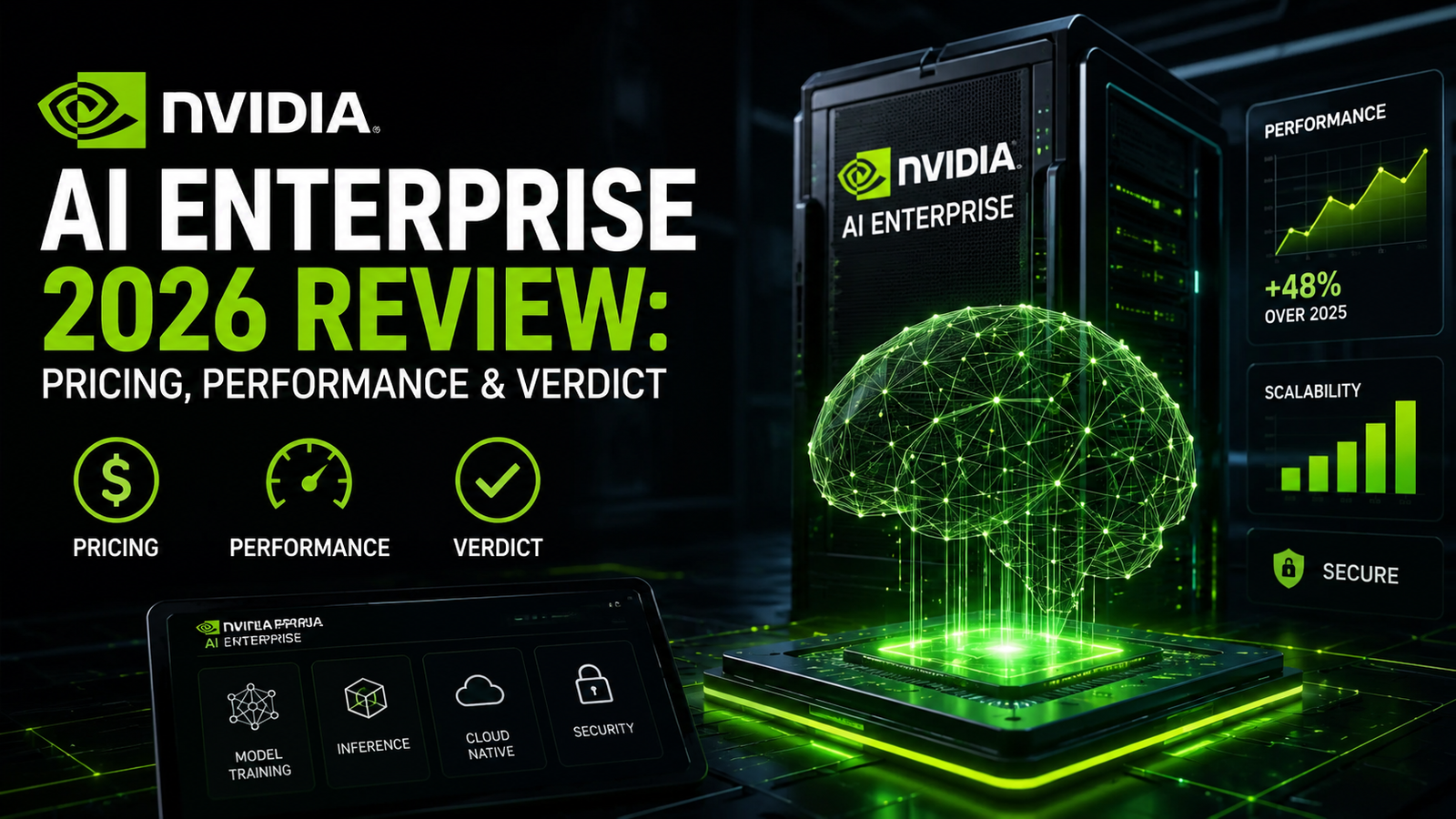
NVIDIA AI Enterprise is NVIDIA’s commercial software platform designed to help companies move AI projects from development to production. Unlike consumer AI tools, it focuses on enterprise deployment, GPU optimization, security, and operational management.
Think of it this way: buying NVIDIA GPUs without AI Enterprise is like buying a Ferrari engine without a chassis. You have immense power, but you can’t actually drive it anywhere safely. The software suite provides the orchestration, optimization, and enterprise support that makes large-scale AI deployment actually viable for organizations that aren’t Google or OpenAI.
The suite includes everything from data preparation tools (RAPIDS) to deep learning frameworks (optimized TensorFlow and PyTorch), model optimization (TensorRT), and inference serving (Triton). It’s a full-stack play, and that’s precisely the point.
What it actually does: It streamlines the journey from AI experimentation to production deployment. It gives you enterprise-grade security patches, API stability, and support SLAs that open-source alternatives simply don’t offer.
What it doesn’t do: It won’t magically make your team experts in AI. It won’t eliminate the need for data scientists. And it certainly won’t be cheap.
The Core Components: NIM, NeMo, Omniverse, and Run:ai
NVIDIA has assembled four major pillars under the AI Enterprise umbrella. Here’s what each actually does—and what the marketing won’t tell you.
NVIDIA NIM: The Microservices Play
NIM (NVIDIA Inference Microservices) is arguably the most hyped component. These are containerized microservices that package foundation models with optimized inference engines. In plain English: they make it easier to deploy models like Llama or Mistral on your own infrastructure without spending weeks on optimization.
The reality: NIM delivers real performance gains. NVIDIA’s own testing shows dynamic fractions delivering up to 1.4x higher throughput and 1.7x lower latency under heavy concurrency. That’s not trivial.
The catch: Independent comparisons have shown that NVIDIA NIM can deliver performance advantages in certain enterprise workloads, but whether those gains justify licensing costs depends heavily on infrastructure requirements and support needs. For 90% of organizations, open-source inference solutions like vLLM remain the more cost-effective choice. NIM makes sense primarily if you’re already deep in the NVIDIA ecosystem and need enterprise support.
NVIDIA NeMo: For Custom Model Work
NeMo provides tools for training, fine-tuning, and guarding AI models. It’s particularly relevant for organizations building custom LLMs or RAG pipelines. The RAG building blocks are genuinely useful—they handle the messy parts of connecting models to enterprise data.
NVIDIA Omniverse: The Physical AI Bet
Omniverse is NVIDIA’s bet on industrial digital twins and robotics simulation. It’s included with AI Enterprise, which is interesting because most enterprises won’t use it. This is NVIDIA preparing for the physical AI era—factories, robotics, autonomous vehicles—rather than just the chatbot era.
NVIDIA Run:ai: The Orchestration Layer
Run:ai handles GPU orchestration across the AI lifecycle, promising to maximize utilization with “zero manual effort”. Key note: The 90-day trial license for AI Enterprise explicitly excludes Run:ai. If you want to test it, you need to contact NVIDIA separately. That’s worth flagging—the most valuable orchestration tool is walled off from the free trial.
Performance Claims vs. Reality
NVIDIA reports significant performance improvements with AI Enterprise, including claims of up to 10x greater GPU availability for data scientists, up to 5x better GPU utilization, and up to 20x workload throughput improvement.
The independent reality: Actual improvements depend heavily on workload size, GPU utilization before deployment, and infrastructure maturity. These numbers represent best-case scenarios. If you’re currently running a static, poorly optimized infrastructure, yes, you might see dramatic gains. If you’re already reasonably efficient, the improvement will be more modest.
What real users say: PeerSpot users rate NVIDIA AI Enterprise 8.4 out of 10. One reviewer reported cutting deployment time by 40% and saving 25-30% in infrastructure costs. Another noted that the platform “positively impacted my organization by improving productivity, response time, and overall GPU performance”.
What users complain about: Setup and onboarding are consistently cited as difficult, especially for teams “not deeply experienced with GPU infrastructure”. Documentation is described as overwhelming—there are so many resources that users don’t know where to start.
The performance is excellent, but the learning curve is steep. This is not a plug-and-play solution.
Pricing: The Elephant in the Room
NVIDIA does not publish transparent pricing on its website, which is always a red flag. Pricing varies significantly based on region, partner agreements, cloud marketplace options, support level, and hardware bundles.
What we know about the pricing model:
- Subscription model: Per-GPU licensing, typically with 3- or 5-year terms
- Perpetual license: Requires a 5-year support contract
- Consumption-based: Available through cloud marketplaces
Industry estimates: Third-party sources suggest subscription costs can reach several thousand dollars per GPU annually, depending on licensing terms, support requirements, and deployment environment. For example, the Essentials tier (5 years with 24/7 support for 1 GPU) has been reported around the mid-four-figure range.
The hidden costs: You need NVIDIA-Certified Systems to run AI Enterprise. That means specific server configurations—you can’t just install it on any old hardware. This significantly increases the total cost of ownership.
The ROI question: One reviewer gave the product an 8 out of 10 for ROI, noting they gained about 30% time savings. But the same reviewer emphasized that the cost is “a big investment”.
For smaller teams and mid-sized organizations, the pricing is prohibitive. This is enterprise software for enterprise budgets.
Security and Compliance: The Good, the Bad, and the Ugly
The Good
NVIDIA has made significant security investments. AI Enterprise includes:
- STIG-hardened containers
- Regular security patching
- Software Bill of Materials (SBOM) for supply chain transparency
- Government-ready versions designed to meet FedRAMP High and FISMA High SDLC controls
The Bad
Full compliance is not achieved by software alone. NVIDIA explicitly states that while the software meets SDLC controls for FedRAMP High, “achieving full system compliance and final authorization cannot be attained by software alone”. This is a polite way of saying: you still have to do the heavy lifting.
The reality for regulated industries: Some enterprise customers have raised concerns around compliance requirements, deployment complexity, and the additional work required to achieve industry-specific certifications. Security features like zero trust architecture and FIPS compliance are still evolving. For US federal government clients, this remains an area of active development.
The bottom line: NVIDIA is making progress, but enterprise software sales remain a challenge. The company dominates hardware but is still learning how to sell software to risk-averse procurement teams.
NVIDIA AI Enterprise Pros and Cons
Pros
Optimized for NVIDIA GPUs – Performance tuning that’s difficult to achieve with open-source alternatives
Enterprise support – SLAs and dedicated support for production workloads
Strong AI deployment ecosystem – Full-stack solution from training to inference
Security-focused containers – STIG-hardened and regularly patched
Supports generative AI workloads – Pre-built microservices for popular models
Reduces deployment time – Real-world users report 40% faster deployment
Government-ready versions – FedRAMP High controls built in
Cons
Expensive licensing – Costs can reach thousands per GPU annually
Hardware dependency – Requires NVIDIA-Certified Systems
Steep learning curve – Setup and onboarding are challenging
Less attractive for small teams – Pricing model scales poorly for small deployments
Cloud platforms may be simpler – AWS, Azure, and GCP offer more accessible alternatives
Run:ai excluded from trial – Can’t test the full orchestration layer
Compliance still evolving – Full certification requires additional work
Who Is This Actually For?
Use It If:
- You’re running large-scale AI workloads (multiple GPUs, multiple teams)
- You need enterprise support and SLAs for production AI
- You’re already heavily invested in the NVIDIA ecosystem (CUDA, NGC, certified hardware)
- You’re in an industry where security patching and API stability are non-negotiable
- You have the budget (think six figures annually for a meaningful deployment)
- You have dedicated infrastructure and AI operations teams
Avoid It If:
- You’re a startup or small business with limited AI budgets
- Your team lacks deep GPU infrastructure expertise—the learning curve will hurt
- You’re comfortable with open-source alternatives (vLLM, Kubernetes, open-source frameworks)
- You don’t need enterprise support—the premium isn’t worth it
- You’re a cloud-native team—your cloud provider’s AI platform is likely sufficient
- You’re still experimenting rather than deploying to production
The Competition: How It Stacks Up
| Platform | Primary Strength | Best For | Pricing Model | NVIDIA Integration |
|---|---|---|---|---|
| NVIDIA AI Enterprise | GPU optimization | On-prem/hybrid NVIDIA shops | Per-GPU subscription | Native |
| AWS SageMaker | AWS integration | AWS cloud users | Pay-as-you-go | Optional |
| Google Vertex AI | Agent orchestration | Google cloud users | Pay-as-you-go | Optional |
| Azure AI | Enterprise tooling | Microsoft shops | Pay-as-you-go | Optional |
| Databricks Mosaic AI | Data + AI workflows | Data-first enterprises | Workload-based | Optional |
| Hugging Face Enterprise | Open-source AI ecosystem | Open-source-first teams | Subscription | Optional |
| AMD ROCm | GPU software stack | AMD GPU users | Open-source | Limited |
The competitive reality: NVIDIA dominates the AI compute market with an estimated 75-80% market share in AI accelerators. Competitors like AMD are gaining, but NVIDIA’s CUDA ecosystem remains the overwhelming preference for developer.
The real choice: If you’re cloud-native, you probably don’t need AI Enterprise—your cloud provider’s AI platform will suffice. If you’re on-prem or hybrid and heavily invested in NVIDIA hardware, AI Enterprise makes strategic sense. If you’re focused on data-first workflows, Databricks offers compelling alternatives. If you’re committed to open-source, Hugging Face Enterprise provides enterprise support for the open-source ecosystem.
Future Outlook: Where NVIDIA Is Headed
NVIDIA’s GTC 2026 made one thing clear: the company is repositioning from chipmaker to AI infrastructure orchestrator. The message is no longer about faster GPUs—it’s about full-stack systems that span cloud, edge, and data center.
Key signals:
- The Rubin platform entered full production in 2026
- The Feynman architecture is expected around 2028
- Agentic AI is becoming central to NVIDIA’s narrative
- The Enterprise AI Factory reference design is being positioned as the standard for on-prem AI
- NVIDIA is increasingly positioning itself as the enterprise AI platform, not just a hardware provider
The opportunity: For enterprises planning long-term AI infrastructure investments, NVIDIA’s roadmap offers clarity and stability. The company has a proven track record of executing on ambitious hardware roadmaps.
The risk: NVIDIA’s dominance is attracting competition. AMD’s ROCm is positioning itself as a production-grade CUDA alternative. Google’s eighth-generation TPUs are targeting agentic inference. And enterprises are starting to push back on “CUDA lock-in” and rising inference costs.
NVIDIA’s software strategy—making AI Enterprise the default for enterprise AI—is smart. But it’s also a bet that customers will pay a premium for integration and support rather than building their own stacks. That bet isn’t guaranteed to pay off.
Prediction: NVIDIA will continue to dominate high-end AI compute, but the enterprise software layer will face increasing competition from cloud providers and open-source alternatives. The pricing pressure on AI Enterprise is likely to increase.
FAQs
1. What is NVIDIA AI Enterprise?
A: NVIDIA AI Enterprise is a commercial software suite that combines microservices, frameworks, and libraries for AI development with GPU orchestration and infrastructure management. It’s designed for production-grade AI deployment across generative AI, computer vision, and speech AI workloads, with enterprise support and security features.
2. Is NVIDIA AI free to use?
A: No, NVIDIA AI Enterprise is a paid product. You can try NVIDIA-hosted NIM APIs and download software for prototyping for free, but production deployment requires a paid license. A 90-day trial license is available for production testing, though it excludes Run:ai. The free tier is designed for evaluation, not production.
3. Does NVIDIA AI Enterprise support open-source AI models?
A: Yes. NVIDIA AI Enterprise supports many popular open-source models through optimized deployment tools such as NVIDIA NIM, allowing enterprises to run models like Llama-based solutions, Mistral, and other foundation models on NVIDIA infrastructure. The platform provides pre-optimized containers and inference servers for these models.
4. What does NVIDIA do?
A: NVIDIA designs graphics processing units (GPUs) and associated software for gaming, professional visualization, data centers, and AI. In the AI space, NVIDIA dominates the market for accelerators used in training and deploying large language models and other AI systems, commanding roughly 80% of the AI chip market. The company has evolved from a GPU maker to a full-stack AI computing company.
5. How much does NVIDIA AI Enterprise cost?
A: NVIDIA does not publicly display universal pricing. Industry estimates suggest subscription costs can reach several thousand dollars per GPU annually, depending on licensing terms, support requirements, and deployment environment. For accurate pricing, organizations need to contact NVIDIA sales directly or work with certified partners. Costs vary significantly by region and volume.
6. What are the alternatives to NVIDIA AI Enterprise?
A: Alternatives include cloud provider AI platforms (AWS SageMaker, Google Vertex AI, Azure AI), open-source inference stacks (vLLM, TGI, Ollama), data platforms with AI capabilities (Databricks Mosaic AI), enterprise open-source support (Hugging Face Enterprise), and AMD’s ROCm ecosystem. For most teams, open-source alternatives are sufficient unless enterprise support and NVIDIA-specific optimization are required.
7. Is NVIDIA AI Enterprise secure?
A: NVIDIA has made significant security investments, including STIG-hardened containers, regular patching, and government-ready versions for FedRAMP High environments. However, full system compliance requires additional work beyond the software itself. Some security features like zero trust architecture and FIPS compliance are still evolving. Organizations in regulated industries should thoroughly evaluate the platform against their specific requirements.
Final Verdict
NVIDIA AI Enterprise is strategically important but not universally necessary.
What it does well: It turns raw GPU power into a manageable, supportable AI platform. The performance gains are real. The security features are improving. For large enterprises already committed to NVIDIA, it’s the logical choice. The integration with NVIDIA’s hardware roadmap provides a clear upgrade path.
What it does less well: It’s expensive, complex to set up, and overkill for most organizations. The learning curve is steep. Some compliance features are still maturing. For cloud-native teams, the cloud providers offer more accessible alternatives. The pricing model penalizes smaller deployments.
The honest take: NVIDIA AI Enterprise is not a universal AI solution. It is a premium enterprise platform designed for organizations running serious AI workloads on NVIDIA infrastructure. Large companies that need stability, support, and optimized GPU performance will find value here. Smaller teams, startups, and developers experimenting with AI will likely get better results from open-source tools or cloud AI platforms.
Next steps: Start with the free NVIDIA-hosted APIs on build.nvidia.com. Download the software from NGC and prototype on your own infrastructure. If it delivers value, consider the 90-day trial license. Only then should you commit to a paid subscription. For most organizations, the right entry point is starting with open-source and only scaling to AI Enterprise when the infrastructure requirements demand it.
For regular updates about the AI, AI tools, AI guides, technology & more. Visit, The TechUnfoldedAi.com.
Leave a Reply