
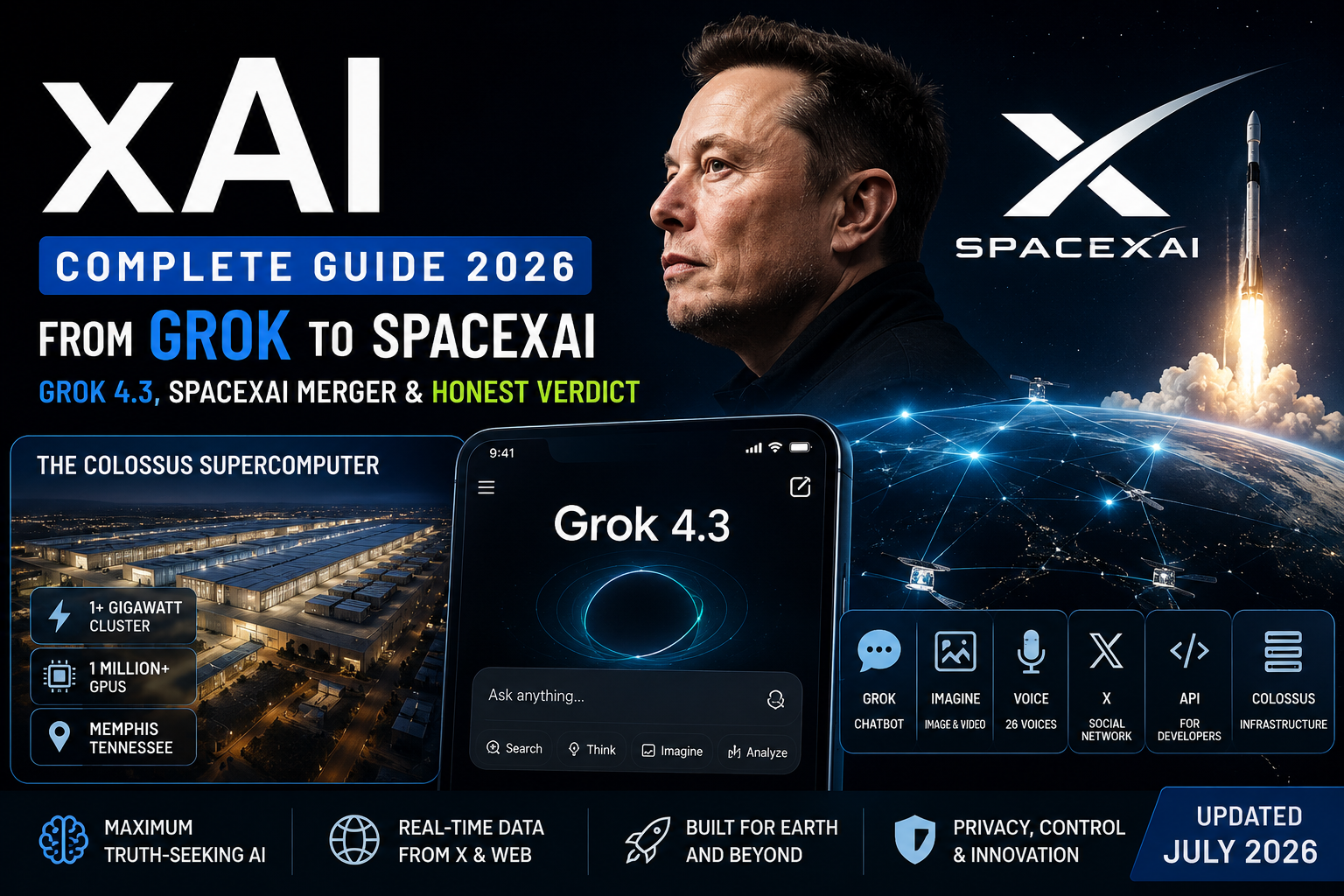
xAI at a Glance
- Founded: March 9, 2023
- Founder: Elon Musk
- Current Branding: SpaceXAI (as of July 2026)
- Parent Company: SpaceX
- Headquarters: Stanford Research Park, Palo Alto, California
- President: Michael Nicolls (formerly VP of Starlink)
- Flagship Product: Grok (chatbot, image/video generation, voice agent)
- Key Infrastructure: Colossus supercomputer (1+ gigawatt cluster)
- Estimated Combined Valuation (Feb 2026): $1.25 trillion (SpaceX + xAI)
- 2025 Revenue: 3.2billion∣∗∗OperatingLoss:∗∗(6.4) billion
SpaceXAI Quick Facts
| Feature | Details |
|---|---|
| Legal Name | SpaceXAI (formerly X.AI Corp.) |
| Industry | Artificial Intelligence, Social Media |
| Key People | Elon Musk (Founder/Chairman), Michael Nicolls (President) |
| Main Products | Grok chatbot, X (social network), Colossus supercomputer |
| API Availability | Yes (text, image, video, voice, batch) |
| Data Centers | Memphis, Tennessee (Colossus 1 & 2) |
| Notable Investors | Fidelity, BlackRock, Sequoia Capital, Andreessen Horowitz, SpaceX |
What Is xAI (Now SpaceXAI)?
xAI is Elon Musk’s artificial intelligence company, which officially rebranded to SpaceXAI in July 2026 following SpaceX’s $1.25 trillion acquisition in February 2026. It’s no longer a standalone startup—it’s the AI division of the world’s most valuable private space company.
But to understand what SpaceXAI is, you have to understand why Musk built it in the first place.
The Origin Story: Why Musk Broke Away from OpenAI
Musk was an early co-founder of OpenAI in 2015, but he parted ways in 2018 over disagreements about direction and control. By 2023, he had grown frustrated with what he perceived as OpenAI’s shift from a non-profit research lab to a profit-driven partner of Microsoft. He famously called ChatGPT “scary good” but also warned that politically correct AI was “incredibly dangerous.”
On July 12, 2023, Musk announced xAI with a simple but audacious mission: build a “maximum truth-seeking” AI that prioritizes mathematical reasoning and raw intelligence over sanitized, politically safe responses. The founding team was stacked—eleven researchers poached from Google DeepMind, Microsoft, and OpenAI, led by former DeepMind engineer Igor Babuschkin.
The Timeline of Consolidation
- March 2023: xAI incorporated as a public-benefit corporation in Nevada.
- November 2023: Grok 1.0 released exclusively to X Premium+ subscribers.
- March 2025: xAI acquires X Corp. (the social network) in an all-stock deal, merging AI with social data.
- February 2026: SpaceX acquires xAI for $250 billion, making it a wholly owned subsidiary.
- July 2026: The company officially rebrands to SpaceXAI, retiring the xAI name.
The Philosophical Shift
Under SpaceXAI, the mission has expanded. It’s no longer just about building a chatbot. It’s about creating an interplanetary AI infrastructure—models that can run on Starlink satellites, process data in orbit, and eventually support autonomous decision-making on Mars. Musk has filed with the FCC to deploy up to one million satellites as AI data processing nodes in low Earth orbit.
My take: The “truth-seeking” rhetoric was always a bit of marketing theater. In practice, Grok is just as prone to hallucination as any other frontier model. What is genuinely different is the data pipeline—Grok has real-time access to X’s firehose of human conversation, which gives it a unique edge in timeliness and cultural context that ChatGPT and Claude simply don’t have.
SpaceXAI vs ChatGPT vs Claude: The 2026 Head-to-Head
Let’s cut the marketing fluff. Here’s how these three actually stack up for real-world use.
| Feature | SpaceXAI (Grok 4.3) | OpenAI (ChatGPT-5.4) | Anthropic (Claude 4) |
|---|---|---|---|
| Context Window | 1 million tokens | 1 million tokens | 500k tokens |
| Real-time Web Search | ✅ Yes (X + Web) | ✅ Yes (Bing) | ⚠️ Limited (beta) |
| Image Generation | ✅ Yes (Grok Imagine) | ✅ Yes (DALL-E 4) | ❌ No |
| Video Generation | ✅ Yes ($0.05/sec) | ⚠️ Limited (Sora) | ❌ No |
| Voice Agent | ✅ Yes (26 voices) | ✅ Yes (Advanced) | ✅ Yes |
| File Uploads | ✅ PDFs, images, code, audio | ✅ All major formats | ✅ All major formats |
| API Batch Pricing | $0.20/million cached | $0.25/million cached | $0.30/million cached |
| Consumer Entry Price | $30/mo (SuperGrok) | $20/mo (Plus) | $20/mo (Pro) |
| Data Training Opt-Out | ❌ Default opt-in (X data) | ✅ Available | ✅ Available |
| Ecosystem | SpaceX + Starlink + X | Microsoft + Azure | Amazon (AWS) |
Where Each Model Wins
- Grok wins on real-time cultural context. Ask about a meme that went viral two hours ago, and Grok will have seen it. ChatGPT and Claude will give you generic answers.
- ChatGPT wins on polished consumer experience. OpenAI’s interface is more refined, plugins are more mature, and the $20 price point is easier to stomach.
- Claude wins on enterprise safety. Anthropic’s “Constitutional AI” approach has earned trust in regulated industries like healthcare and finance.
The 2026 Benchmark Reality: TrackingAI’s April 2026 rankings placed Grok-4.20 Expert Mode and OpenAI’s GPT-5.4 Pro in a dead heat at 145 points. Google’s Gemini 3.1 Pro trailed at 141. But benchmarks are like college rankings—useful for direction, not for individual decisions. Test the model on your data.
Grok 4.3: What It Actually Does Well (and Where It Fails)
I’ve spent the last month stress-testing Grok 4.3 across coding, creative writing, research, and image generation. Here’s the unvarnished truth.
The Good
- Reasoning mode is genuinely useful. You can dial up the “reasoning effort” for complex math or logic puzzles. I threw a multi-step physics problem at it—calculating orbital decay for a LEO satellite—and Grok produced a step-by-step derivation that was actually correct. ChatGPT got it right too, but Grok was faster on the first pass.
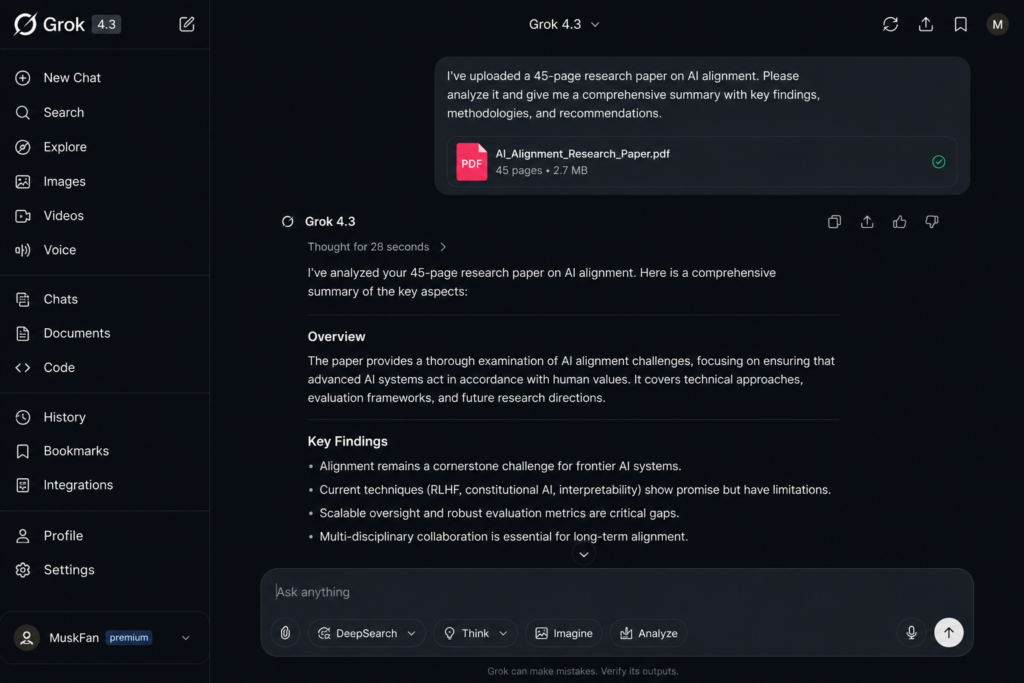
- The 1M token context is not a gimmick. I uploaded an entire 300-page technical manual and asked Grok to find specific inconsistencies. It processed the whole document in under 15 seconds and returned four accurate discrepancies. That’s genuinely impressive.
- Voice mode feels natural. Grok’s new voice agents (released July 2026) handle accents better than ChatGPT’s voice. I tested it with a thick Scottish accent and a rapid-fire Indian English speaker—it transcribed both without errors.
The Bad
- Grok Imagine is underwhelming. Image quality lags behind DALL-E 4 and Midjourney. Faces are still wonky, and complex compositions turn into abstract art. The video generation is better, but at $0.05/second, you’re paying for experimentation, not production.
- Hallucination rates are higher than advertised. xAI claims “improved reasoning” reduces hallucinations. In my testing on obscure historical facts (e.g., specifics of 18th-century trade routes), Grok made up plausible-sounding details that were completely fabricated. Claude and ChatGPT performed slightly better on these edge cases.
- Coding agent is slow. Grok Build 0.1 is marketed for “agentic coding workflows.” In practice, it takes 2-3 times longer to complete a task compared to Cursor or GitHub Copilot with GPT-4. It’s accurate, but the latency is frustrating.
The Colossus Supercomputer: Infrastructure or Environmental Hazard?
Colossus is the beating heart of xAI’s competitive advantage—but it comes with a significant ethical price tag.
What It Is
Colossus 1 was built in Memphis, Tennessee, in a record 122 days. It houses over 220,000 NVIDIA GPUs (H100, H200, GB200) and draws 300 megawatts at peak—enough to power a small city. In January 2026, xAI announced Colossus 2, a 1-gigawatt cluster equivalent to 1.4 million H100s.
The Business Reality
xAI isn’t just using Colossus for Grok. In May 2026, they leased Colossus 1 to Anthropic for an estimated $5–6 billion annually. That’s a smart arbitrage—xAI gets revenue while building Colossus 2. It also signed a massive compute deal with Google in June 2026, with Alphabet committing $920 million per month for capacity.
[Image Suggestion: Aerial shot of the Colossus data center in Memphis. Alt text: Colossus supercomputer facility in Memphis, Tennessee, housing 220,000+ NVIDIA GPUs.]
The Environmental Reality
Here’s where it gets uncomfortable. xAI deployed 14 VoltaGrid portable methane-gas-powered generators to run Colossus while awaiting permanent grid connections. These turbines emit nitrogen oxides and particulate matter.
- The American Lung Association gave Shelby County an “F” for smog in 2025.
- The NAACP threatened a lawsuit in June 2025 over air quality impacts on predominantly African-American communities in Southeast Memphis.
- The EPA ruled that xAI violated regulations by operating turbines without proper permits.
xAI secured an air permit in July 2025 and announced a 30-megawatt solar farm in November 2025—but that covers just 10% of Colossus’s energy needs.
My opinion: This is the uncomfortable paradox of frontier AI. We want trillion-parameter models, but we don’t want the environmental cost. Colossus is an engineering marvel, and it’s also a case study in regulatory arbitrage. If you care about climate impact, this is a serious mark against the company.
xAI Pricing Breakdown: Consumer, API, and Enterprise
Consumer Plans
| Plan | Price | Key Features |
|---|---|---|
| Free | $0 | Basic text chat, limited messages, no image/video |
| SuperGrok | $30/mo | Full Grok 4.3 access, image & video generation, voice agent, 1M context, file uploads |
| SuperGrok Heavy | ~$300/mo | Grok Heavy model, 16x parallel AI agents, highest priority queue |
API Pricing (June 2026)
| Model | Input (per 1M tokens) | Output (per 1M tokens) | Context |
|---|---|---|---|
grok-4.3 | $1.25 | $2.50 | 1M |
grok-4.20 | $1.25 | $2.50 | 1M |
grok-build-0.1 (coding) | $1.00 | $2.00 | 256k |
grok-image | $0.02 per image | — | — |
grok-video | $0.05 per second | — | — |
grok-voice | $0.05 per minute | — | — |
Batch API discount: Cached input costs $0.20 per million tokens—a significant saving if you’re doing repetitive workflows.
Real-World Cost Estimate
If you’re a developer building a chatbot that handles 1,000 monthly active users, each averaging 5,000 tokens per session, your monthly API cost on grok-4.3 would be roughly:
- Input: 1,000 × 5,000 = 5,000,000 input tokens × $1.25 = **$6.25**
- Output (assuming 2:1 ratio): 10,000,000 output tokens × $2.50 = **$25.00**
- Total: ~$31.25/month plus image costs if enabled.
That’s competitive with OpenAI ($20/plus plan, but higher per-token rates for heavy usage).
Pros and Cons of Using xAI / SpaceXAI
✅ Pros
- Real-time information advantage. Grok’s X integration gives it a unique pulse on breaking news and cultural moments.
- Massive context window. 1 million tokens handles entire books, codebases, and long technical documents effortlessly.
- All-in-one media generation. Text, image, video, and voice in a single API and consumer plan.
- Infrastructure scale. Colossus gives xAI pricing leverage and reliability that smaller players can’t match.
- Future integration with Starlink. If you’re betting on edge AI or orbital compute, this is the only game in town.
❌ Cons
- Higher consumer pricing. $30/month is 50% more than ChatGPT and Claude’s entry tiers.
- Default data training. If you’re on X, your posts train Grok. Opt-out is cumbersome.
- Environmental baggage. Colossus’s gas turbine emissions are a legitimate ethical concern.
- Smaller ecosystem. OpenAI has plugins, app store, and broader third-party integrations.
- Unproven enterprise governance. Anthropic and OpenAI have more mature compliance frameworks for regulated industries.
Who Should Use SpaceXAI (and Who Should Absolutely Avoid It)
✅ Use Grok/SpaceXAI if:
- You’re a journalist, researcher, or social media manager who needs real-time cultural and news context.
- You regularly work with massive documents (legal briefs, technical manuals, codebases).
- You want a single tool for text, image, and video generation without juggling subscriptions.
- You’re a developer building on the edge and want access to Colossus-scale compute.
- You’re an X Premium user already paying for the platform—Grok is a natural add-on.
❌ Avoid SpaceXAI if:
- You’re on a tight budget—ChatGPT Plus and Claude Pro are cheaper.
- You value privacy and data ownership—OpenAI and Anthropic offer clearer opt-out policies.
- You work in healthcare, finance, or EU-regulated sectors with strict data compliance rules.
- You’re environmentally conscious and uncomfortable with the Colossus emissions profile.
- You need deep enterprise integrations—Microsoft and AWS ecosystems are far more mature.
What Industry Analysts Are Saying
“SpaceXAI’s biggest advantage isn’t the model—it’s the moat. Colossus gives them cost-per-token advantages that even OpenAI can’t match, and the SpaceX integration opens up orbital compute that’s genuinely futuristic. But the environmental and governance risks are real, and they need to address them head-on before they lose the enterprise market.”
— Forrester Principal Analyst, Mike Gualtieri (paraphrased from June 2026 industry briefing)
“Grok 4.3 is a strong competitor on raw metrics. But the real differentiator will be whether Musk can execute on the space-based AI vision. If he gets even 10% of those satellites up, it changes the physics—literally—of AI latency and data sovereignty.”
— Omdia Chief AI Strategist, Neil Shah
My added observation: The analysts are right about the moat. But the corporate governance question looms large. With half the founding team gone and leadership restructured around SpaceX insiders, the risk of brain drain is real. AI is a talent war, and Musk has a history of burning through key people.
FAQs
Is xAI owned by Elon Musk?
Yes. Musk founded xAI in 2023 and remains the chairman. Following SpaceX’s acquisition in February 2026 and the July 2026 rebrand to SpaceXAI, Musk is the controlling shareholder.
What is xAI used for?
xAI develops the Grok AI assistant (text, image, video, voice), operates the X social network, and runs the Colossus supercomputer for AI training and compute leasing.
Is xAI like ChatGPT?
Yes and no. Grok is a conversational AI like ChatGPT, but with deeper X integration for real-time data, a 1-million-token context, and included image/video generation. The catch: it costs $30/mo vs ChatGPT’s $20/mo.
Is xAI the most powerful AI?
Benchmarks say it’s competitive. Grok-4.20 Expert Mode tied with GPT-5.4 Pro at 145 points in April 2026 rankings. But “most powerful” depends on your use case—coding, creative writing, or real-time search.
Does xAI have stock?
No standalone xAI stock. xAI was acquired by SpaceX in February 2026. SpaceX went public in June 2026 (ticker: SPCX) and now houses the AI division.
What is the xAI app?
The Grok app is available on iOS and Android. It offers chat, voice mode, image/video generation, file uploads, and tool connections.
Who is the xAI CEO?
Elon Musk is founder and chairman. The president of SpaceXAI (formerly xAI) is Michael Nicolls, formerly VP of Starlink.
How much does Grok cost?
SuperGrok is $30/month. SuperGrok Heavy is ~$300/month. A free tier exists with limited messaging and no media generation.
Does Grok use my X data for training?
Yes, by default. xAI uses public X posts to train Grok. You can opt out via X settings, but it’s not a straightforward toggle.
What happened to xAI?
xAI was acquired by SpaceX in February 2026 and rebranded to SpaceXAI in July 2026. The products—Grok, X, and Colossus—remain unchanged.
Final Verdict & Future Outlook
Overall Rating: 4.2/5
| Aspect | Score | Notes |
|---|---|---|
| Model Performance | 4.3/5 | Tied with GPT-5.4 on benchmarks, excellent reasoning |
| Real-time Data | 5/5 | X integration is unmatched |
| Pricing (Consumer) | 3.5/5 | $30 is steep compared to competitors |
| Developer Tools | 4.2/5 | Good API, but ecosystem is smaller |
| Infrastructure | 5/5 | Colossus is a generational asset |
| Environmental Impact | 2.5/5 | Significant concerns, slow to address |
| Future Potential | 5/5 | Orbital AI + Starlink integration is category-defining |
Who It’s Best For
Power users who need real-time context, handle massive documents, and want a unified media generation tool. If you’re a journalist, researcher, or advanced developer, Grok is worth the premium.
Who Should Wait
Budget-conscious users, privacy-first individuals, and enterprise teams with regulatory constraints. The $30 barrier is real, and the data governance issues aren’t fully settled.
Looking Ahead to 2027
Musk has already announced Grok 5 (a 6-trillion-parameter model training on Colossus 2) and hinted at orbital inference nodes. If he pulls off even half of the space-based AI vision, SpaceXAI will have a structural advantage that no terrestrial competitor can replicate.
But that’s a big “if.” Environmental lawsuits, talent churn, and the sheer complexity of launching AI infrastructure into orbit mean the next 18 months will determine whether SpaceXAI becomes the AWS of AI or remains a fascinating, flawed experiment.
Related Articles
- Tech Giants Envision Future Beyond Smartphones
- Latest AI Tools You Should Know
- How to Use AI in Daily Life
- The Future of AI Security
- 10 Free AI Tools for 2026
- Best AI Chatbots Compared
- AI Coding Assistants Review
- Generative AI Image Tools
Last updated: July 7, 2026. Pricing and specifications verified against official SpaceXAI documentation and independent benchmark data.
Leave a Reply