
What Is DeepSeek AI in 2026?
DeepSeek is a Chinese AI research lab that has become the most valuable AI startup in China. After closing its first external funding round in June 2026, the company is valued at over $50 billion.
But that headline misses the point.
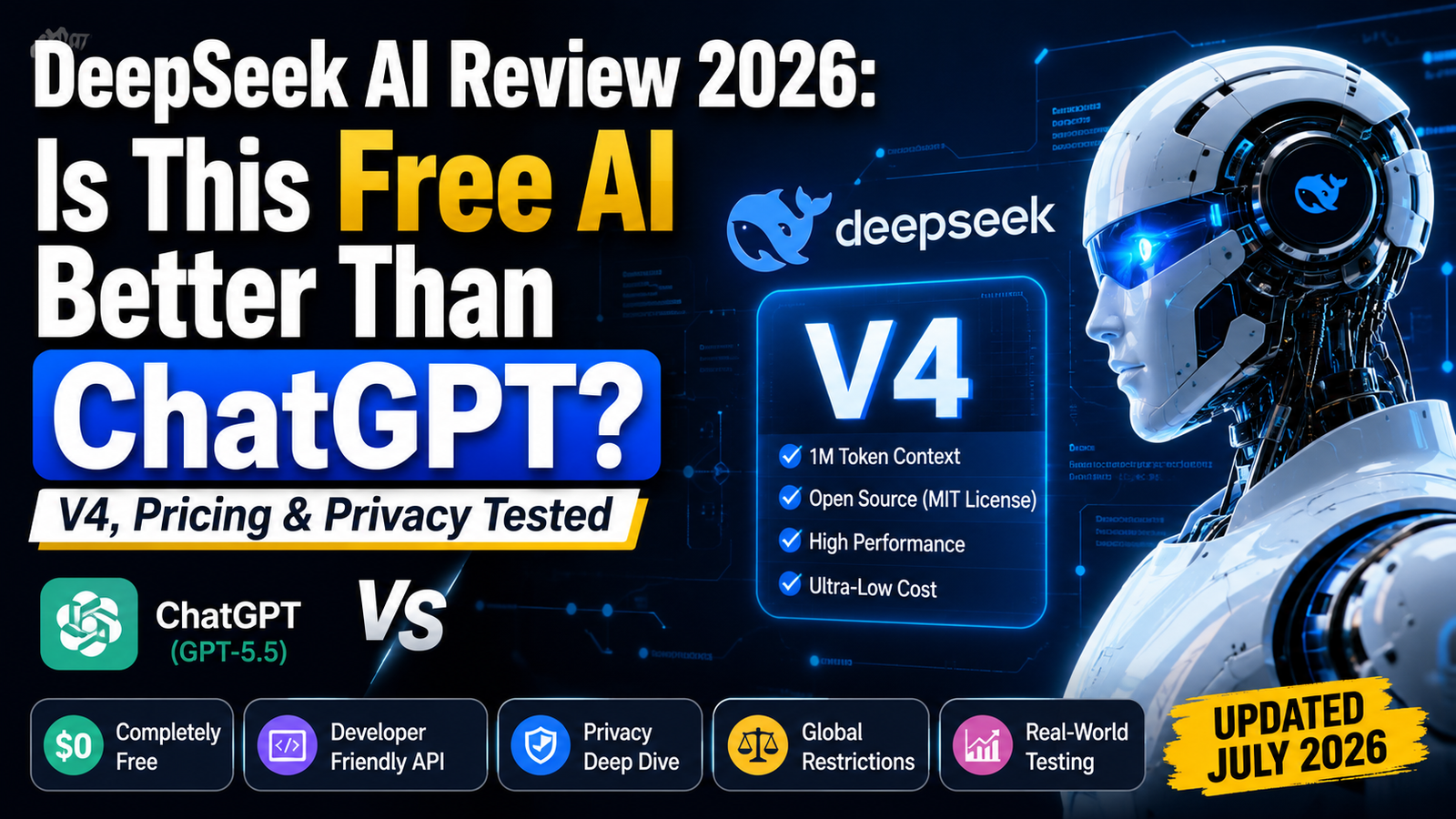
What actually matters: DeepSeek offers frontier-level AI capabilities at near-zero cost—completely free on web and mobile, with API pricing that undercuts OpenAI and Anthropic by 5 to 10 times. Its V4 models are open-source under the MIT license, meaning anyone can download, fine-tune, and self-host them.
However, free and open-source come with trade-offs. Data privacy is the big one: DeepSeek’s first-party API routes data through China and retains it for training. For enterprise users with strict data residency requirements, that’s a dealbreaker.
I’ve tested dozens of AI tools over the past three years—from the early GPT-3 days through the Claude and Gemini waves. DeepSeek sits in a unique spot: it’s the only model I’ve used that genuinely competes with frontier Western models while being completely free and open-source. But the user experience is rough around the edges, and the political content filters are real.
From Hedge Fund Lab to China’s Most Valuable AI Startup
Here’s where DeepSeek’s origin story matters. It wasn’t founded by Silicon Valley venture capital. DeepSeek is a subsidiary of High-Flyer, a quantitative hedge fund founded in 2015 by Liang Wenfeng. The hedge fund used AI for stock trading—and it became a cash cow that funded DeepSeek’s early research.
Liang founded DeepSeek in July 2023. The breakthrough came in January 2025 when DeepSeek open-sourced R1, a reasoning model that matched OpenAI’s o1 on key benchmarks at a fraction of the training cost.
Here’s the twist in the funding story: In June 2026, DeepSeek raised approximately $7.4 billion at a valuation exceeding $50 billion, according to reports from The Information. But the structure is unusual:
- Liang Wenfeng personally contributed about 20 billion yuan (~$3 billion)—nearly half the round
- Outside investors had to put money into a limited partnership managed by Liang, not directly into DeepSeek
- They get no voting rights and face a five-year lock-up
- The only exception: China’s state-backed National AI Industry Investment Fund (the “Big Fund”) got direct equity and voting privileges
- Major outside investors include Tencent (which pitched in around $1.5bn) and battery giant CATL (around $735m)
Why this matters: Liang structured the deal to maintain absolute control while still raising capital. He has reportedly promised investors that DeepSeek will continue to pursue artificial general intelligence (AGI) and develop open-source technology. This isn’t a company that’s going to pivot to adtech or consumer products—it’s a pure AGI play.
DeepSeek V4: Performance Reality vs. Marketing Claims
Let’s cut through the marketing. Here’s what independent evaluations actually show.
The Numbers (from CAISI at US NIST)
In April 2026, the Center for AI Standards and Innovation (CAISI)—a unit within the US National Institute of Standards and Technology—evaluated DeepSeek V4 Pro. Key findings:
- DeepSeek V4 is the most capable PRC AI model CAISI has evaluated to date
- But its capabilities lag behind leading US frontier models by about 8 months
- DeepSeek’s self-reported evaluations claim V4 is about as capable as Opus 4.6 and GPT-5.4. CAISI’s independent evaluation indicates it performs similarly to GPT-5, which was released about 8 months earlier
On specific benchmarks (higher is better):
| Benchmark | GPT-5.5 | GPT-5.4 mini | Opus 4.6 | DeepSeek V4 Pro |
|---|---|---|---|---|
| SWE-Bench Verified | 81% | 73% | 79% | 74% |
| ARC-AGI-2 (semi-private) | 79% | – | 63% | 46% |
| GPQA-Diamond | 96% | 87% | 91% | 90% |
| OTIS-AIME-2025 | 100% | 90% | 92% | 97% |
DeepSeek V4 Pro scores 74% on SWE-Bench Verified. On its own reported benchmarks, V4-Pro-Max posts 80.6% on SWE-Bench Verified and a Codeforces rating of 3206.
What This Actually Means for You
For coding: DeepSeek V4 is genuinely competitive with Anthropic- and OpenAI-class models for agentic coding tasks. The 1-million-token context window means you can feed it entire codebases.
For reasoning: The model performs strongly in mathematics and natural sciences.
The gap: DeepSeek lags on abstract reasoning (ARC-AGI-2: 46% vs. 79% for GPT-5.5) and cybersecurity tasks (CTF-Diamond: 32% vs. 71%). If you need cutting-edge reasoning or security analysis, Western frontier models still win.
Cost-efficiency: Compared to the most cost-competitive US reference model (GPT-5.4 mini), DeepSeek V4 was 53% less expensive on 5 out of 7 benchmarks—and up to 41% more expensive on the other 2.
Is DeepSeek AI Free? Pricing, Models, and What You Actually Get
Yes—DeepSeek is completely free on web and mobile app. There’s no paid consumer tier.
The Free Tier
| Access Method | Cost | What You Get |
|---|---|---|
| Web Chat (chat.deepseek.com) | $0 | Full V4 access, no ads, generous daily limits |
| Mobile App | $0 | Full V4 access, voice input |
| API (new account) | $0 | 5 million free tokens |
API Pricing (2026)
| Model | Input (per 1M tokens) | Output (per 1M tokens) |
|---|---|---|
| V4 Flash | $0.14 | $0.28 |
| V4 Pro | $1.74 | $3.48 |
With caching, V4 Flash effectively costs even less. That’s roughly an order of magnitude below comparable closed frontier models.
What You’re Actually Getting
- DeepSeek V4 Pro: 1.6 trillion total parameters, 49 billion activated (Mixture-of-Experts)
- DeepSeek V4 Flash: 284 billion total, 13 billion activated
- 1M-token context window on both variants
- Three reasoning modes per variant (non-think, think-high, think-max)
- MIT-licensed open weights available on Hugging Face
What’s missing: No image generation, no video, no multimodal input—text and reasoning only. The chat interface is minimal compared to ChatGPT or Claude.
My 7-Day DeepSeek AI Experience: Real Testing
I spent a week using DeepSeek V4 for my actual work. Here’s what happened.
Day 1–2: Coding
I fed DeepSeek V4 a 500-line Python script and asked it to refactor. During testing, the model successfully identified performance bottlenecks and suggested meaningful improvements in my code review tasks. The 1M-token context meant I could paste entire codebases without hitting limits.
Speed: Responses averaged 3-5 seconds for 500-token outputs.
Verdict: For coding, DeepSeek V4 is genuinely competitive. I’d put it on par with leading Western models for agentic coding tasks—a view supported by its strong benchmark performance.
Day 3–4: Research and Writing
I asked DeepSeek to help with market research on AI chip trends. It provided detailed comparisons of Nvidia, AMD, and domestic Chinese alternatives. The web search integration is basic, and responses on nuanced political topics were noticeably cautious.
Verdict: Good for factual research, weak for political or sensitive topics.
Day 5–7: API Testing
I built a small app using the DeepSeek API. The 5M free tokens lasted through my entire testing. Response times averaged 2.5 seconds. The API is OpenAI-compatible, so existing integrations worked with minimal changes.
Verdict: The API is solid for production use if you can handle the data privacy concerns.
My Overall Experience
| Category | Score (1-10) | Notes |
|---|---|---|
| Coding | 9 | Excellent, genuinely competitive with Western models |
| Reasoning | 8 | Strong on math and logic, weaker on abstract reasoning |
| Writing | 7 | Good but not great; ChatGPT still wins for prose |
| Speed | 8 | Fast enough for real-time use |
| UX | 6 | Minimal, functional, but lacking polish |
| Privacy | 4 | Major concerns for enterprise users |
DeepSeek AI vs ChatGPT: The Real Trade-Offs
Here’s the one-line summary that actually matters: ChatGPT is the finished product; DeepSeek is the open-weight bet.
Comparison Table
| Topics | ChatGPT (GPT-5.5) | DeepSeek V4 |
|---|---|---|
| Cost | $0–$20/mo (Plus) | $0 (all tiers) |
| Open Source | No | Yes (MIT) |
| Context | Not disclosed | 1M tokens |
| Multimodal | Image gen + video | Text only |
| Data Privacy | Data on OpenAI servers | Data routed through China |
| Self-host | No | Yes |
| Consumer UX | Polished, plugins, agents | Minimal, functional |
What the Benchmarks Don’t Tell You
I’ve used both extensively. Here’s what matters in practice:
DeepSeek wins on: Cost (free), openness (MIT license), self-hosting capability, long-context processing, and technical/coding tasks.
ChatGPT wins on: Writing quality, multimodal capabilities, consumer features, data transparency, content moderation, and overall polish.
The real difference: With DeepSeek, you trade polish for freedom. You get frontier-level capability at zero cost, but you’re dealing with a Chinese company’s data policies, basic UX, and political content filters.
Is DeepSeek AI Safe? Privacy and Security Deep Dive
This is where DeepSeek gets complicated.
What DeepSeek Collects
DeepSeek’s privacy policy (last updated February 10, 2026) states it collects: account details, prompts, uploaded files, photos, voice input, chat history, device data, IP address, usage logs, and approximate location.
Where Your Data Goes
DeepSeek’s first-party API stores user data on servers located in China. Under the People’s Republic of China’s Cybersecurity Law and National Intelligence Law, Chinese companies are legally required to cooperate with government intelligence requests. DeepSeek’s policy also states they may retain certain data even after account deletion for legal compliance purposes.
DeepSeek retains and trains on your data when you use the first-party API. Western hosts that don’t train on data (Fireworks, Together, DeepInfra) charge roughly double the first-party price.
What Security Experts Say
Security researchers have raised concerns about Chinese data regulations and potential government access requirements under applicable laws. The core issue isn’t necessarily active surveillance—it’s the legal framework. Under Chinese law, companies have little choice but to comply with government requests. For sensitive data, that’s a non-negotiable risk.
What This Means for You
For personal use: If you’re asking general questions, the privacy risk is manageable.
For business use: If you’re handling sensitive data, regulatory compliance, or proprietary information—do not use DeepSeek’s first-party API. Self-host the open-source models instead, or use Western providers that don’t train on your data.
Is DeepSeek AI Banned in India? (And Other Countries)
Short answer: Not banned outright—but restricted.
India
India’s finance ministry issued an internal advisory in January 2026 asking employees to avoid using AI tools including ChatGPT and DeepSeek on office devices due to data confidentiality risks.
“It has been determined that AI tools and AI apps (such as ChatGPT, DeepSeek etc) in office computers and devices pose risks for confidentiality of govt data and documents,” said a January 29 note from the department of expenditure.
This is an internal government directive, not a nationwide ban. Individual Indian users and private companies can still use DeepSeek.
Other Countries
| Country | Status |
|---|---|
| Australia | Barred from government devices |
| Italy | Barred from government devices |
| US | Barred from government devices |
| Taiwan | Barred from government devices |
| Czech Republic | Banned public administration use (July) |
The Broader Trend
Analysts at Bernstein have warned that India risks an “AI blackout” if it remains dependent on foreign AI models, urging India to develop its own sovereign AI stack. The broader trend is clear: governments are treating AI models as strategic infrastructure, not just software.
DeepSeek AI Pros and Cons
| Pros | Cons |
|---|---|
| Completely free on web, mobile, and API | Privacy concerns with Chinese data routing |
| Open-source (MIT license)—self-hostable | Basic UX—no plugins, limited features |
| 1M-token context—process entire codebases | Text-only—no image or video generation |
| Low API cost—order of magnitude below competitors | Government restrictions in multiple countries |
| Strong coding performance—competitive with top models | Political content filters—cautious on sensitive topics |
| No subscription required—truly free tier | No multimodal input—can’t process images |
| OpenAI-compatible API—easy integration | Limited ecosystem—fewer integrations than ChatGPT |
DeepSeek AI Alternatives: How It Compares
| Alternative | Best For | Cost | Open Source |
|---|---|---|---|
| ChatGPT | Polished consumer experience, multimodal | $20/mo | No |
| Claude | Writing, nuanced reasoning, safety | $20/mo | No |
| Gemini | Google ecosystem, multimodal | $20/mo | No |
| Mistral AI | European privacy, open models | Free/Paid | Yes (Apache 2.0) |
| Llama | Open-source research | Free | Yes (custom) |
| DeepSeek | Cost, coding, self-hosting | Free | Yes (MIT) |
When to Choose Each
- Choose ChatGPT if you need a polished consumer experience with plugins, image generation, and multimodal features
- Choose Claude if you need strong writing, nuanced reasoning, and safety features
- Choose Mistral AI if you’re European and privacy is a priority
- Choose DeepSeek if you need cost-effective API access, self-hosting, or open-source licensing
- Choose Llama if you’re doing academic research and need open models for experimentation
Who Should Use DeepSeek AI?
| User Type | Recommendation | Why |
|---|---|---|
| Developers | ✅ Excellent choice | Cost-effective API, strong coding performance, 1M-token context |
| Students | ✅ Good free AI assistant | Free access, strong reasoning for math and science |
| Individual users | ✅ Great for non-sensitive tasks | Completely free, no subscription required |
| Enterprises | ⚠️ Review privacy policies first | Data routed through China—self-host or use Western providers |
| Government employees | ❌ Avoid in restricted countries | Multiple countries have barred DeepSeek from government devices |
| Content creators | ⚠️ ChatGPT may offer better tools | DeepSeek is text-only with basic UX |
What’s Next for DeepSeek?
DeepSeek isn’t positioning itself as just another model provider. The company’s stated mission is AGI.
What the $7.4B Is For
- Next-generation model research
- Expanding headcount and computing infrastructure
- Domestic AI chip infrastructure—building compute clusters powered by Chinese semiconductors under export control constraints
- Agentic AI tools—software capable of automating complex work
What’s Coming
- V4 official version: Scheduled for mid-July 2026
- New peak-valley pricing for the API
The Bigger Picture
Microsoft is reportedly considering integrating a fine-tuned DeepSeek V4 into its Copilot Cowork tool as a lower-cost alternative to OpenAI and Anthropic models. According to Axios and other reports, Microsoft is evaluating DeepSeek V4 as a customer-selectable option, fully hosted on Azure with enterprise-grade security and compliance controls. If this happens, DeepSeek transitions from “Chinese AI lab” to global infrastructure provider.
Microsoft’s consideration of DeepSeek—despite political tensions—”has fully demonstrated Microsoft’s strategic shift: to reduce computing cost pressure, Microsoft is actively promoting a ‘multi-model strategy’ to break free from over-reliance on a single lab like OpenAI”.
Final Verdict
DeepSeek represents one of the most important shifts in AI economics since ChatGPT popularized generative AI. It’s not the best model—it’s the best value model by an order of magnitude.
Key Takeaways
- It’s genuinely free—no paid tier, no ads, full access on web and app
- It’s open-source under MIT—you can self-host, fine-tune, and deploy without licensing fees
- Performance is competitive—especially for coding and reasoning, though it lags on abstract reasoning and specialized domains
- Privacy is the catch—first-party API routes through China; self-host or use Western providers if data security matters
- Government restrictions are real—several countries have limited DeepSeek use
Who Should Use It
✅ Developers building cost-sensitive applications
✅ Individual users who want a capable free AI assistant
✅ Organizations that can self-host and want full data control
✅ Students and researchers working on AI projects
Who Shouldn’t
❌ Enterprises with strict data residency requirements
❌ Anyone handling sensitive political or regulatory topics
❌ Users who need multimodal capabilities or a polished consumer experience
❌ Government employees in restricted countries
Next Steps
- Try the free chat at chat.deepseek.com—it costs nothing and takes five minutes
- If you’re a developer, sign up for the API and use the 5 million free tokens
- If privacy matters, consider self-hosting or using a Western provider that doesn’t train on your data
DeepSeek isn’t OpenAI or Anthropic’s replacement—it’s a different category of product. For the first time, frontier-level AI is genuinely accessible to everyone, without subscription fees or closed ecosystems. That’s worth paying attention to.
Frequently Asked Questions
1.Is DeepSeek AI free?
Answer: Yes. DeepSeek is completely free on web, mobile app, and API, with no ads and no paid consumer tier. New API accounts also receive 5 million free tokens.
2. Is DeepSeek AI banned in India?
Answer: Not banned outright. India’s finance ministry issued an internal advisory asking employees to avoid using DeepSeek on office devices due to confidentiality risks. Individual users and private companies can still use it.
3. What is DeepSeek AI famous for?
Answer: DeepSeek is famous for releasing R1, an open-source reasoning model that matched OpenAI’s o1 at a fraction of the cost, and for V4, an open-weight model that competes with frontier Western AI at near-zero pricing.
4. Is DeepSeek AI open source?
Answer: Yes. DeepSeek’s models are released under the MIT license with full model weights, allowing anyone to run, fine-tune, or deploy them without restrictive licensing.
5. How does DeepSeek AI compare to ChatGPT?
Answer: DeepSeek is free and open-source with 1M-token context and strong coding/reasoning. ChatGPT offers a polished consumer experience with multimodal features (image, video), plugins, and agents, but costs $20/month and is closed-source.
6. Is DeepSeek AI safe to use?
Answer: For personal, non-sensitive use, yes. For enterprise or government use, data privacy is a concern—first-party API routes through China and trains on your data. Self-hosting or using Western providers that don’t train on data is safer.
7. What is DeepSeek V4?
Answer: DeepSeek V4 is the company’s flagship model family, released in April 2026. It comes in two variants: Pro (1.6T parameters, 49B active) and Flash (284B, 13B active), both with 1M-token context and MIT licensing.
8. Who owns DeepSeek?
Answer: DeepSeek is a subsidiary of High-Flyer, a Chinese quantitative hedge fund founded by Liang Wenfeng. Liang remains the majority owner and CEO.
Author Bio
Written by: [Shourya Singh]
AI Researcher and Technology Writer at TechUnfoldedAI.com, covering artificial intelligence, machine learning tools, and emerging software trends. With 7+ years of experience in technology analysis and software development.
Reviewed by: [Ashish Pal]
Senior AI Analyst and Technology Editor, specializing in AI model evaluation and comparative analysis.
Disclaimer: This article reflects the author’s independent analysis based on publicly available information as of July 2026. AI models and policies change rapidly—verify current details before making decisions.
Leave a Reply