
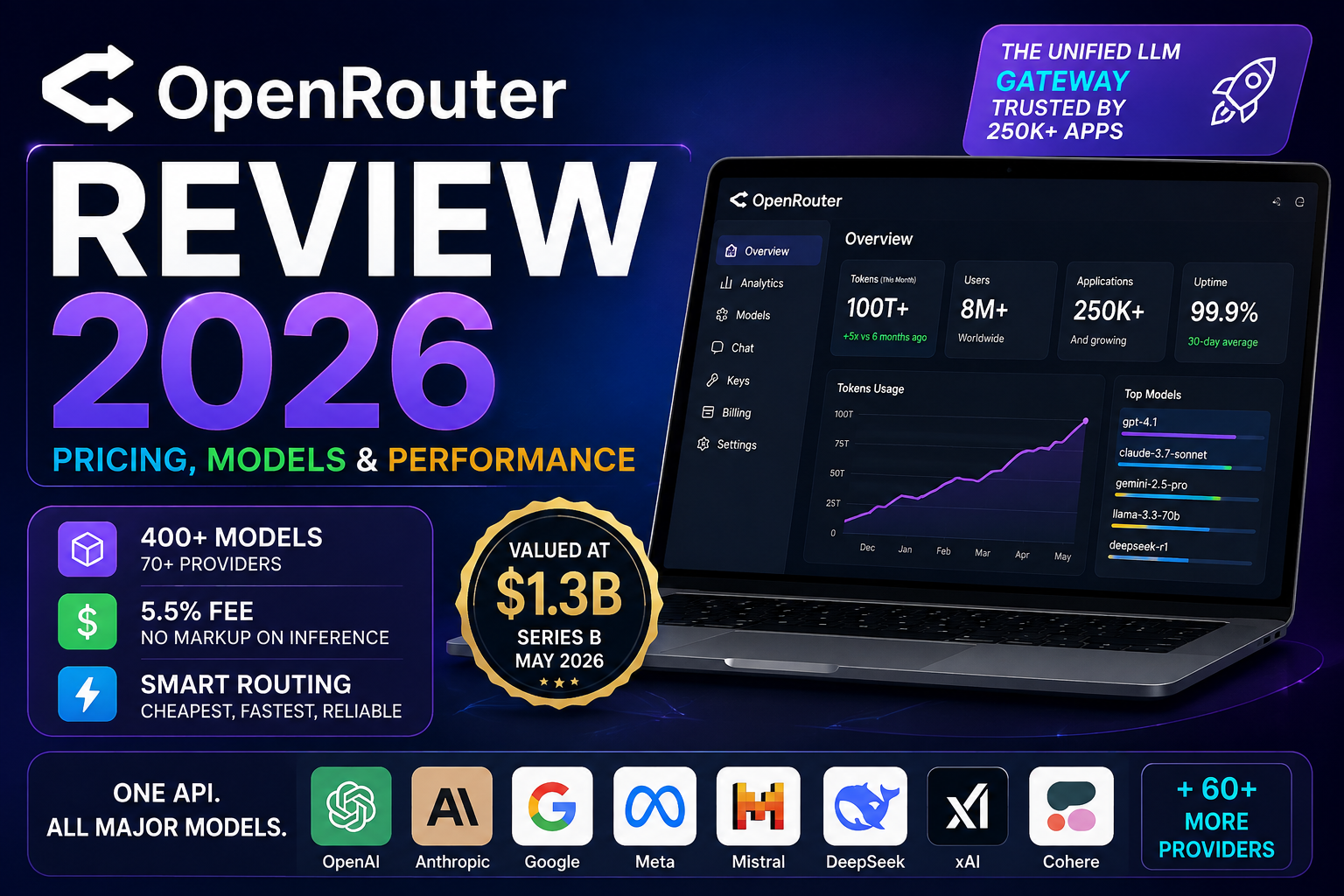
OpenRouter is a hosted LLM gateway that exposes one OpenAI-compatible API endpoint to 400+ models across 70+ providers – including OpenAI, Anthropic, Google, Meta, Mistral, DeepSeek, xAI, Cohere, and dozens of open-weight providers like Together, Fireworks, and NVIDIA NIM.
In plain English: instead of managing separate API keys, SDKs, and billing accounts for GPT-4, Claude, Gemini, and Llama, you get one key, one bill, one codebase.
How big is it now? As of May 2026, OpenRouter processes 25 trillion tokens per week (100 trillion per month) – a 5x increase from six months ago. It serves over 8 million global users across more than 250,000 applications.
In May 2026, OpenRouter raised a $113 million Series B** led by CapitalG (Google’s venture arm) at a **$1.3 billion post-money valuation. Two months later, Stripe entered talks to acquire it for nearly $10 billion.
That’s a lot of hype. But does the product actually deliver?
Founder context: OpenRouter was founded in early 2023 by Alex Atallah – previously co-founder and CTO of NFT marketplace OpenSea – and engineer Louis Vichy. Atallah’s pivot from NFTs to AI infrastructure is worth noting: he’s building the “marketplace” layer for AI models, not the models themselves.
The Routing Intelligence
OpenRouter’s real value isn’t just aggregation – it’s routing. For any given model, multiple providers may offer inference. OpenRouter automatically picks the best one based on:
- Default router: Favors cheaper providers automatically
:floorsuffix: Always routes to the cheapest provider:nitrosuffix: Routes to the highest-throughput (fastest) provider:freesuffix: Routes to free-tier models- Auto-fallback: If one provider fails or rate-limits, OpenRouter retries others
For example, Llama 3.3 70B costs anywhere from $0.10 to over $1.00 per million input tokens depending on the provider. Appending :floor automatically locks in the cheapest option.
Beyond Text: Multimodal Support
OpenRouter now supports image, video, audio, embeddings, and transcription through the same API endpoint. You set one base URL and call any modality. This is significant – it means OpenRouter isn’t just a text gateway anymore.
Response Healing
This is one feature that genuinely surprised me. OpenRouter’s Response Healing plugin automatically detects and repairs malformed JSON responses from models – fixing missing brackets, trailing commas, markdown wrappers, and mixed text before they hit your application. It cuts JSON defects by over 80%. If you’ve ever spent hours debugging why your model returned with that extra comma, you’ll appreciate this.
OpenRouter Pricing: The 5.5% Fee Nobody Talks About
OpenRouter’s marketing claims “no markup on inference”. Technically, this is true. The per-token rates match what providers charge.
But here’s where it gets interesting.
The Real Fee Stack
The $0.80 Minimum
The $0.80 minimum fee is where indie developers get stung.
- Top up **$5** → pay $0.80 fee = 16% effective rate
- Top up **$10** → still $0.80 = 8%
- Top up **$25** → $1.38 = 5.5% (finally normalized)
The fix is simple: load $50 or more at a time. Credits never expire, so there’s no downside to loading larger amounts.
BYOK (Bring Your Own Key)
If you already have API keys with OpenAI, Anthropic, or others, you can use them through OpenRouter. The first 1 million requests per month are free; after that, OpenRouter takes 5%.
Free Tier
OpenRouter offers 25+ free models at $0 per token – including DeepSeek R1, Llama 3.3 70B, and Qwen3.
- Free account: 50 requests per day
- After one-time $10 credit purchase: higher limits
- Rate limit: 20 requests per minute (fixed)
No credit card required for free models.
OpenRouter Models: 400+ and Counting
OpenRouter’s model catalog is the largest in the industry. As of mid-2026, it supports:
- 400+ models
- 70+ providers
- Multiple modalities: text, image, audio, video, embeddings, transcription
Notable Free Models (July 2026)
| Model | Context | Capabilities |
|---|---|---|
| NVIDIA Nemotron 3 Ultra | 1M tokens | Frontier reasoning, agent orchestration |
| Llama 3.3 70B | 131K tokens | Proven JSON, ingestion |
| DeepSeek R1 | Variable | Reasoning |
| Qwen3 | Variable | General purpose |
Paid Models
OpenRouter routes to every major frontier model:
- OpenAI: GPT-4.1, GPT-4o, o1
- Anthropic: Claude Opus 4.7, Claude Sonnet 4.6
- Google: Gemini 3.1 Flash, Gemini 3 Pro
- Meta: Llama 3.3 70B, Llama 4
- Mistral: Mistral Large, Small 3.1
- DeepSeek: DeepSeek-V3, DeepSeek-R1
- xAI: Grok
Performance: Does the Gateway Add Latency?
The conventional wisdom is that adding a gateway layer adds latency. Third-party benchmarks suggest the penalty is 15–40ms in typical conditions. That’s roughly the blink of an eye.
However, two significant outages in February 2026 – caused by a caching layer failure and concurrent DoS attacks – hurt developer confidence. OpenRouter has since improved its infrastructure, but the incidents are a reminder: you’re adding a dependency.
The takeaway: for most applications, the latency penalty is statistically negligible. But if you’re building latency-sensitive real-time systems, self-hosting LiteLLM may be safer.
OpenRouter vs LiteLLM vs Portkey vs Vercel
| Gateway | Self-host? | Open-source? | Models | Best for |
|---|---|---|---|---|
| OpenRouter | No | Gateway core open | 400+ | Zero-ops, widest model access |
| LiteLLM | Yes | MIT | 100+ providers | Self-hosted, data residency |
| Portkey | Limited | OSS core + hosted | 1,600+ | Governance, guardrails, compliance |
| Vercel AI Gateway | No | No | Limited | Vercel ecosystem |
The Real Choice
Use LiteLLM if you want to self-host and keep data inside your infrastructure. It’s an MIT-licensed Python proxy that deploys with Docker and PostgreSQL.
Use Portkey if you need compliance (SOC2, ISO 27001, HIPAA, GDPR), 50+ guardrails, and enterprise governance.
Use OpenRouter if you want zero operational burden and the widest possible model selection.
Avoid Vercel AI Gateway unless you’re already deeply embedded in Vercel’s ecosystem – it’s more limited and proprietary.
Who Should Use OpenRouter (And Who Shouldn’t) Use OpenRouter if:
- You’re prototyping across multiple models and need to compare outputs quickly
- You want to avoid vendor lock-in without managing multiple SDKs
- You’re a solo developer or small team that can’t maintain custom gateway infrastructure
- You need access to obscure or experimental models that aren’t available elsewhere
- You value simplicity over fine-grained control
Avoid OpenRouter if:
- You have strict data residency requirements (data passes through OpenRouter’s servers)
- You’re at massive scale (the 5.5% fee adds up – at 100M tokens/month, that’s real money)
- You need deep observability and custom guardrails (Portkey or self-hosted LiteLLM is better)
- You’re in regions with high latency to US/EU servers – cross-ocean TTFT can exceed 1.5 seconds
Security, Privacy & Compliance
What OpenRouter Provides
- IP allowlist enforcement: API keys with IP allowlists now actively block unauthorized requests
- Zero data retention: Models can be configured with zero data retention
- In-region routing: Option to route requests within specific regions
- Data policy-based routing: Available for enterprise customers
What OpenRouter Doesn’t Provide
- No SOC2, HIPAA, or ISO 27001 certification (unlike Portkey)
- No self-hosting option – all traffic goes through their infrastructure
- Data processing transparency: Free models may use your inputs/outputs for training
The Privacy Trade-off
OpenRouter sits between you and every model provider. That means:
- Your requests and responses pass through OpenRouter’s infrastructure
- OpenRouter can see what you’re sending and receiving
- For free models, usage data may be used for model improvement
If you’re handling PII, healthcare data, or financial information, OpenRouter may not be appropriate without additional safeguards.
The $1.3B Question: Is OpenRouter Overvalued?
Let’s look at the numbers.
What justifies the valuation:
- 100 trillion tokens/month – that’s real, massive usage
- 8 million+ users and 250,000+ applications
- Network effects: More users attract more models, more models attract more users
- Strategic value: A unified AI gateway is infrastructure – the kind of thing Stripe, Cloudflare, or AWS would want to own (as evidenced by the $10B acquisition talks)
- Google’s investment: CapitalG’s $113M lead signals strategic interest
What doesn’t:
- Thin margins: 5.5% on credit top-ups isn’t a high-margin business
- Commoditization risk: LiteLLM and other open-source alternatives are catching up fast
- Provider direct access: As OpenAI, Anthropic, and others improve their own APIs, the need for a gateway may diminish
My take: OpenRouter has built something genuinely useful. The $10B acquisition talks – nearly 7.7× its May 2026 valuation – reflect strategic positioning more than current fundamentals. If Stripe acquires them, it’s about controlling the AI payment layer – not about the 5.5% fee.
FAQs
1. What is OpenRouter used for?
2. Is OpenRouter free?
3. How much does OpenRouter cost?
A: OpenRouter passes through provider rates with no markup on inference. You pay the provider’s per-token price plus a 5.5% fee ($0.80 minimum) when you add credits. BYOK (bring your own key) is free for the first 1M requests/month, then 5%. Effective cost ranges from **$0 to $75+ per million tokens** depending on the model.
4. How does OpenRouter compare to LiteLLM?
A: OpenRouter is a fully managed gateway – you deploy nothing, just sign up and get an API key. LiteLLM is an open-source, self-hosted Python proxy that you deploy yourself. Choose OpenRouter for zero ops and widest model access; choose LiteLLM for data residency and full control.
5. What models does OpenRouter support?
6. Is OpenRouter legit?
7. Does OpenRouter add latency?
A: Third-party benchmarks suggest OpenRouter adds 15–40ms of latency over direct provider calls. For most applications, this is negligible. However, OpenRouter experienced two significant outages in February 2026, so reliability is a consideration.
Final Verdict
OpenRouter solves a real problem – managing dozens of AI providers is a nightmare, and they’ve made it simple. The single API, unified billing, auto-fallback, and Response Healing are genuinely useful features that save development time.
But it’s not for everyone.
| Audience | Recommendation |
|---|---|
| Beginners / hobbyists | Yes, free tier is generous, zero setup |
| Indie developers | Yes—one API for all models, minimal ops |
| Startups | Yes—speeds up prototyping, avoids lock-in |
| Enterprises | Consider that compliance and data residency may be concerns |
| Researchers | Yes—access to obscure models, easy comparison |
| Massive scale | No – 5.5% fee adds up; self-host LiteLLM |
The bottom line: OpenRouter is the best zero-ops LLM gateway in 2026. Whether it’s worth the fee depends on how much you value your time versus your infrastructure budget.
Key Takeaways
- One API, 400+ models – OpenRouter consolidates every major provider behind a single OpenAI-compatible endpoint
- **5.5% fee with a $0.80 minimum** – effective rate drops to 5.5% only on top-ups of $25+
- 25+ free models – no credit card required, 50 requests/day free
- 15–40ms latency penalty – negligible for most applications
- Best for prototyping and small teams – enterprises with strict compliance needs should consider self-hosted alternatives
- $1.3B valuation (and $10B acquisition talks) – reflects strategic positioning, not just fundamentals
For regular updates about the AI, AI tools, AI guides, technology & more. Visit, The TechUnfoldedAi.com.
Leave a Reply