The Paradox at the Heart of DeepMind
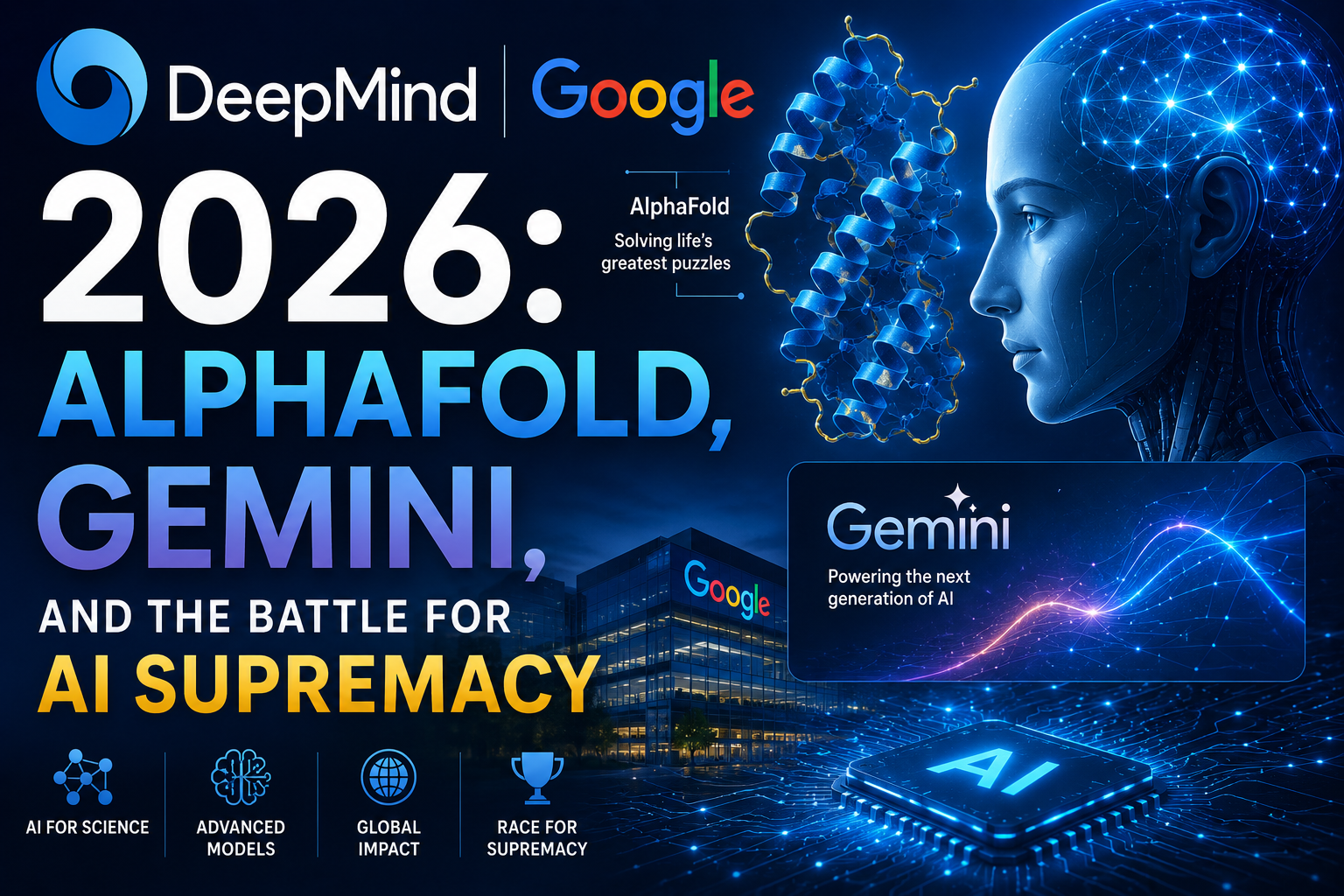
In 2024, Google DeepMind won the Nobel Prize in Chemistry for AlphaFold—an achievement that should have cemented its legacy. Two years later, the company has dismantled that very team, reassigned most of its members to Gemini-related projects, and watched its Nobel laureate walk out the door.
This isn’t a failure. It’s a strategic pivot—one that reveals the tension between scientific discovery and commercial survival in the age of generative AI.
Key Data Point: Nearly a quarter of the full-time Google DeepMind authors of the original AlphaFold papers have left the company altogether, according to a Financial Times analysis of recent job moves.
The story of DeepMind in 2026 is the story of what happens when a research lab built to “solve intelligence” gets pulled into a commercial arms race it never signed up for.
What DeepMind Actually Is (and Isn’t)
DeepMind is not a standalone company. It hasn’t been since 2014, when Google acquired it for approximately $500–650 million.
Today’s Google DeepMind is the product of a 2023 merger between the original London-based DeepMind and Google’s internal Brain team. The merger was an explicit response to ChatGPT’s sudden dominance—an admission that Google’s fragmented AI efforts couldn’t compete with OpenAI’s focused assault.
Demis Hassabis, the co-founder and CEO, described the merger as a cultural and structural reset. In practice, it meant merging two deeply different cultures: DeepMind’s long-horizon research ethos and Google Brain’s product-oriented engineering mindset.
The result? A lab that now operates less like a research institution and more like a product division with a research budget.
The AlphaFold Reckoning: What the Data Shows
AlphaFold wasn’t just another AI project. It solved a problem that had stumped biologists for half a century: predicting a protein’s 3D structure from its amino acid sequence. The system mapped nearly all known proteins and earned John Jumper and Demis Hassabis the 2024 Nobel Prize in Chemistry.
What happened next:
Pushmeet Kohli, DeepMind’s VP of research, defended the move: “Our strategy over the last nine years has been to focus on grand challenges… The strategy has evolved”. He said the lab is now focused on building Gemini-powered systems that can assist scientists—and eventually automate parts of the scientific process—while competing with OpenAI and Anthropic.
What this tells us: DeepMind has made a strategic decision to prioritize Gemini—the large language model that powers Google’s commercial AI ambitions—over the pure scientific research that built its reputation.
Internal reaction: A DeepMind employee, who asked not to be named, told the Financial Times that Jumper, Adler, and Pritzel had all been “instrumental, important, core members” of the company and that their departures had sparked surprise internally.
Gemini 2026: Speed Over Smarts?
On July 21, 2026, Google DeepMind released three new Gemini models: Gemini 3.6 Flash, Gemini 3.5 Flash-Lite, and Gemini 3.5 Flash Cyber.
The data tells a mixed story:
The rankings tell a more concerning story:
- Gemini 3.6 Flash ranked #12 in Arena.ai’s front-end code arena with 1,537 points
- Kimi K3 (Moonshot) ranked #1 with 1,677 points
- Chinese models Zhipu GLM-5.2 ranked #4
- Anthropic’s Claude and OpenAI’s GPT models occupied top positions
Developer feedback: One tester noted: “The front-end capabilities are poor, and the spatial reasoning is also terrible”. Another commented: “Google is like the tortoise and hare—it leads for a while and then falls asleep”.
The bottom line on Gemini: Google optimized for speed and cost rather than raw capability. The flagship Pro model remains conspicuously absent, and employees have cited poor morale as a contributing factor to delayed releases.
The Cost of Playing Catch-Up
DeepMind doesn’t report standalone revenue. It’s a cost center—a very expensive one—inside Alphabet.
The numbers:
| Metric | Value |
|---|---|
| Alphabet Q2 2026 revenue | $119.8 billion (+24%) |
| Google Cloud revenue | +82% year-over-year |
| Alphabet 2026 capex guidance | $175–185 billion (more than double 2025) |
| Compute infrastructure share of costs | 50–65% of frontier lab budgets |
Barclays analysts noted that Infrastructure, DeepMind, and Waymo costs “weighed on overall Alphabet profitability” and will continue to do so in 2026.
The irony: Hassabis himself has claimed that roughly 90% of the breakthroughs underpinning today’s AI industry came from Google Brain, Google Research, or DeepMind. The transformer architecture, reinforcement learning from human feedback, AlphaFold—all trace back to Google’s labs.
And yet, Google is spending record amounts to stay competitive. The company that invented modern AI is now running like a startup to maintain its position.
DeepMind vs OpenAI vs Anthropic: The 2026 Landscape
Key insight: No single lab dominates. OpenAI has the strongest independent platform. Google DeepMind has the strongest structural advantages. Anthropic has the clearest specialization in enterprise and safety.
What this misses: DeepMind is fighting a two-front war—competing with OpenAI on consumer AI and with Anthropic on enterprise and safety—while navigating internal friction.
Related: xAI Complete Guide 2026
The AI Safety Paradox: Regulate Us, Please
In July 2026, Hassabis published a manifesto calling for a U.S.-led global AI watchdog modeled on FINRA, the private industry-funded regulator that polices Wall Street.
His proposal:
- Frontier labs would share models up to 30 days before release
- Testing would probe cyber, biological, and “deception” capabilities
- The body would be industry-funded but U.S. government-backed
- A majority-independent board with Turing Award winners and technical experts
- Timeline: operational “before year-end”
Hassabis’s warning: Within 18 months, cyber, biological, and nuclear threats “could live inside open-source models beyond any government’s control”.
The critics’ case:
Gartner VP analyst Nader Henein: “Self-regulation is not viable because it implies everyone is able to regulate themselves and will do so in line with the best interests of the public. For-profit organizations are required to do what is best for their shareholders”.
The less charitable interpretation: A regulatory regime that requires pre-release testing and substantial compliance costs benefits incumbents with deep pockets. It’s moat-building by regulation.
Both things can be true simultaneously. Hassabis can be genuinely concerned about AI safety and strategically motivated to shape regulation in Google’s favor.
The FLI Safety Index (Summer 2026):
| Company | Grade | Score | Trend |
|---|---|---|---|
| Anthropic | C+ | 2.66 | Stable |
| OpenAI | C | 2.28 | ▼ from C+ |
| Google DeepMind | C | 2.01 | Stable |
| Meta | D+ | 1.32 | ▲ |
| xAI | F | 0.65 | ▼ |
Key finding: “From 2024 to 2026, companies including Anthropic, OpenAI, Google DeepMind, and Meta that previously banned military applications gradually reversed course”.
Related: The Future of AI Security
The Military AI Controversy
In early 2025, Google updated its AI principles to remove pledges against using AI for weapons or mass surveillance. Hassabis co-authored the blog post announcing the changes.
What happened next:
The contract: Google agreed to let the Pentagon use Gemini AI for classified operations for “any lawful purpose”. Critics argue the wording contains loopholes for autonomous weapons and expanded surveillance.
Turner’s words: “When Google signed the deal, my conscience simply said ‘nope’”. He told Business Insider he doesn’t have another job lined up yet.
The broader context: DeepMind UK staff voted to unionize in protest against work with the Israeli and US militaries. The pattern is clear: Google will pursue military and government AI contracts regardless of internal objection.
What this means for users: If you’re using Gemini or any DeepMind technology, you’re using technology that may be deployed in military contexts. The company’s public-facing safety commitments no longer include the hard lines that once defined its ethical positioning.
Related: Tech Giants Envision Future Beyond Smartphones
Who Should Use DeepMind’s Technology (and Who Shouldn’t)
Who should use it:
Developers on Google Cloud: If you’re already on Google Cloud, Gemini’s native integration—Search, Workspace, Android—is a legitimate advantage.
Researchers in biology/chemistry: AlphaFold 3 remains free for non-commercial research through the AlphaFold Server.
Cost-conscious developers: Gemini 3.5 Flash-Lite at $0.30/$2.50 per million tokens is aggressively priced for high-volume applications.
Teams needing speed over peak intelligence: Gemini 3.6 Flash cuts time per task by 50%.
Who should avoid it:
Teams needing the best reasoning: Gemini 3.6 Flash ranked #12 in coding benchmarks. If your use case demands sharp logic, benchmark carefully.
Organizations with strict data privacy: DeepMind’s models run on Google’s infrastructure. For air-gapped or highly sensitive work, this is a limitation.
Ethically sensitive organizations: The military AI pivot and weakened safety pledges may be deal-breakers.
Teams seeking stability: The AlphaFold team dismantling, delayed Pro releases, and internal churn suggest a lab in flux.
Checklist before committing:
- □ Have you benchmarked Gemini against alternatives for your specific use case?
- □ Are you comfortable with Google’s military AI partnerships?
- □ Does your organization accept Google’s data handling policies?
- □ Can you tolerate delayed flagship releases and shifting roadmaps?
Related: Latest AI Tools 2026 | How to Use AI in Daily Life
The Verdict
Google DeepMind in 2026 is a study in contradictions.
- It’s the lab that won a Nobel Prize and then disbanded the team that won it.
- It’s the company that invented the transformer architecture and is now fighting to stay relevant in the ecosystem it created.
- It’s the organization whose CEO calls for AI regulation while his lab pursues military contracts that weaken safety pledges.
Fact: DeepMind has prioritized product over discovery, shipping over science.
Analysis: This is a rational response to market pressure—OpenAI and Anthropic forced Google’s hand.
Prediction: The commercial payoff is uncertain. Gemini’s performance lags competitors. Internal morale is low. Key talent is leaving.
For users: DeepMind’s technology is powerful and increasingly accessible. But it’s also subject to a corporate strategy that has proven willing to sacrifice long-term research for short-term competitiveness.
Final recommendation: Use DeepMind’s tools. Benchmark them against alternatives. But don’t confuse the lab’s scientific legacy with its current trajectory.
FAQs
1. Is DeepMind a public company?
A: No. DeepMind is a wholly-owned subsidiary of Alphabet (Google’s parent company). There is no “DeepMind stock” to buy. Investors gain exposure through Alphabet (GOOG/GOOGL).
2. Who founded DeepMind?
A: DeepMind was founded in 2010 by Demis Hassabis, Shane Legg, and Mustafa Suleyman in London. Hassabis currently serves as CEO of Google DeepMind.
3. What does DeepMind do?
A: DeepMind develops frontier artificial intelligence systems, including the Gemini family of large language models, AlphaFold for protein structure prediction, and research into artificial general intelligence (AGI).
4. How can I use DeepMind’s technology?
A: Access Gemini through Google’s products (Search, Workspace, the Gemini app) or via the Gemini API through Google Cloud. AlphaFold 3 is available for free non-commercial research through the AlphaFold Server.
5. Is DeepMind’s AI safe?
6. Why did DeepMind disband the AlphaFold team?
Key Takeaways
- DeepMind is no longer a pure research lab. The 2023 merger with Google Brain and the pivot to Gemini reflect a fundamental shift toward commercial priorities.
- AlphaFold’s legacy is secure, but its team is gone. Nearly a quarter of the original authors have left the company.
- Gemini 3.6 Flash prioritizes speed over intelligence. The model scores the same as its predecessor in intelligence but cuts task time in half. The flagship Pro model remains delayed.
- The safety paradox is unresolved. Hassabis calls for regulation while DeepMind pursues military contracts. FLI gave DeepMind a C grade in 2026.
- Use DeepMind’s tools, but verify. Benchmark carefully and don’t assume stability.
For regular updates about the AI, AI tools, AI guides, technology & more. Visit, The TechUnfoldedAi.com.
Leave a Reply