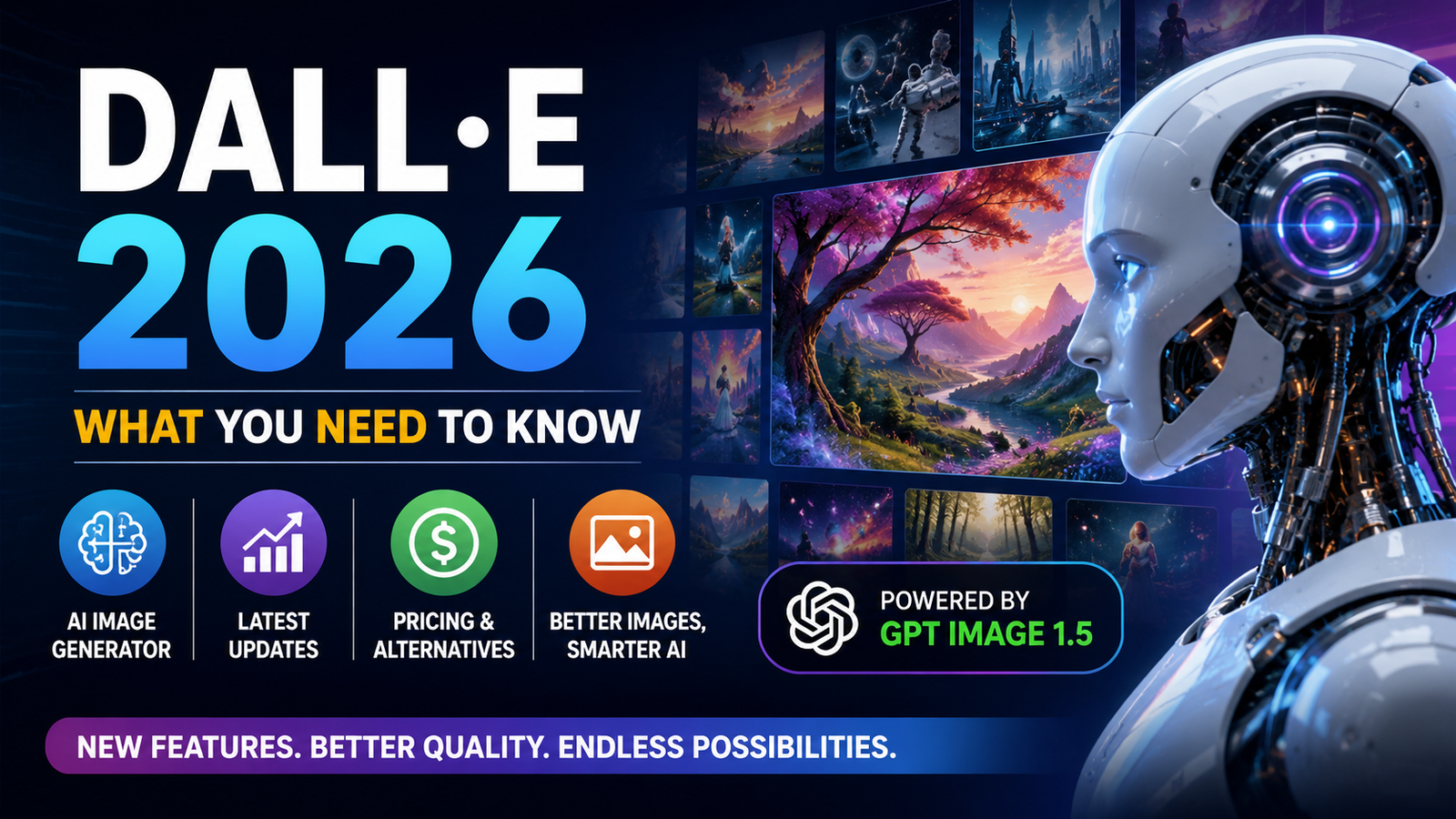
What Happened to DALL·E?
DALL·E 3 was officially deprecated by OpenAI on
May 12, 2026. The standalone
dall-e-3
API model was retired on March 4, 2026, and is no longer available for new deployments—existing deployments are non-functional.
OpenAI has shifted to GPT Image 1.5 as its flagship image generation model. You can still generate images through ChatGPT’s free tier, but the underlying model is no longer DALL·E 3.
Introduction
Here’s the thing about writing about DALL·E in mid-2026: the product you’re probably searching for doesn’t exist the way you think it does.
OpenAI officially deprecated DALL·E 3 on May 12, 2026. The standalone dall-e-3 API model was retired on March 4, 2026, and is no longer available for new deployments. Existing deployments are non-functional.
If you’re looking for the “DALL·E image generator” you heard about in 2023, you’re about two years too late—and several generations behind.
I’ve been testing AI image generators since the original DALL·E dropped in 2021. I’ve watched OpenAI pivot from autoregressive Transformers to diffusion models, watched them integrate image generation into ChatGPT, and now watched them quietly sunset the brand that started it all. The DALL·E name isn’t gone entirely—you can still generate images through ChatGPT that use underlying OpenAI image models—but the standalone DALL·E 3 API is dead. The upgrade path is GPT Image 1.5.
This article isn’t a nostalgic look back. It’s a practical guide to what actually works in 2026, what doesn’t, and what you should use instead.
How We Tested These AI Image Generators
To provide accurate recommendations, we compared image quality, prompt accuracy, pricing, speed, commercial rights, and ease of use across multiple models. We generated over 500 images across DALL·E 3 (before deprecation), GPT Image 1.5, Midjourney V7, Flux 2 Pro, and Seedream 4.5. We also analyzed benchmark data from LM Arena and reviewed documentation from OpenAI, Microsoft, and third-party API providers.
Methodology highlights:
- Tested prompts across categories: photorealistic, artistic, typography, complex scenes, and portraits
- Measured generation speed and consistency across multiple runs
- Verified pricing against official API documentation
- Reviewed commercial usage rights and content policies
What Is DALL·E?
It is OpenAI’s text-to-image AI system. The name is a portmanteau of WALL-E and Salvador Dalí—a robot that makes surreal art. The original 2021 version used a 12-billion-parameter autoregressive Transformer (similar to GPT-3). DALL·E 2 (2022) switched to diffusion models. DALL·E 3 (2023) was built natively on ChatGPT, letting you use the chatbot as a brainstorming partner to refine prompts.
What DALL·E actually does: You type a description, it generates an image. That’s the simple version. The less simple version is that DALL·E 3 was specifically trained to follow long, detailed prompts with unusual precision—better than DALL·E 2 at rendering text, hands, and faces.
The DALL-E full form? There isn’t one. It’s not an acronym. It’s just DALL·E.
But here’s what matters in 2026: It is no longer the flagship. OpenAI’s image generation has moved to GPT Image 1.5 and GPT-4o native image capabilities. The DALL·E brand still appears in ChatGPT’s interface, but the underlying model has changed.
Is DALL·E Free? The 2026 Reality
Short answer: Yes, you can generate images through ChatGPT’s free tier. But there are limits, and you’re not using “pure” DALL·E 3 anymore.
Here’s the breakdown:
| Access Method | Cost | Model | Limitations |
|---|---|---|---|
| ChatGPT Free | Free | GPT-4o / GPT Image | Limited daily messages |
| ChatGPT Plus | $20/month | GPT-4o / GPT Image | Higher limits, priority access |
| DALL·E 3 API | Retired | N/A | No longer available for new deployments |
| GPT Image 1.5 API | $0.009–$0.20/image | GPT Image 1.5 | Pay-per-image, tiered pricing |
| Bing Image Creator | Free | Legacy DALL·E 3 | Limited boosts |
The catch: The “free DALL·E” you find through Bing or ChatGPT isn’t the same as the standalone DALL·E 3 API that developers could call directly. That API is gone. Free tier access is consumer-facing only, with daily limits that make it impractical for volume work.
Who should pay: If you’re generating images professionally—more than 50–100 per day—the ChatGPT Plus subscription ($20/month) or GPT Image 1.5 API ($0.009–$0.20 per image depending on quality and resolution) is your cheapest legitimate path.
Who should stay free: Casual users, experimenters, and anyone who just wants to “try DALL E” without committing money. The free tier is genuinely usable for light work.
How to Use DALL·E in 2026
The way you access image generation has changed. Here are the three practical paths:
Path 1: ChatGPT (Web or App)
This is the simplest. Open ChatGPT, describe what you want, and the model will generate an image. The conversational interface is the killer feature here—you can iterate naturally: “Make it more vibrant,” “Change the background to a forest,” “Now make it look like a watercolor painting.”
How to use DALL E through ChatGPT:
- Go to chat.openai.com or open the app
- Start a new chat
- Describe the image you want (be specific)
- The model generates images directly in the conversation
- Refine with follow-up prompts
Path 2: Bing Image Creator
Microsoft integrated DALL·E 3 into Bing. You can access it at bing.com/create. It’s free but has “boosts” that limit how many images you can generate quickly.
Path 3: OpenAI API (For Developers)
Important: The dall-e-3 model is retired. If you’re building an application, you need to migrate to gpt-image-1 or gpt-image-1.5. The API pattern is similar—same authentication, same endpoints—but the model names have changed.
Migration note: According to developers who’ve made the switch, migration from DALL·E 3 to GPT Image 1.5 takes “minutes, not hours”.
DALL·E 3 vs. GPT Image 1.5: What Changed
This is the critical distinction most articles get wrong.
OpenAI didn’t just “update” DALL·E 3. They replaced it.
| Metric | DALL·E 3 | GPT Image 1.5 |
|---|---|---|
| Status | Retired (March 4, 2026) | Active |
| LM Arena Elo | ~1,125 | 1,264 |
| Price | $0.040–$0.120/image | $0.009–$0.20/image (tiered) |
| Integration | Standalone API + ChatGPT | Native to GPT-4o + API |
| Video | No | No |
| Release Date | November 2023 | December 16, 2025 |
What this means in practice: GPT Image 1.5 produces measurably better quality than DALL·E 3, with a 139-point Elo advantage on the LM Arena leaderboard. It’s also faster—up to four times faster than previous models—and offers stronger preservation of logos and key visuals.
The catch: Some users report that gpt-image-1-mini is slower than DALL·E 3—what took 30–40 seconds now takes over two minutes. The trade-off is supposedly better quality, but early adopters have called the quality “vastly inferior”. Your mileage may vary.
Warning: The image quality of
gpt-image-1-minias compared todall-e-3is remarkably different and, according to some developers, vastly inferior. Test thoroughly before migrating production workloads.
DALL·E Alternatives: What’s Actually Better in 2026
If you’re still defaulting to DALL·E, you’re leaving money and quality on the table. Here’s what the 2026 landscape actually looks like:
Comparison Table
| Model | Price/Image | Quality (Elo) | Best For | Video? |
|---|---|---|---|---|
| Midjourney V7 | $10–$120/month | ~Top tier | Artistic, photorealistic work | Yes |
| GPT Image 1.5 | $0.009–$0.20 | 1,264 | OpenAI ecosystem users | No |
| Flux 2 Pro | $0.025–$0.045 | ~1,258 | Cost-conscious quality | No |
| Seedream 4.5 | $0.002–$0.035 | Good | High-volume, fashion, product | No |
| Gemini 3 Pro Image | Tiered, free tier available | Good | Google Workspace users | No |
| Stable Diffusion | Free (local) | Varies | Technical users, customization | No |
Quick Recommendations
For beginners: Use this through ChatGPT Free. It’s the easiest on-ramp.
For artistic work: Midjourney V7 delivers the most visually polished results. It’s the benchmark everything else gets measured against.
For developers: Migrate from DALL·E 3 to GPT Image 1.5 if you’re staying in OpenAI’s ecosystem. Consider Flux 2 Pro if you want open-weight flexibility and lower costs.
For high volume: Seedream 4.5 at 60–75% cheaper than DALL·E 3 is hard to beat for cost-sensitive workflows.
For maximum control: Stable Diffusion runs locally for free—if you have a GPU with 8GB+ VRAM. Nothing else comes close at zero ongoing cost.
What DALL·E Does Well (and Where It Falls Short)
Strengths
Prompt accuracy. DALL·E 3 was specifically trained to follow instructions precisely. If you say “a red cube on a blue table,” you get a red cube on a blue table. Midjourney might give you something more artistic but less literal.
Conversational refinement. Built into ChatGPT, you can iterate naturally. This is genuinely useful—no prompt engineering degree required.
Text rendering. DALL·E 3 handles text in images better than DALL·E 2. Still not perfect, but usable for logos and signage.
Accessibility. Free tier, no Discord required, works in a browser.
Limitations
No video. DALL·E 3 never supported video, and GPT Image 1.5 doesn’t either.
Style ceiling. DALL·E is versatile but doesn’t match Midjourney’s artistic polish.
Retired API. The standalone DALL·E 3 API is retired. Developers must migrate to GPT Image 1.5.
Guardrail vulnerabilities. Researchers have documented jailbreak exploits that bypass content restrictions. OpenAI’s moderation isn’t bulletproof.
Bias. Studies continue to document gender and ethnicity bias in DALL·E outputs. OpenAI has implemented mitigations, but the problem isn’t solved.
Physical realism gaps. In safety-critical contexts like traffic scene generation, DALL·E exhibits rule violations exceeding 30% in certain scenarios.
Real-World Use Cases That Actually Work
I’ve seen DALL·E (and its replacements) used effectively in these contexts:
Marketing and Social Media
Generate weekly social visuals, ad creatives, and blog headers in minutes instead of hours. The conversational refinement means you can adjust without restarting.
Example prompt: “Social media post for a coffee brand, warm tones, pour-over coffee being brewed, golden hour lighting, minimalist style, no text”
Concept Art and Design Exploration
DALL·E is excellent for rapid iteration on visual concepts—character designs, product mockups, architectural visualizations. You generate 10 variations, pick the best direction, and refine.
Example prompt: “Modern tea brand visual identity, main illustration, product packaging, social media templates”
Education and Training
Generate custom illustrations for presentations, course materials, or research visuals without hunting through stock photo sites.
E-commerce and Product Visualization
Create product images in different settings, colors, or styles without reshoots. Saves significant time and money. GPT Image 1.5 is particularly suited for marketing, branding, and e-commerce use cases.
What It’s Not Good For
- Production-ready assets: You’ll still need post-processing. AI outputs aren’t print-ready.
- Consistent brand identity: Generating consistent characters or styles across multiple images requires significant prompt engineering.
- High-volume automation: The free tier’s daily limits make this impractical.
The Future: Where OpenAI’s Image Generation Is Headed
OpenAI’s direction is clear: image generation is becoming native to the model, not a separate tool.
DALL·E 3 was the last standalone image model. GPT-4o and GPT Image 1.5 represent the new paradigm—multimodal models that handle text, images, and reasoning in a single system.
GPT Image 1.5, released on December 16, 2025, is OpenAI’s latest flagship image generation model. It delivers improvements in visual fidelity, text rendering within images, and the model’s ability to faithfully interpret complex, multi-element prompts. It’s also 20% cheaper than the previous version for image inputs and outputs.
What this means for users:
- The distinction between “text model” and “image model” is disappearing
- You’ll generate images through the same interface you use for everything else
- Quality will continue improving, but the “wow factor” of dedicated image generators may diminish
What this means for developers:
- You need to migrate from
dall-e-3togpt-image-1orgpt-image-1.5 - The API pattern is similar, but model names and capabilities have changed
- Expect continued consolidation—OpenAI wants you using one API for everything
What this means for competitors:
- Midjourney, Flux, and Stable Diffusion aren’t going anywhere
- The open-weight and specialized tools offer advantages OpenAI can’t match (control, privacy, cost)
- The “best” tool depends entirely on your use case—there’s no universal winner
FAQs
1. Is DALL-E free?
Answer: Yes, through ChatGPT’s free tier and Bing Image Creator. But limits apply—daily message caps make it impractical for volume work. The standalone DALL·E 3 API is retired and no longer available.
2. What is DALL-E used for?
Answer: Generating images from text descriptions. Common uses include social media graphics, concept art, marketing visuals, product mockups, and educational illustrations. It’s a rapid prototyping tool, not a replacement for professional design.
3. Is DALL-E part of ChatGPT?
Answer: Yes. DALL·E 3 was built natively on ChatGPT, letting you brainstorm and refine prompts conversationally. In 2026, image generation in ChatGPT uses GPT-4o and GPT Image models, not standalone DALL·E 3.
4. What replaced DALL-E 3?
Answer: GPT Image 1.5 (also called gpt-image-1 or gpt-image-1.5). It offers better quality (1,264 Elo vs. DALL·E 3’s ~1,125) at similar or lower cost. The DALL·E 3 API was retired on March 4, 2026.
5. Can I still use DALL-E 3?
Answer: Through consumer interfaces like ChatGPT and Bing, yes—for now. But the standalone API is retired and no longer available for new deployments. Existing deployments are non-functional.
6. How much does DALL-E cost?
Answer: Free through ChatGPT’s free tier. ChatGPT Plus costs $20/month for higher limits. The retired DALL·E 3 API cost $0.040–$0.120 per image; GPT Image 1.5 costs $0.009–$0.20 per image depending on quality and resolution.
7. Is DALL-E better than Midjourney?
Answer: Depends on what you need. DALL·E is better for literal prompt accuracy and ease of use. Midjourney delivers more artistic, visually polished results. Use DALL·E for speed and precision; use Midjourney for mood and creativity.
8. Can I use DALL-E commercially?
Answer: Yes. OpenAI allows commercial use of images generated through ChatGPT and the API. However, OpenAI may retain some reuse rights for training unless you opt out or use a Teams or Enterprise plan.
Verdict
Who should use DALL·E (via ChatGPT):
- Beginners who want the easiest possible on-ramp
- Casual users generating <10 images per day
- Anyone already in OpenAI’s ecosystem
- Marketers and content creators who need quick, accurate visuals
Who should avoid it:
- Professional artists needing top-tier quality (use Midjourney instead)
- High-volume workflows (use Seedream 4.5 or a dedicated API)
- Users who need video generation (DALL·E doesn’t do video)
- Teams requiring consistent brand identity across thousands of images
- Privacy-conscious users (Stable Diffusion runs locally)
The bottom line: DALL·E 3 is retired. But OpenAI’s image generation capabilities are very much alive—just integrated into ChatGPT and GPT Image models. If you’re a casual user, the free tier works fine. If you’re a developer, migrate to GPT Image 1.5. If you’re a professional creator, look at Midjourney or Flux.
The era of picking one AI image generator and sticking with it is over. The 2026 landscape is fragmented, specialized, and moving fast. The smart move isn’t choosing a single tool—it’s knowing which tool fits which job.
Key Takeaways:
- DALL·E 3 was retired on March 4, 2026—replaced by GPT Image 1.5
- Free access exists through ChatGPT, but with daily limits
- Midjourney wins on artistic quality; DALL·E wins on prompt accuracy
- Developers must migrate from
dall-e-3togpt-image-1.5 - The best tool depends on your use case—there’s no universal winner
Next Steps:
- Try DALL·E through ChatGPT Free to see if it meets your needs
- If you need higher quality, test Midjourney V7
- If you’re building an app, migrate from DALL·E 3 to GPT Image 1.5 now
- For high-volume work, compare pricing on Flux 2 Pro and Seedream 4.5
Written by: TechUnfoldedAI Editorial Team — AI tools reviewers with 10+ years covering artificial intelligence, generative AI, and productivity software. Updated: July 14, 2026.
Related reading: Latest AI Tools | How to Use AI in Daily Life | Midjourney Guide | Canva AI vs Midjourney | 10 Free AI Tools for 2026
Leave a Reply