
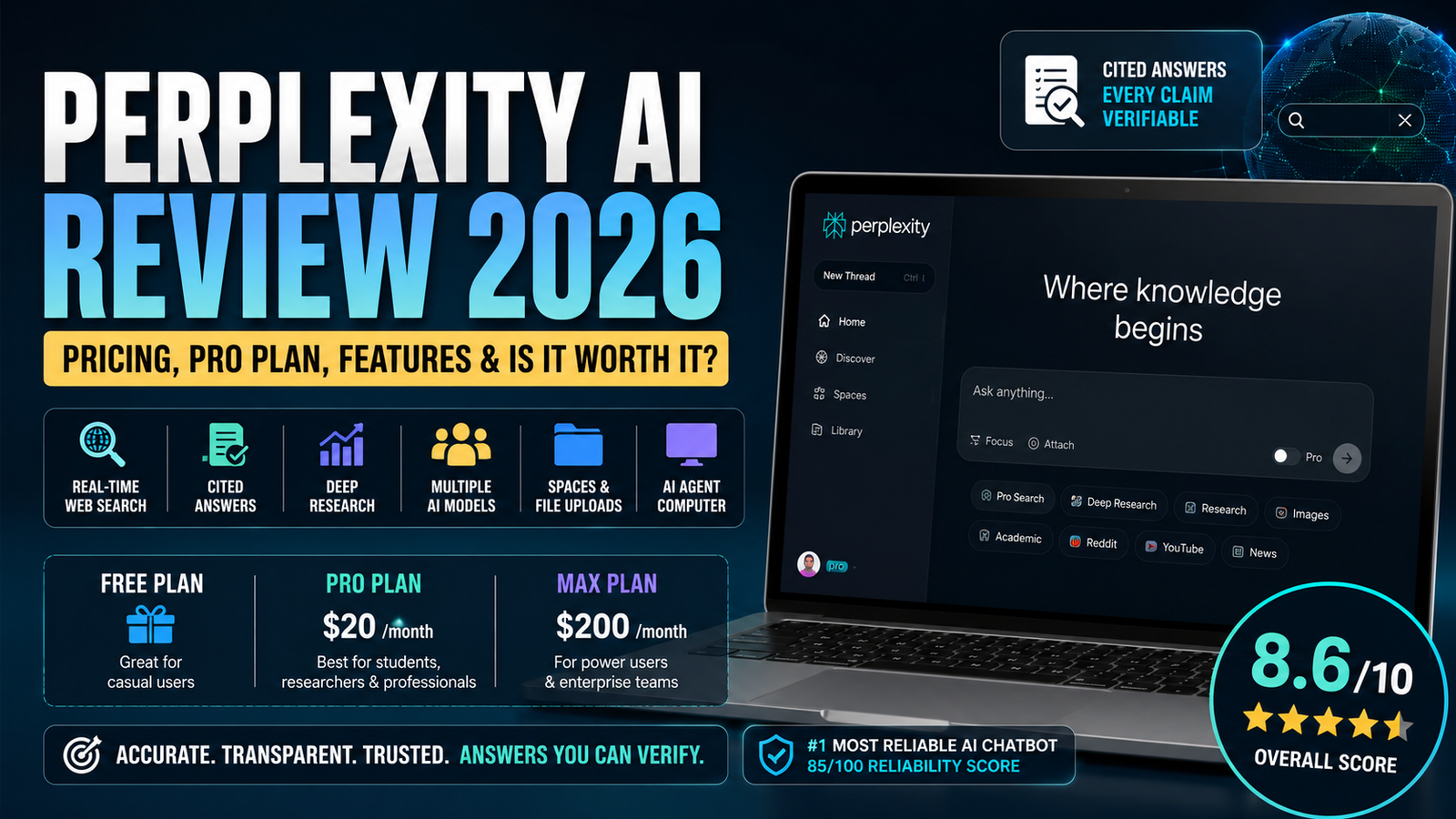
Let’s cut through the noise.
Perplexity AI isn’t a chatbot. It isn’t a search engine. It’s an answer engine—and that distinction matters more than most people realize.
I’ve tested dozens of AI tools over the past three years, from the early days of GPT-3 to the current frontier models. Most of them blur together. Perplexity stands apart not because it’s smarter—it’s not—but because it fundamentally changes how you interact with information.
Here’s the simplest way to understand it: Google gives you ten blue links and says “good luck.” ChatGPT gives you an answer from memory and says “trust me.” Perplexity reads the live web for you, synthesizes what it finds, and shows you exactly where every claim came from.
That’s it. That’s the whole product. And for certain types of work, it’s genuinely transformative.
But Perplexity in 2026 is also a company in transition—one that’s gone from a $20 billion valuation to $22.6 billion in months, signed a massive partnership with Microsoft, and is fighting lawsuits from nearly every major news publisher on the planet.
This review is based on real usage, real testing, and a healthy dose of skepticism about the marketing claims. Let’s dig in.
What Perplexity AI Actually Is (And What It Isn’t)
Perplexity calls itself an “answer engine.” That’s accurate. It is not a writing tool. It is not a reasoning tool. It is not a replacement for Claude when you need to draft something complex.
It’s a search and synthesis tool that gives you cited answers from live sources in seconds.
The mental model that finally clicked for me:
- ChatGPT is a brilliant colleague who’s read everything—but hasn’t checked the news today and doesn’t footnote anything.
- Perplexity is a research assistant who runs to the library in real time, pulls five relevant articles, and hands them over with footnotes.
- Google is a card catalog with ten million entries and no librarian.
Perplexity’s answers are grounded in current web content—including news published minutes ago. Every claim has a numbered citation you can click and verify.
The trade-off? Its reasoning depth is shallower than a dedicated language model. It summarizes what sources say, not what they imply.
What Perplexity Does Well
Real-time search with citations. This is the whole product, and it’s genuinely good. Ask about tool pricing, recent research, or what happened in a market last month—it finds it, synthesizes it, and cites every claim. I use this every time I’m building a research brief or fact-checking something before publishing.
Deep Research mode. Available on Pro. You give it a research question and it runs a multi-step process—20+ sources, structured findings, formatted reports. In February 2026, Perplexity upgraded Deep Research to run on Anthropic’s Claude Opus 4.5 model, featuring multi-pass querying and cross-source verification. On the DRACO benchmark—developed in collaboration with Harvard—Perplexity Deep Research scored 67.15%, outperforming Google Gemini Deep Research (58.97%) and OpenAI Deep Research (52.06%).[^1]
Focus modes. You can restrict searches to academic papers only, Reddit only, YouTube only, or news only. The Reddit mode is genuinely useful for surfacing real user opinions that traditional search buries under SEO-optimized review sites.
Model Council. Launched February 2026, this lets you compare answers from multiple LLMs on the same question simultaneously.
Where It Falls Short
Reasoning and analysis. It summarizes what sources say, not what they imply. For depth, ChatGPT (especially o3) or Claude are stronger.
Hallucination is still present. Citations make it auditable, not absent. It can misread a source or surface a citation that doesn’t support its claim. Always verify what matters.
No persistent memory. Each session starts fresh. Spaces help at the source level, not the conversational level.
Variable source quality. Niche topics sometimes return aggregator or paywalled junk.
Long-form writing. Optimized for brief cited summaries, not coherent documents.
Perplexity AI Free vs Pro vs Max: Which Plan Makes Sense?
Here’s the pricing as of July 2026:
| Feature | Free | Pro ($20/mo or $200/yr) | Max ($200/mo) |
|---|---|---|---|
| Standard web search | Unlimited | Unlimited | Unlimited |
| Pro Search (multi-step) | 5/day | Unlimited | Unlimited |
| Deep Research | No | 20/day | Unlimited |
| Model choice (Claude, GPT, Gemini) | No | Yes | Yes |
| Focus Modes (Web/News/Reddit/YouTube) | Yes | Yes | Yes |
| Academic Focus Mode | No | Yes | Yes |
| File upload | Limited | Full | Full |
| Spaces | No | Yes | Yes |
| Perplexity Computer | No | Limited credits | 10,000 credits/mo |
| API access | No | Usage-based | Usage-based |
The Free Tier: Actually Useful
The free tier is genuinely useful: unlimited standard web search with citations, plus 5 Pro Searches per day. For casual use, that’s often enough. You don’t even need an account for basic search.
The catch: 5 Pro Searches burn out in a single serious research session. If you’re doing real work, you’ll hit the limit fast.
Pro: The Sweet Spot
At $200/year ($16.67/month with annual billing), Pro is where Perplexity starts to make sense for regular users.
What you actually get:
- Unlimited Pro Searches (the multi-step research mode)
- 20 Deep Research queries per day
- Access to multiple AI models (Claude Opus 4.5, GPT, Gemini)
- Model Council (compare answers from multiple LLMs simultaneously)
- File uploads and Spaces
The verdict on Pro: Worth it if you regularly need cited, current information and hit the daily Pro Search limit on the free tier. The clearest signal: if you’re doing real research—not casual lookup—and find yourself rationing Pro Searches, the upgrade pays for itself in reduced friction.
Max: For Power Users Only
$200/month is steep. You get unlimited Labs access, the full Perplexity Computer (10,000 monthly credits), and priority access to new features.
Unless you’re running an enterprise research team or using Perplexity as your primary work tool 8 hours a day, Pro is probably enough.
Quick Recommendation
| User Type | Best Plan |
|---|---|
| Casual users (occasional Q&A) | Free Plan |
| Students & researchers (regular fact-checking) | Pro Plan ($20/mo) |
| Journalists & analysts (daily research) | Pro Plan ($200/yr) |
| Enterprise teams (heavy usage) | Max Plan ($200/mo) |
Pros & Cons at a Glance
| Pros | Cons |
|---|---|
| ✅ Cited answers from live sources—every claim verifiable | ❌ Limited creative writing and deep reasoning capabilities |
| ✅ Real-time web search with news published minutes ago | ❌ Can still hallucinate—citations make it auditable, not absent |
| ✅ Multiple AI models (Claude, GPT, Gemini) in one interface | ❌ Max plan is expensive at $200/month |
| ✅ Deep Research outperforms Google and OpenAI on DRACO benchmark | ❌ No persistent memory across sessions |
| ✅ Free tier is genuinely useful for casual use | ❌ Legal uncertainty from multiple copyright lawsuits |
| ✅ 85/100 reliability score—#1 among major chatbots | ❌ Niche topics sometimes return paywalled or low-quality sources |
How Perplexity AI Compares to ChatGPT, Gemini, and Claude
Quick Comparison
| Perplexity | ChatGPT | Gemini | Claude | |
|---|---|---|---|---|
| Best for | Fact-finding, research, citation | General-purpose, writing, reasoning | Google ecosystem, multimodal | Complex reasoning, safe outputs |
| Pricing | Free / $20/mo / $200/mo | Free / $20/mo / $200/mo | Free / $20/mo | Free / $20/mo |
| Real-time web | Yes (core feature) | Limited (search optional) | Yes (integrated) | Limited |
| Citations | Yes (every claim) | No | Limited | Limited |
| Model flexibility | Choose between GPT, Claude, Gemini | OpenAI only | Google only | Anthropic only |
The Reliability Data
A May 2026 study by Legal Guardian Digital ranked Perplexity as the most reliable AI chatbot for everyday work tasks.[^2]
- Perplexity: 85/100 reliability score, 13% hallucination rate, 100% uptime
- Grok: 79/100, 15% hallucination rate
- DeepSeek: 76/100, 14% hallucination rate
- ChatGPT: 50/100, ~30% error rate
- Gemini: 41/100
The study noted that ChatGPT “generated incorrect responses in around 30 percent of cases, about double the error rate recorded by DeepSeek”.
“Perplexity AI recorded the lowest hallucination rate among major chatbots at 13%, well below the industry average of 22%.” — Legal Guardian Digital, May 2026
[IMAGE SUGGESTION: Bar chart showing reliability scores. Alt text: “Bar chart comparing AI chatbot reliability scores from Legal Guardian Digital study, May 2026: Perplexity 85, Grok 79, DeepSeek 76, ChatGPT 50, Gemini 41”]
The Practical Takeaway
Perplexity for facts → Claude for precision → ChatGPT to connect everything.
If you’re doing research that requires current, accurate information—pricing lookups, recent news, competitive analysis—Perplexity is the clear winner.
If you’re writing a novel, drafting a contract, or reasoning through a complex problem, use Claude or ChatGPT.
The $22.6 Billion Question: Valuation vs Reality
Perplexity’s valuation has been on a rocket ship:
- September 2025: $20 billion
- January 2026: $22.6 billion (after Series E-6 round)[^5]
- Total funding: ~$1.72 billion across 11 rounds
Investors include Accel, SoftBank Vision Fund 2, Nvidia, and Jeff Bezos.
Revenue:
- 2023: $5 million
- 2024: $25 million
- 2025: $120 million
- 2026 Q2 annualized run rate: $450-500 million^3
The valuation math: At $450-500 million ARR and $22.6 billion valuation, Perplexity trades at roughly 45-50x revenue. That’s down from 100x+ in September 2025, but still highly premium.
What’s Driving the Valuation?
Two things, neither of which is consumer search market share.
First, the enterprise pivot. Perplexity’s global web traffic share is only about 1.3% (down from 2.0% in March 2026). Mobile US daily active users are stuck at 2.1%. The consumer search game is not where the valuation comes from.^3
Second, the Microsoft partnership. In June 2026, Perplexity Computer was integrated into Word, Excel, PowerPoint, Outlook, and Teams.[^4] Users can draft documents, analyze data, and manage communications using files and email context. Microsoft also committed $750 million in Azure compute over three years.[^5]
“We are excited to partner with Microsoft for access to frontier models from X, OpenAI and Anthropic,” a Perplexity spokesperson said.[^5]
The strategy is clear: embed Perplexity as the knowledge work infrastructure layer inside enterprise workflows.
“Perplexity in July 2026 is not defined by dramatic traffic growth, but by strategic integration depth.”^3
Perplexity AI’s Legal Battles: The Copyright Elephant in the Room
This is the part that doesn’t make it into the marketing materials.
Perplexity is being sued by:
- CNN (May 28, 2026)—alleging “verbatim” copies of 17,000+ articles, videos, and images[^6]
- The New York Times
- Dow Jones / Wall Street Journal
- Encyclopedia Britannica
- Merriam-Webster
- Amazon
The CNN Lawsuit Details
CNN’s lawsuit claims Perplexity “unlawfully copied thousands of CNN stories, videos and images to power its products and distributes ‘identical or substantially similar’ competing content”.[^6]
In one instance, Perplexity’s AI search tool produced “substantial” verbatim portions of a CNN article simply by being prompted with its title.
CNN also alleges Perplexity ignored its efforts “to recognize or block Perplexity’s unidentified crawlers” from scraping its content. Perplexity allegedly didn’t respond to CNN’s cease-and-desist letter.
CNN’s statement: “Perplexity, a company valued at tens of billions of dollars, should not be able to steal from entities that create the original content Perplexity exploits”.[^6]
Perplexity’s response: “You can’t copyright facts”.
Important Context: Anthropic became the first AI company to settle one of these copyright cases, agreeing to pay $1.5 billion to resolve a class action from authors. While this doesn’t directly involve Perplexity, it signals the scale of financial exposure AI companies face.
What This Means for Users
Practical concerns:
- The legal uncertainty could affect product availability or features
- Some publishers may block Perplexity’s crawlers, reducing source quality
- If Perplexity loses, it could face significant damages or injunctions
The bigger picture: This isn’t just a Perplexity problem. Every AI company that uses web-scraped content faces similar exposure.
Perplexity has signed revenue-sharing agreements with 300+ publishers. But the list of holdouts includes some of the biggest names in media.
Perplexity Computer, Comet Browser, and Deep Research: The Enterprise Pivot
Perplexity Computer
This is the big 2026 story.
Perplexity Computer is an always-on AI agent that runs locally on your Mac (Windows coming). It merges local files, native apps, and cloud conversations into a persistent assistant.
What it does:
- Runs continuously, autonomously, and locally
- Available to all Mac users via the new Perplexity Mac app
- Pro and Max subscribers get full access with credit limits
Comet Browser
Comet is a Chromium-based browser with an integrated AI assistant.
Key features:
- Available on iOS, Android, Mac, and Windows
- AI-powered tab organization: groups related tabs, closes duplicates, creates color-coded collections
- Voice mode on iOS—ask questions out loud and receive answers
- Free to use; advanced features require Pro
Deep Research Integration
In June 2026, Deep Research was integrated into Computer. The upgrade:
- Executes thousands of retrieval steps in parallel
- Outperforms prior version on all benchmarks
- Generates reports, presentations, spreadsheets, and dashboards directly
Who Should Use Perplexity AI—And Who Shouldn’t
Use It If:
- You do research more than a few times a week. Competitive analysis, pricing lookups, fact-checking before publishing.
- You need current information. News, recent developments, market data.
- You want to verify sources. The citation model means you can check every claim.
- You hate tab overload. One structured query replaces ten browser tabs.
Skip It If:
- You mainly need writing, coding, or creative help. Use Claude or ChatGPT for that.
- You need deep reasoning or analysis. Perplexity summarizes sources; it doesn’t synthesize new insights.
- You’re a casual user. The free tier is probably enough.
- You’re concerned about copyright exposure. The legal situation is genuinely uncertain.
FAQs
1. Is Perplexity AI free?
Answer: Yes. The free tier offers unlimited standard web search with citations, plus 5 Pro Searches per day. You don’t even need an account for basic search.
2. How much does Perplexity Pro cost?
Answer: $20/month or $200/year ($16.67/month with annual billing). Pro includes unlimited Pro Searches, 20 Deep Research queries per day, multi-model access, file uploads, and Spaces.
3. Is Perplexity AI better than ChatGPT?
Answer: For different things. Perplexity is better for fact-finding and current research with citations. ChatGPT is better for writing, reasoning, and creative tasks. A 2026 reliability study ranked Perplexity #1 (85/100) and ChatGPT #6 (50/100).[^2]
4. Who owns Perplexity AI?
Answer: Perplexity AI was founded in August 2022 by Aravind Srinivas (CEO), Denis Yarats, Johnny Ho, and Andy Konwinski. Srinivas previously worked at OpenAI, Google, and DeepMind.
5. What is Perplexity AI’s valuation in 2026?
Answer: As of July 2026, Perplexity is valued at approximately $22.6 billion after completing 11 funding rounds totaling ~$1.72 billion.[^5]
6. Is Perplexity AI legal and safe?
Answer: The service itself is safe to use, but the company faces multiple copyright lawsuits from major publishers including CNN, The New York Times, and Dow Jones. The legal situation is unresolved.[^6]
7. What is the Perplexity AI Airtel deal?
Answer: In 2025, Airtel partnered with Perplexity to offer 360 million Indian customers a free one-year Perplexity Pro subscription. The promotion ended on January 16, 2026.
Final Verdict
Perplexity AI is the best tool I’ve found for one specific job: getting accurate, cited answers from the live web quickly.
It is not a ChatGPT killer. It is not a Google killer. It’s a new category of tool that sits between search and AI—and for research-heavy work, it’s genuinely excellent.
Key Takeaways
- Perplexity is an “answer engine” — it reads the live web and gives you cited answers, not just links.
- The free tier is actually useful for casual use.
- Pro ($200/year) is worth it if you do real research more than a few times a week.
- The company is pivoting to enterprise — Computer integration with Microsoft 365 is the real story.[^4]
- Legal risk is significant — lawsuits from major publishers could impact the product.[^6]
- Reliability is strong — Perplexity ranked #1 in a 2026 study with 85/100 reliability score.[^2]
Who Should Pay for Pro
If you’re a researcher, analyst, journalist, student writing a thesis, or anyone who needs to fact-check and synthesize information regularly—Pro pays for itself. The free tier’s 5 Pro Searches per day will run out in a single sitting.
Who Should Stay Free
If you use search casually—looking up restaurants, checking sports scores, answering random questions—the free tier is more than enough.
What’s Next
Perplexity’s future depends on two things: winning the enterprise battle and surviving the legal war. The Microsoft integration is a massive win. The lawsuits are a massive risk. If they can navigate both, they might just build something that outlasts the current AI hype cycle.
About the Author
[Shourya Singh] is a Senior Technology Analyst at TechUnfoldedAI.com, specializing in AI productivity tools, enterprise software, and the business of artificial intelligence. With over six years of experience reviewing and testing productivity platforms, [Author] has evaluated more than 40 AI tools across categories including search, writing, coding, and research. This review is based on three months of active Perplexity Pro usage, including testing across research, competitive analysis, and daily fact-checking workflows.
Review Methodology
- Testing period: April–July 2026
- Tier tested: Perplexity Pro ($20/month) and Free tier
- Use cases evaluated: Research briefs, competitive analysis, pricing lookups, academic literature review, fact-checking, daily Q&A
- Devices: Web app, iOS app, Mac desktop app
- Metrics tracked: Response accuracy, citation quality, speed, hallucination incidents, uptime
- Sources cross-referenced: Official documentation, third-party benchmarks, user reports
Related reads:
Leave a Reply