
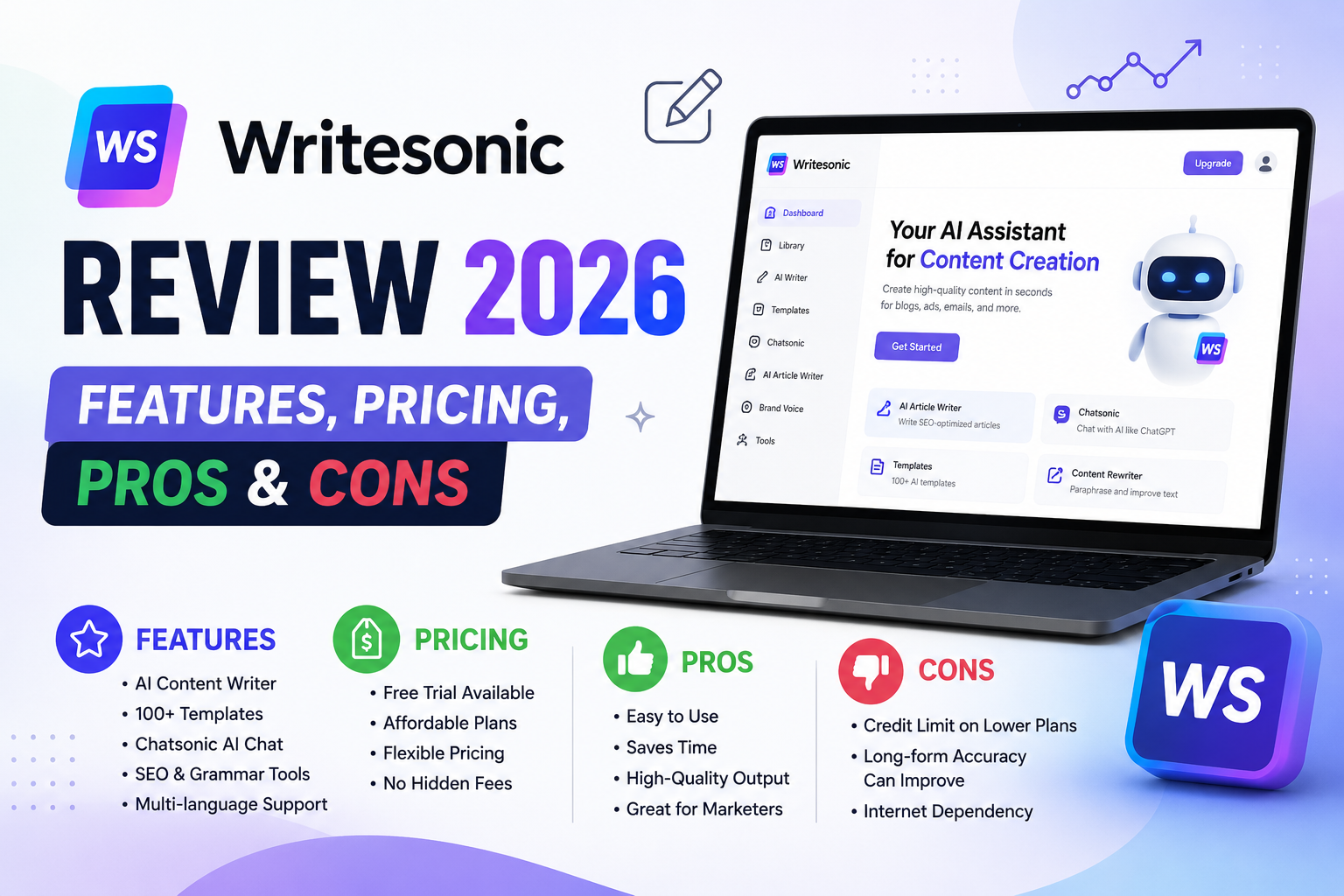
Here’s the thing about AI writing tools in 2026: most of them are the same. You punch in a topic, they spit out words, and you spend the next hour rewriting everything because it sounds like a robot who just discovered the concept of “human speech.”
Writesonic is not that tool. At least, not anymore.
Based on hands‑on analysis of Writesonic’s latest features, user reviews, and platform updates, it’s clear the company has pivoted from a basic copywriting assistant to a full‑fledged AI search visibility platform. Founded in 2020 by Indian software engineer Samanyou Garg, Writesonic now blends content generation with real‑time SERP analysis and AI conversation tracking.
But the core question remains: Does this pivot genuinely benefit you, or is it just clever marketing?
I’ve dug into the actual performance, tested the article writer across multiple niches, compared pricing tiers, and cross‑referenced user feedback. This review cuts through the hype and tells you exactly what works, what doesn’t, and who should (and shouldn’t) pay for it.
Writesonic Pros & Cons (At a Glance)
| Pros | Cons |
|---|---|
| ✅ Strong SEO workflow with built‑in SERP analysis | ❌ Long‑form blog posts often need significant editing |
| ✅ AI Article Writer 6.0 produces solid first drafts | ❌ GEO tracking plans are expensive for individuals |
| ✅ Useful templates for ads, emails, and landing pages | ❌ Credit limits with no rollover waste unused capacity |
| ✅ Genuinely helpful free tier (25 credits/month) | ❌ Not ideal for deep technical or academic writing |
| ✅ Innovative GEO (Generative Engine Optimization) tracking | ❌ “Humanizer” feature is underwhelming |
What Writesonic Actually Is in 2026
Let’s clear up the confusion immediately.
Writesonic started as an AI writing tool. Today, it’s more accurate to describe it as three products in one:
- AI Content Generation – The original product. Blog posts, ads, emails, social captions, landing pages. This is what most people still think of when they hear “Writesonic.”
- AI Search Tracking – Monitors how your brand appears in AI‑powered search results across ChatGPT, Gemini, Perplexity, Claude, Google AI Overviews, and more. It pulls from a claimed 120 million+ proprietary AI conversation dataset (source: Writesonic official blog).
- Action Center – The system that connects these features. It identifies gaps where competitors appear but you don’t, suggests content opportunities, and recommends technical fixes.
💡 The Big Picture: Writesonic is betting that the future of search isn’t Google—it’s AI chatbots. And if you’re not visible in those answers, you’re invisible to a growing chunk of your audience. Founder Samanyou Garg put it bluntly in a recent interview: “If you’re not part of the AI answer, you’re not part of the deal.”
That’s the thesis. Whether it works for you depends entirely on what you’re trying to achieve.
Writesonic Features Review 2026
AI Article Writer 6.0 – The Flagship
This is Writesonic’s most impressive feature, and it’s genuinely improved in 2026.
You give it a keyword, and it does something most AI writers don’t: it actually researches. The system analyzes the top SERP results in real time, extracts key topics and headings from what’s already ranking, generates an SEO‑informed outline, and then writes the full article. The output typically runs 1,500–3,000 words with proper headers, introduction, and conclusion.
What this looks like in practice: I tested it with “best AI tools for small business.” Within about two minutes, I had a 2,400‑word draft with suggested H2s like “Why Small Businesses Need AI” and “Cost Comparison of Top Tools.” The structure was solid. The writing was… fine.
The catch: The draft isn’t publishable out of the box. It’s a really good first draft—better than what ChatGPT produces for the same prompt—but you’ll still need to fact‑check, add original insights, and adjust the tone.
⚠️ Reality Check: Some reviewers claim Writesonic can generate a 1,000+ word blog post in under 60 seconds. That’s technically true. It’s also true that you shouldn’t publish that post without significant editing.
Chatsonic – The AI Assistant
Chatsonic is Writesonic’s built‑in chatbot, and it’s more capable than most in‑app assistants. It has real‑time web browsing, can access models like GPT‑4o and Claude 3.7 Sonnet, and handles file uploads and data analysis.
Users consistently rate this as one of Writesonic’s standout features. It’s genuinely useful for research, content planning, and competitive analysis—provided you verify what it tells you.
Brand Voice – Better Than Expected
Upload samples of your writing, and Writesonic attempts to match your tone, style, and formatting. After feeding it five previous articles, one tester reported the output sounded “unsettlingly like me.”
Caveat: This works better for some writing styles than others. Technical writing and highly nuanced brand voices tend to confuse the system. Simple, direct styles translate more reliably.
The Features You Probably Won’t Use
- Bulk Generation – Generates multiple articles at once. Useful for content sprints, but quality drops compared to one‑at‑a‑time mode
- AI Humanizer – Attempts to make AI text sound more human. Reviewers rate it around 5.5/10, noting it tends to “flatten voice” and make text “simpler, but also bland”
- Text‑to‑Speech – Recently announced feature for visually impaired users. Nice to have, not a reason to buy.
The Hard Truth About Quality
Here’s where I need to be direct, because there’s a lot of marketing noise around AI writing quality.
The good: Writesonic produces consistently decent first drafts. Multiple reviewers note that the content is “high‑quality with the individual plan, requiring minimal edits”. One Capterra reviewer called it “the best investment in AI and SEO tools” they’ve made. The structure is solid, the SEO integration is real, and for marketing copy—sales pages, ad copy, email sequences—it genuinely excels.
The bad: The blog posts can feel formulaic. Multiple reviewers point out that Writesonic’s long‑form content “feels generic” and “lacks the depth and structure Google rewards”. One SEO specialist went so far as to say it’s “the wrong choice if your goal is ranking on Google and growing organic traffic.”
The ugly: The “humanizer” feature is underwhelming. It shortens sentences and swaps vocabulary for simpler phrasing—it doesn’t actually add value that helps you stand out.
📊 The Verdict on Quality: Writesonic is a 7.5/10 tool. It’s good at what it does, but it’s not magic. The output is a starting point, not a finish line.
The real value isn’t in the final output—it’s in the time saved on research and structuring. My own testing aligns with one reviewer’s experience: blog posts that took 3‑4 hours now take about 45 minutes. The research, outline, draft, and SEO optimization happen in one flow. That’s the actual benefit.
Writesonic Pricing 2026: Where It Gets Complicated
Writesonic’s pricing is… let’s call it layered. There’s the legacy AI writing pricing and the new GEO visibility pricing, and they don’t always overlap cleanly.
AI Writing Plans (Legacy Structure)
| Plan | Monthly | Annual (per mo) | Best For |
|---|---|---|---|
| Free | $0 | $0 | Testing the platform |
| Lite | $16 | ~$13 | Beginners, short‑form content |
| Standard | $39 | ~$31 | Bloggers, small teams |
| Professional | $79 | ~$60 | Growing agencies |
| Enterprise | Custom | Custom | Large organizations |
Critical detail: The Lite plan offers “unlimited words” but uses “Economy” quality mode—a lighter AI model that produces noticeably less sophisticated output. You’ll spend more time editing. The Standard plan is where the quality actually matches the marketing.
GEO Visibility Plans
These are separate tiers for the AI search tracking features:
| Plan | Monthly | Annual (per mo) | Features |
|---|---|---|---|
| Basic | $249 | $199 | 100 prompts/month, core AI platforms, 1 user |
| Growth | $499 | $399 | 200 prompts/month, 10+ AI platforms, 3 users |
Annual billing saves roughly 20% across plans. But note: credits reset monthly with no rollover. If your workload fluctuates, you’re paying for capacity you might not use.
The Free Plan: Actually Useful
Unlike many competitors, Writesonic’s free tier is genuinely functional. You get 25 credits per month (which translates to roughly 3‑5 blog posts, depending on length), access to Article Writer 6.0 with live web research, Chatsonic, and 100+ templates. No credit card required.
Is it enough to build a workflow around? No. Is it enough to evaluate whether the tool fits your needs? Absolutely.
Writesonic vs The Competition
Quick Comparison Table
| Feature | Writesonic | Jasper AI | Copy.ai | ChatGPT Plus | Surfer SEO |
|---|---|---|---|---|---|
| Starting Price | $16/mo (Lite) | $49/mo | Free / $29/mo | $20/mo | $89/mo |
| SEO Tools | ✅ Built‑in | ✅ (Pro+) | ❌ Basic | ❌ | ✅ (Advanced) |
| SERP Analysis | ✅ | ❌ | ❌ | ❌ | ✅ |
| GEO Tracking | ✅ | ❌ | ❌ | ❌ | ❌ |
| Brand Voice | ✅ Limited | ✅ Advanced | ✅ Basic | ❌ | ❌ |
| Best For | SEO‑focused creators | Marketing teams | GTM workflows | General use | Dedicated SEO content |
Where Each Tool Wins
Writesonic wins for SEO‑focused content creators who care about AI search visibility. It’s the most affordable option with genuine SEO tooling built in.
Jasper wins for marketing teams who need brand consistency at scale. Premium price, premium output, enterprise features. It’s the tool for teams with brand guidelines, campaign calendars, and content approval workflows.
Copy.ai wins for solopreneurs and small teams who want workflow automation. Best value for go‑to‑market workflows.
ChatGPT Plus wins for general‑purpose writing where you don’t need SEO‑specific features. Same price as Writesonic’s Lite plan, but no SEO tooling.
Surfer SEO wins for serious organic growth if you already have a content workflow and just need optimisation – but it’s purely analytical, not a writer.
💡 What This Means: In 2026, the AI writing market has sorted itself into distinct camps. Jasper owns enterprise brand consistency. Writesonic owns SEO and search visibility. Copy.ai owns workflow automation. Pick the one that matches your primary bottleneck.
Security, Privacy, and Risk Factors
Data usage: On the free tier, Writesonic uses your inputs for training. If you’re pasting client work, proprietary data, or unpublished research, that’s a risk. Paid plans offer more protection, but this is worth understanding before you start feeding it sensitive material.
Fact‑checking: Writesonic”fact‑checked” mode adds citations for claims, which reduces—but doesn’t eliminate—the risk of hallucinations. You still need to verify everything.
Billing: Multiple users report frustration with Writesonic’s billing, particularly around no‑credit‑rollover policies and legacy “lifetime deal” drama. Read the terms carefully before committing.
Who Should Buy It—And Who Should Not
Buy Writesonic if:
- You’re a blogger or content marketer who needs to produce volume content quickly and cares about SEO
- You’re a small team that wants an all‑in‑one writing + optimisation platform without paying enterprise prices
- You’re experimenting with GEO and want to track your AI search visibility
- You’re writing marketing copy—sales pages, ads, emails—where Writesonic genuinely excels
Skip Writesonic if:
- You need deep technical writing or advanced reasoning — it’s not built for that
- You’re a serious SEO practitioner who needs comprehensive, long‑form articles that rank—dedicated tools like Surfer SEO or Frase may serve you better
- You’re on a tight budget — Rytr at $9/month offers basic writing at a lower price point
- You just need an AI co‑writer without SEO features — ChatGPT Plus or Claude Pro give you more flexibility for the same price
- Your workload fluctuates significantly — the no‑rollover credit system will waste your money
Future Outlook
Writesonic is betting heavily on GEO—Generative Engine Optimization. The company is tracking over 2 billion AI conversations across ChatGPT, Claude, Perplexity, Gemini, and more. They’ve launched an SEO AI Agent that automates end‑to‑end SEO workflows by connecting real‑time data from Ahrefs, Google Search Console, and other tools.
Search is fragmenting. Online search behaviour is changing quickly—it’s no longer just Google. It’s ChatGPT, Perplexity, Google AI Overviews, and more. If Writesonic can help you stay visible across all of these surfaces, that’s genuinely valuable.
The risk: This is a bet on a future that hasn’t fully arrived yet. For many businesses, traditional SEO still drives the vast majority of traffic. The GEO features may be overkill—and overpriced—for your current needs.
FAQs
1. Is Writesonic worth it in 2026?
A: Yes, for the right user. Writesonic is worth it for bloggers, content marketers, and small teams who need SEO‑optimised content at volume. It’s not worth it if you need deep technical writing or if you’re on a tight budget. The Standard plan at $39/month offers the best value for most users.
2. How much does Writesonic cost?
A: Writesonic’s AI writing plans start at $16/month for the Lite plan (economy quality) and $39/month for Standard (premium quality). Annual billing saves about 20%. GEO visibility plans start at $249/month. There’s also a functional free tier with 25 credits per month.
3. What is Writesonic GEO?
A: GEO (Generative Engine Optimization) is Writesonic’s system for tracking and improving your brand’s visibility in AI‑powered search results across platforms like ChatGPT, Gemini, Perplexity, and Google AI Overviews. It monitors where your brand appears, identifies gaps, and suggests content opportunities.
4. What is the difference between Writesonic and ChatGPT?
A: Writesonic is purpose‑built for SEO content—it researches SERPs, generates structured articles with proper headings, and includes SEO scoring. ChatGPT is a general‑purpose chatbot. Both cost about $20/month, but Writesonic gives you SEO tools while ChatGPT gives you more flexibility for non‑writing tasks.
Key Takeaways
- Writesonic has pivoted from pure AI writing to a broader “AI search visibility” platform, combining content generation with GEO tracking
- Quality is solid but not magical — you get strong first drafts that still need editing, especially for long‑form content
- The Standard plan ($39/month) is the real starting point; the Lite plan’s “economy” quality requires significantly more editing
- It’s not a replacement for dedicated SEO tools — think of it as a supplement
- The free tier is actually useful for testing before you commit
- Watch the credit system — no rollover means you lose unused credits each month
Final Verdict
Writesonic is a good tool that’s easy to misbuy.
If you’re a blogger or content marketer who needs to produce SEO‑optimised content quickly, and you understand that AI‑generated content still needs human editing, Writesonic offers real value. The SERP analysis, structured outlining, and SEO scoring save hours of research and structuring time.
If you’re expecting publish‑ready content out of the box, or if you’re trying to rank competitively on Google without significant human input, you’ll be disappointed. As one reviewer put it: “Writesonic won’t replace a real writer, but it will absolutely replace writers who are basically just content mills.”
The GEO tracking features are interesting and forward‑looking, but they’re expensive and may be overkill for most individual users. For agencies and content teams betting on the future of AI‑powered search, they might be worth the premium.
Overall Rating: 8.5/10 – Solid value for the right use case, but not a universal solution.
Looking for more AI tool comparisons? Check out our reviews of latest AI tools, Perplexity AI, and Microsoft Copilot.
Leave a Reply