
Students nowadays have to filter through vast information overload. It quickly becomes chaotic trying to keep track of notes, textbooks, PDFs, lectures & videos from various sources and practice questions & revision material. This is where the learning tools based on artificial intelligence were very helpful.
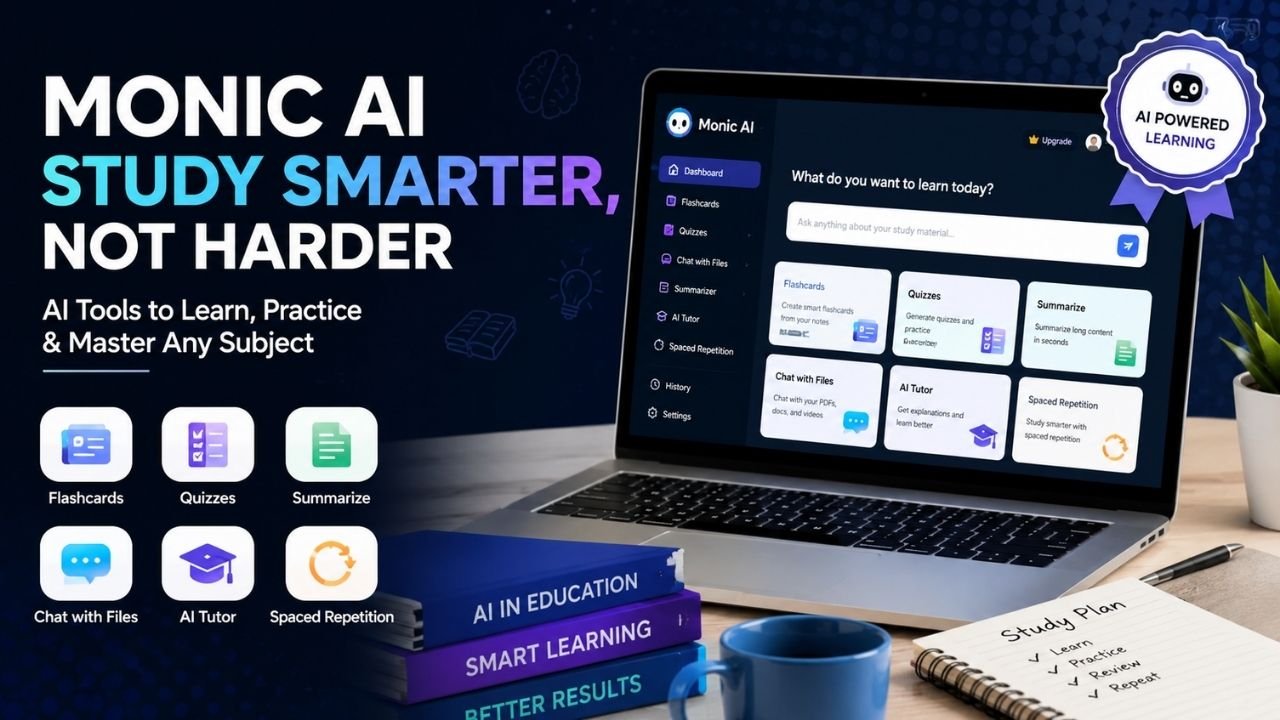
Monic AI was developed as a one-stop-learning-hub to make studying much simpler. It offered users the opportunity to bring many of these activities into one with no need for separate apps for summaries, flashcards, quizzes, document questions and revision.
The platform is well known for making study materials disappear into creativity, learning resources. You could upload documents, create flashcards, take quizzes, summarize long content and ask questions about the files to which you make them available. It had multilingual support and other tools designed to help students better revise.
But there is one crucial thing to know for anyone looking up the platform in 2026: Monic AI discontinued its service on March 7, 2026. In an announcement, it claims to have supported over 100,000 learners in just under two years of operation.
What Was Monic AI?
Monic AI was an artificial intelligence-powered learning platform built for students, educators, and people who wanted to learn independently.
Its main idea was simple: give the platform your learning material and let its AI turn that material into useful study resources.
For example, a student could upload a PDF containing a chapter of biology notes. Instead of manually creating dozens of questions, the platform could analyze the material and generate flashcards or a quiz.
The platform also allowed users to interact with uploaded material. Its Chat with Files feature was designed to work like an AI tutor, allowing users to ask questions about documents and receive explanations. The platform stated that responses could include references to the relevant page in the uploaded material.
This made the service particularly interesting for students who had large amounts of material but limited time for revision.
Why Did Students Use Monic AI?
The biggest attraction was convenience.
Traditional studying often requires several separate steps:
- Read the material.
- Find the important points.
- Write notes.
- Create questions.
- Make flashcards.
- Test yourself.
- Review weak areas.
Monic AI attempted to combine many of these tasks into one learning environment.
Its tools included flashcard creation, quiz generation, summarization, document conversations, AI explanations, exam-style practice, spaced repetition, and other study functions. The company’s own feature pages described support for documents, videos, audio, YouTube content, images, and handwritten notes.
The idea was not to replace studying. Rather, it was designed to reduce the amount of manual preparation required before studying could begin.
Main Features of Monic AI
1. AI Flashcard Generator
One of the platform’s most recognizable features was its flashcard maker.
Users could provide text, PDFs, or other study documents, and the system could create flashcards from the material. Different question formats were available, including multiple-choice, fill-in-the-blank, and true-or-false questions.
The platform also promoted spaced repetition. The basic idea behind spaced repetition is to review information at suitable intervals instead of repeatedly reading the same material in one sitting.
This can make revision more structured, particularly when a student has hundreds of facts to remember.
2. Quiz Generator
Another important feature was the quiz generator.
Users could upload study material and generate questions from it. The platform described options for interactive practice as well as timed examination simulations.
This was useful because reading notes alone does not tell a student whether they can actually remember the information.
A quiz changes the process from passive reading to active recall.
For example, instead of reading a history chapter three times, a student could read it once and then use generated questions to identify which parts they remembered and which areas needed another review.
3. Chat With Files
The Chat with Files feature was designed to turn uploaded material into an interactive source of answers.
A user could upload a PDF, document, lecture material, YouTube video, or other supported content and ask questions about it. According to the platform, the system could provide answers based on the uploaded material and reference the relevant page.
This could be particularly helpful when studying complicated subjects.
For example, a student reading a long research paper could ask:
- What is the main argument?
- Explain this concept in simple language.
- What are the important findings?
- Where does the document discuss this topic?
The purpose was to make large documents easier to understand.
4. AI Summarizer
Long documents can be difficult to read when time is limited. Monic AI offered a summarization tool designed to reduce lengthy material into shorter explanations.
Its official page described support for PDFs, DOCX files, audio, YouTube videos, images, and handwritten notes. It also offered different summary styles and claimed support for more than 100 languages.
This could help students get an initial understanding of a long document before reading it in detail.
However, summaries should never automatically be treated as perfect replacements for original educational material. AI systems can misunderstand context, omit important details, or produce incorrect statements.
For important academic work, checking the original source remains essential.
5. Support for Many Languages
Language support was another notable part of the platform.
The company stated that several of its learning tools could work with more than 100 languages. This included flashcards, quizzes, summaries, and document conversations.
This was useful for learners who did not study exclusively in English.
A student could potentially work with source material in one language and create learning resources in another, depending on the feature being used.
6. Exam Simulation
The platform also included exam-oriented practice.
Rather than simply generating individual questions, its broader feature set included exam simulation and practice modes. This gave students a way to test themselves under conditions that were closer to an actual examination.
For students preparing for competitive exams or university tests, this type of practice can be more useful than simply rereading notes.
7. Spaced Repetition
Spaced repetition was another important part of the learning experience.
The platform’s flashcard material described an algorithm intended to determine suitable times for reviewing cards.
The basic principle is straightforward. Information that is repeatedly recalled over increasing intervals can become easier to remember over time.
This is particularly valuable for subjects involving terminology, definitions, formulas, dates, vocabulary, or factual information.
Monic AI Pricing
Pricing changed over the platform’s lifetime, so old articles about its plans should be treated carefully.
At one stage, the platform used a token-based system. Its official explanation described a free Monic Basic allocation of 2,500 tokens, while other plans included larger monthly token allowances. The company explained that token consumption could vary depending on the type and complexity of the task.
An older comparison published by the company also listed a free option and a paid plan around $10 per month.
| Plan information | What was reported |
|---|---|
| Basic | Free access with an initial token allocation |
| Paid plans | Larger token allowances and additional capabilities |
| Token system | Usage depended on the task and material |
| Flashcard maker | Previously available with a free account |
| Quiz generator | Previously offered free access |
| Current availability | Service ended March 7, 2026 |
How Monic AI Was Used for Studying
When the service was active, the general workflow was relatively simple.
Step 1: Add Study Material
A student could upload a document or provide supported learning content.
This could include class notes, PDFs, documents, or other supported media.
Step 2: Select a Learning Tool
The student could choose what they wanted to create.
For example:
- Flashcards
- Quiz
- Summary
- Questions and answers
- Study explanations
- Other practice material
Step 3: Review the Generated Material
The AI would analyze the supplied material and create the requested content.
This step was important because AI-generated material was not guaranteed to be perfect.
Step 4: Practice
Students could then use the generated resources for revision, recall, and testing.
The goal was to turn ordinary study material into something more interactive.
Read Also: AI Flashcard Maker / NVIDIA AI
Benefits of Monic AI
There were several reasons the platform attracted learners.
It Saved Preparation Time
Creating flashcards and practice questions manually can take hours. Automating part of that process could give students more time to actually study.
It Worked With Different Types of Material
The platform supported more than simple text. Its tools were designed to work with documents and several forms of multimedia content.
It Combined Several Learning Tools
Instead of moving between separate applications, users could access multiple study functions from one platform.
It Supported Active Recall
Quizzes and flashcards encouraged students to retrieve information rather than simply reread it.
It Was Useful for Different Learners
The platform was aimed not only at school and university students but also at educators and independent learners.
Limitations of Monic AI
Despite its useful features, the platform had limitations.
AI Can Make Mistakes
Artificial intelligence can generate incorrect answers. A confident-looking explanation is not necessarily a correct one.
This matters especially in subjects such as medicine, law, science, finance, and other areas where small mistakes can have serious consequences.
Generated Flashcards May Need Editing
AI can identify important information, but it may not always understand exactly what a teacher or examination board considers important.
Students should review generated cards before relying on them.
Summaries Can Remove Context
A short summary is convenient, but shortening a document can remove examples, qualifications, evidence, or important details.
The Service Is No Longer Available
This is now the biggest limitation.
The company announced that it was closing the platform and that its service would end on March 7, 2026.
Therefore, people searching for a working Monic AI account or current subscription should understand that the original service is no longer available.
What Happened to Monic AI?
This is one of the most important questions for anyone discovering the platform today.
According to the company’s official announcement, the service closed after approximately two years and more than 100,000 learners had used it.
The company explained that building the platform had been rewarding but that it needed to make difficult decisions about where to focus its resources. As a result, it decided to close Monic AI.
The company also gave users an opportunity to request an export of their study materials before the March 7, 2026 service-ending date.
So, if you find older articles saying that Monic AI is available for free or offering a paid subscription, remember that those pages may describe the platform before its closure.
Is Monic AI Still Available in 2026?
No. The original Monic AI service ended on March 7, 2026.
This distinction is important because many older pages can still appear in search results describing its features and plans.
The company’s current website presents a closing message rather than an active learning service and confirms the March 7, 2026 end date.
Therefore, you should not purchase a subscription or expect the original platform to operate as it did before the shutdown.
Read More: DeepMind Google / Qwen AI / Cohere AI
Was Monic AI Good for Students?
When it was active, Monic AI offered a strong collection of study tools in one place.
Its biggest strength was convenience. A student could start with a PDF or another piece of study material and turn it into several forms of revision content.
The platform was particularly useful for students who struggled with preparing flashcards and practice questions manually.
However, it worked best as a study assistant, not as a replacement for teachers, textbooks, or original sources.
The quality of the result depended partly on the quality of the material supplied to the system and on the student’s willingness to check the generated information.
Who Could Benefit From Monic AI?
When the platform was operating, it could be useful for:
- School students
- College and university students
- Teachers
- Researchers
- Independent learners
- Language learners
- People preparing for examinations
- Professionals learning new subjects
Its broad content support and multiple learning formats made it flexible for different types of study.
Monic AI vs Traditional Studying
Traditional studying usually requires students to manually organize their material.
For example, a student might spend one hour reading a chapter, another hour writing notes, and additional time creating questions and flashcards.
Monic AI attempted to reduce this preparation work.
| Traditional approach | Monic AI approach |
|---|---|
| Manually create flashcards | Generate flashcards from material |
| Write practice questions | Generate quizzes |
| Read long documents first | Create summaries |
| Search through documents | Ask questions about uploaded files |
| Manually organize revision | Use structured practice tools |
What Should Students Learn From the Monic AI Story?
The platform’s closure highlights an important point about digital learning tools.
A useful service can disappear, change ownership, change pricing, or stop operating. Students should therefore avoid keeping their only copy of important notes or study materials inside an online platform.
Keeping original PDFs, notes, flashcards, and important documents in a separate location is a sensible habit.
The Monic AI team itself encouraged users to request an export of their study materials before the service ended.
Conclusion
Monic AI was a powerful learning platform that combined flashcards, quizzes, summaries, document conversations, and more all in one place. What made it handy for students and educators alike was its capability to transform pre-existing learning material into interactive resources.
Its biggest fact that makes it distinct in the field of importance is that Monic AI will not be an active service until 2026. On March 7, 2026, the company put out an official notice that it had closed down the platform after serving over 100,000 learners.
Those looking into the platform today can indeed still learn valuable insights from its dimensions and past—but six-month-old claims regarding present pricing, subscription service, or number of accounts active should not be taken as serious fact.
The story of Monic AI is a cautionary tale of modern learning technology: powerful tools can greatly improve the study process, but students should always hold onto their primary source of information and double-check important data.
Frequently Asked Questions
Q. What is Monic AI?
Monic AI was an artificial intelligence-powered learning platform that provided tools such as flashcard creation, quiz generation, document chat, summarization, AI explanations, and study practice.
Q. Is Monic AI free?
During its operating period, Monic AI offered free access alongside paid options. Its pricing also used a token-based system at one stage. However, the service ended on March 7, 2026, so there is no current subscription to purchase.
Q. Why did Monic AI shut down?
The company said it had to make difficult decisions about where to focus its energy and ultimately decided to close the service.
Q. Did Monic AI create flashcards?
Yes. Flashcard generation was one of its main features. Users could provide study material and generate different types of flashcards from it.
Q. Could Monic AI generate quizzes?
Yes. Its quiz generator could create questions from uploaded learning material and offered interactive practice and examination-style simulations. Yes. Its quiz generator could create questions from uploaded learning material and offered interactive practice and examination-style simulations.
Leave a Reply