

Nanotechnology is one of the most exciting areas of modern science. It allows scientists and engineers to work with materials at an extremely small scale—so small that it is measured in nanometers. By controlling matter at this level, researchers can create new materials and devices with unique properties.
In this article, we will clearly explain what is nano technology, how it works, its important applications, benefits, challenges, and its future potential. The explanation is written in simple language so that anyone can easily understand the topic.
Introduction to Nano Technology
Before understanding what is nano technology, it is important to understand the term nano. The word “nano” comes from the Greek word meaning dwarf or very small. In science, nano represents one billionth of a meter.
To understand this size better:
- A human hair is about 80,000–100,000 nanometers thick
- A DNA molecule is about 2.5 nanometers wide
- A nanoparticle may be 1–100 nanometers in size
Nano technology focuses on designing, creating, and using materials and devices at this nanoscale.
What is Nano Technology?
Nano technology is the branch of science and engineering that deals with manipulating matter at the nanoscale (1–100 nanometers) to create materials, devices, and systems with new and improved properties.
At this scale, materials behave differently compared to their normal size. Their strength, electrical conductivity, chemical reactivity, and optical properties can change significantly. Scientists use these unique behaviors to develop advanced technologies.
Understanding what is nano technology helps us see how modern innovations in medicine, electronics, energy, and environmental science are becoming possible.
Key Features of Nano Technology
Nanotechnology has several unique characteristics that make it different from traditional technologies.
| Feature | Explanation |
| Extremely small scale | Works with particles between 1–100 nanometers |
| Unique material properties | Materials show new electrical, optical, and chemical behaviors |
| High surface area | Smaller particles have a larger surface area compared to their volume |
| Precision control | Scientists can manipulate atoms and molecules |
| Wide applications | Used in medicine, electronics, agriculture, and energy |
These characteristics explain why learning what is nano technology is important for understanding the future of science and industry.
Basic Concepts of Nano Technology
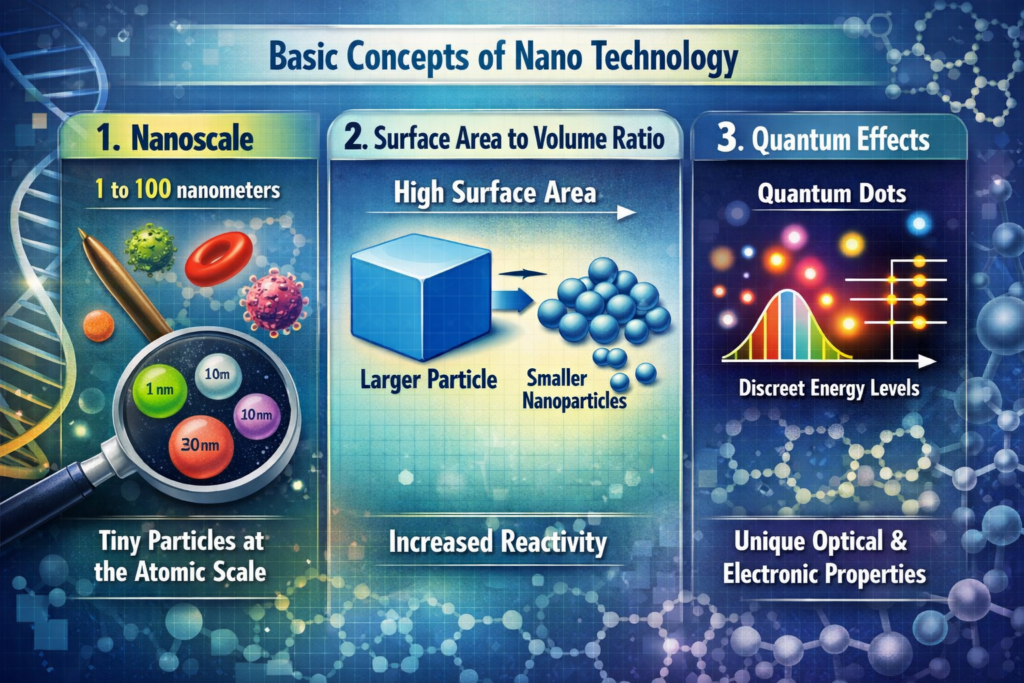
To fully understand what is nano technology, we must look at some of the key scientific concepts behind it.
1. Nanoscale
The nanoscale refers to materials that have at least one dimension between 1 and 100 nanometers.
At this scale, physical and chemical properties may change dramatically.
2. Surface Area to Volume Ratio
When materials become extremely small, their surface area increases compared to their volume.
This makes them:
- More chemically reactive
- Better catalysts
- More efficient in chemical reactions
3. Quantum Effects
At nanoscale, quantum physics begins to influence the behavior of materials.
This can affect:
- Electrical conductivity
- Color and optical properties
- Magnetic behavior
These effects are one of the reasons why understanding what is nano technology is important for modern scientific research.
Types of Nanomaterials
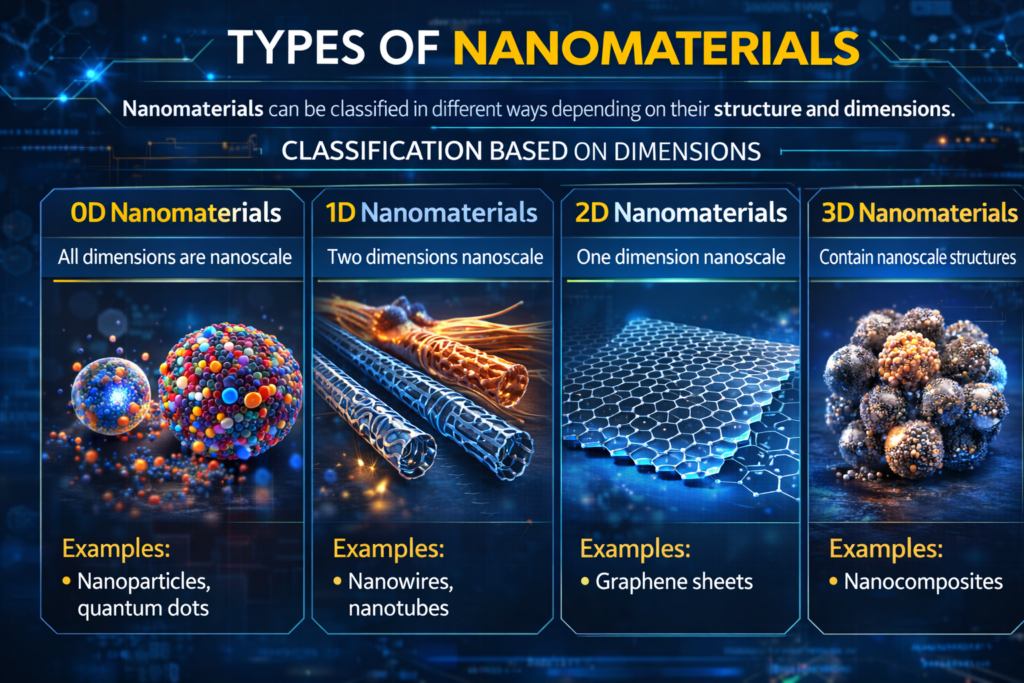
Nanomaterials can be classified in different ways depending on their structure and dimensions.
Classification Based on Dimensions
| Type | Description | Examples |
| 0D Nanomaterials | All dimensions are nanoscale | Nanoparticles, quantum dots |
| 1D Nanomaterials | Two dimensions nanoscale | Nanowires, nanotubes |
| 2D Nanomaterials | One dimension nanoscale | Graphene sheets |
| 3D Nanomaterials | Contain nanoscale structures | Nanocomposites |
These nanomaterials are essential in many industries and help explain what is nano technology in practical terms.
Read More: How to Make Money with AI in 2026 / What Is Artificial Intelligence
Methods Used in Nano Technology
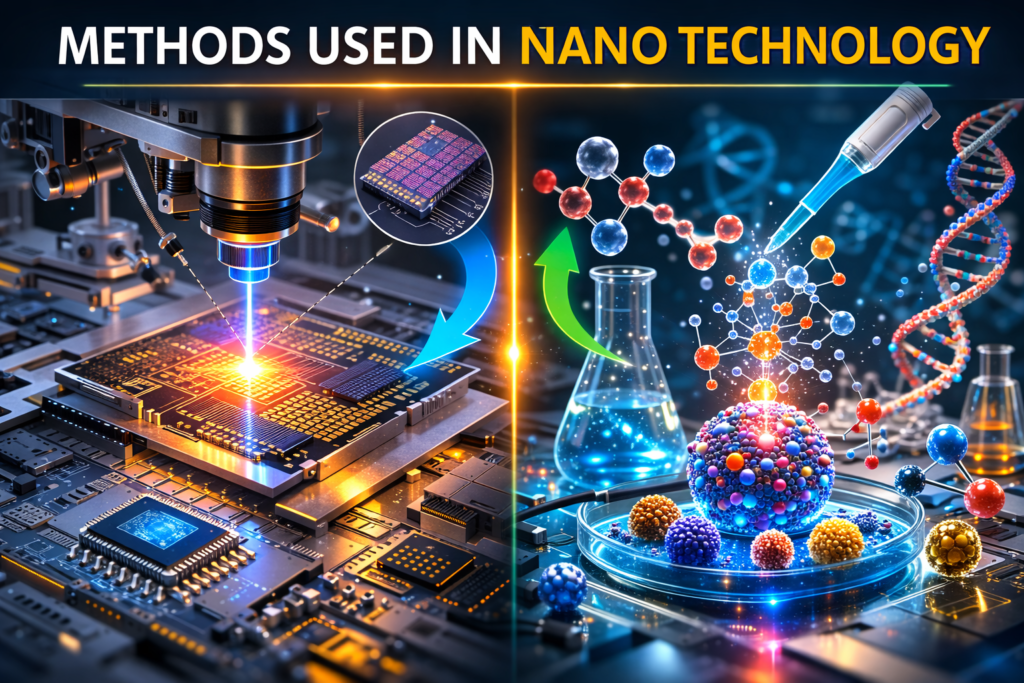
Scientists use two main approaches to create nanoscale materials and devices.
1. Top-Down Approach
In this method, larger materials are broken down into nanoscale structures.
Examples include:
- Lithography techniques
- Semiconductor manufacturing
- Microchip fabrication
2. Bottom-Up Approach
In this method, materials are built atom by atom or molecule by molecule.
Examples include:
- Chemical synthesis
- Molecular self-assembly
- Nanoparticle formation
Both methods are essential for understanding what is nano technology and how nanoscale products are manufactured.
Applications of Nano Technology
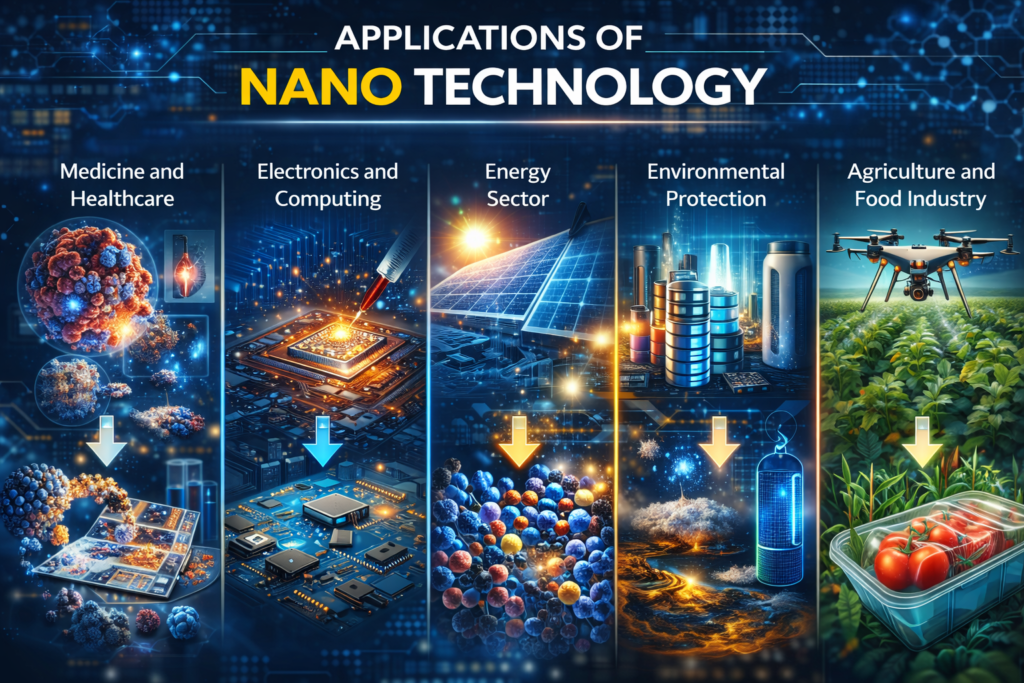
One of the main reasons scientists study what is nano technology is because of its wide range of applications across many industries.
1. Medicine and Healthcare
Nanotechnology is transforming modern medicine.
Important applications include:
- Targeted drug delivery
- Cancer treatment
- Medical imaging
- Tissue engineering
- Antibacterial coatings
For example, nanoparticles can deliver medicines directly to diseased cells, reducing damage to healthy cells.
2. Electronics and Computing
Nanotechnology helps create smaller, faster, and more powerful electronic devices.
Applications include:
- Nanochips
- High-performance processors
- Advanced sensors
- Quantum computing
Many modern electronic devices rely on nanoscale components.
3. Energy Sector
Nanotechnology improves energy production and storage systems.
Examples include:
- High-efficiency solar panels
- Advanced batteries
- Hydrogen fuel storage
- Energy-efficient lighting
These innovations help reduce energy consumption and environmental impact.
4. Environmental Protection
Another important area where we see the importance of what is nano technology is environmental protection.
Applications include:
- Water purification filters
- Pollution control systems
- Oil spill cleanup materials
- Air purification technologies
Nanomaterials can remove contaminants from water and air more effectively than traditional materials.
5. Agriculture and Food Industry
Nanotechnology is also improving agricultural productivity.
Applications include:
- Nano-fertilizers
- Smart pesticides
- Food packaging materials
- Crop monitoring sensors
These technologies help increase crop yields while reducing environmental damage.
Advantages of Nano Technology
Nanotechnology offers several important benefits.
| Advantage | Explanation |
| Improved medical treatments | More effective drug delivery systems |
| Stronger materials | Lightweight but highly durable materials |
| Energy efficiency | Better batteries and solar cells |
| Environmental protection | Improved pollution control technologies |
| Advanced electronics | Smaller and faster computing devices |
These advantages show why scientists are actively studying nano technology and investing in its development.
Challenges and Risks of Nano Technology
Despite its benefits, nanotechnology also presents certain challenges.
1. Health Concerns
Some nanoparticles may enter the human body through inhalation or skin contact. Their long-term effects are still being studied.
2. Environmental Impact
Nanoparticles released into the environment could affect ecosystems.
3. High Production Cost
Manufacturing nanoscale materials requires advanced technology and expensive equipment.
4. Regulation and Safety
Governments and scientists are still developing safety standards and regulations for nanotechnology products.
Understanding these challenges is important when studying nano technology and its real-world impact.
Future of Nano Technology
Nanotechnology is expected to play a major role in the future of science and technology.
Some possible future developments include:
- Nanorobots for medical surgeries
- Self-healing materials
- Advanced renewable energy systems
- Ultra-fast computers
- Smart materials that change properties automatically
Researchers believe that nanotechnology could drive the next industrial revolution.
As technology continues to evolve, the importance of understanding that will become even greater.
Conclusion
Nanotechnology is a powerful scientific field that focuses on controlling matter at the nanoscale. By working with particles between 1 and 100 nanometers, scientists can develop materials and devices with unique and improved properties.
Learning what is nano technology helps us understand how modern innovations in medicine, electronics, energy, and environmental science are being developed. While there are challenges related to safety and regulation, the potential benefits of nanotechnology are enormous.
In the coming decades, nanotechnology is likely to transform many industries and significantly improve the quality of human life.
FAQs About Nano Technology
1. What is nano technology?
Ans: Nano technology is the science of working with extremely small materials at the nanoscale (1–100 nanometers).
2. Why is nano technology used?
Ans: It is used to create stronger materials, better medicines, and faster electronic devices.
3. Where is nano technology used?
Ans: Nano technology is used in medicine, electronics, energy, agriculture, and environmental protection.
4. What are nanomaterials?
Ans: Nanomaterials are very small materials that have at least one dimension between 1 and 100 nanometers.
5. Is nano technology important for the future?
Ans: Yes, nano technology can help develop advanced technologies and improve many industries.
For regular update’s about the AI, AI Tools, AI Guide, Technology & More. Visit, The TechUnfoldedAi.com.
Leave a Reply