
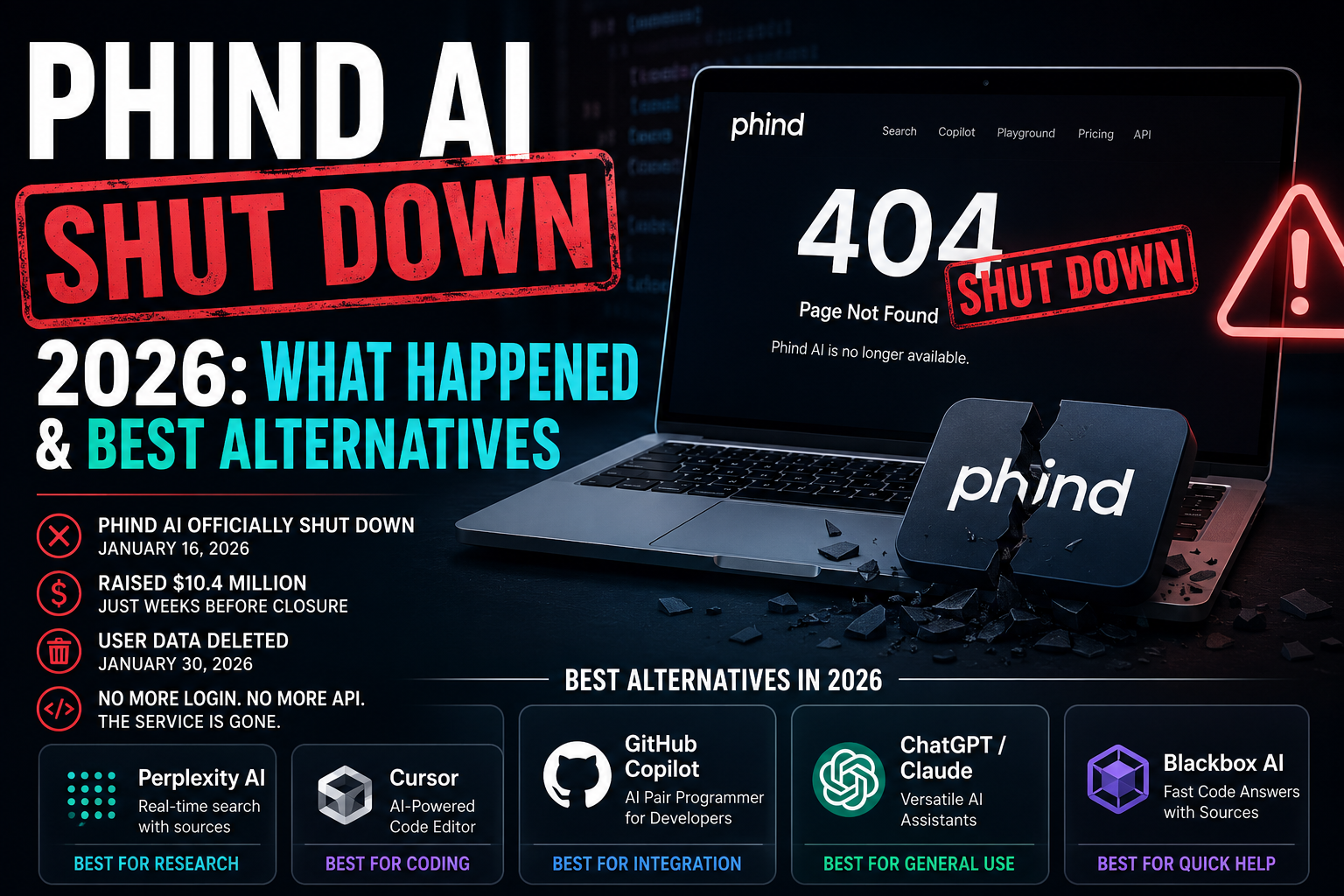
Phind AI shut down permanently on January 16, 2026. The website returns a 404 error. There is no login, no signup, no API, and no product.
If you’re searching for “Phind AI” hoping to use it—stop. It doesn’t exist anymore.
The company raised $10.4 million in a Series A round disclosed on December 3, 2025. Six weeks later, the service went dark. No closure statement. No migration path. No warning.
This isn’t just another startup failure. It’s a case study in how fast the AI landscape moves—and how brutal it can be for specialized tools when the giants catch up.
What Phind AI Actually Was
For those who missed it, Phind was an AI-powered search engine built specifically for developers. It combined live web search with code-aware language models to deliver cited, source-linked answers to programming questions.
Here’s what made it different:
- Code-first output: Answers came as runnable code blocks with inline explanations, not citation-heavy prose.
- Real-time web search: Unlike ChatGPT’s then-limited browsing, Phind pulled live documentation, Stack Overflow threads, and GitHub issues.
- Source citations: Every claim linked back to its origin.
- VS Code extension: You could query Phind directly from your editor.
- Proprietary fine-tuned models: Phind-70B and Phind-405B, plus the open-weight Phind-CodeLlama-34B-v2.
Reddit users described it as “Stack Overflow plus AI.” It was the tool you reached for when you needed a working code snippet, not a philosophical discussion about what code could be.
The Timeline: From $10.4M to 404 in Six Weeks
This is the part that still doesn’t make sense.
Six weeks. From a fresh $10.4 million war chest to a 404 page.
The company issued automatic refunds to paid subscribers. But for everyone else—developers who had built workflows around Phind, teams that had integrated the API, users with years of chat history—there was nothing.
No data export. No transition period. No explanation.
Why Phind AI Failed
Let’s be clear: Phind didn’t fail because it was a bad product. It failed because its competitive advantage evaporated.
The Moat That Wasn’t
Phind’s advantage was cited, developer-focused search at a time when general chatbots couldn’t browse the web.
That gap closed fast.
- ChatGPT added web search and significantly improved its code reasoning.
- Claude became a legitimate coding assistant.
- Perplexity expanded its research capabilities.
- Cursor and GitHub Copilot ate into the same developer workflow.
By late 2025, Phind was competing with products that had larger user bases, deeper pockets, and broader capabilities.
The Narrower Moat Problem
Phind did one thing well: code search with citations. But “one thing well” stopped being enough when general-purpose tools started doing that and everything else.
As one post-mortem analysis put it, Phind’s advantage was a “narrow moat around a feature the larger assistants had absorbed.”
The Unanswered Questions
There are still things we don’t know:
- Did the funding round come with unrealistic expectations?
- Was there an acquisition that fell through?
- Did the team simply run out of runway faster than anticipated?
Phind never published a closure statement. The silence is telling.
What Developers Lost
Phind’s shutdown wasn’t just about losing a tool. It was about losing:
- Chat history and account data—permanently deleted with no export option
- A VS Code extension that actually worked
- Cited, verifiable answers with sources you could trust
- A search experience that filtered out marketing content and content farms
For developers who relied on Phind daily, this was disruptive. One senior dev on Reddit noted they’d been using Phind as a “great addition to my toolset” —and then it was just… gone.
Phind AI vs. The Competition: A Reality Check
Let’s compare Phind to where the market actually stood in 2026. These numbers come from head-to-head testing before the shutdown:
| Metric | Phind | Perplexity Pro | ChatGPT (GPT-5) |
|---|---|---|---|
| Best for | Code search & debugging | Research & citations | General AI + coding |
| Actionability | 13.1/15 | 12.4/15 | N/A |
| Paste-ready code | 92% | 78% | N/A |
| Response time | 1.9s | 4.2s | Varies |
| Context window | 32K tokens | Varies | 128K tokens |
| Source citations | Always | Always | No (default) |
| VS Code integration | Native | Limited | Third-party |
| Multimodal | No | Yes | Yes |
Phind won on speed and code quality. It was faster (1.9 seconds vs. 4.2) and produced more paste-ready code (92% vs. 78%).
But Perplexity won on accuracy (94% vs. 83%) and risk handling (89% vs. 31%).
ChatGPT won on everything else—context window, multimodal, ecosystem.
The trade-off was clear: Phind was a specialized tool that outperformed on its narrow focus. But narrow focus became a liability.
Best Phind AI Alternatives in 2026
Here’s where developers should go now, based on what they actually need:
1. Perplexity AI — Best for Research-Heavy Work
Perplexity is the closest replacement for Phind’s cited, source-linked answers. It’s built for research workflows with robust citation tracking.
Best for: Architecture decisions, learning new concepts, staying updated with tech trends
Pricing: Free tier available; Pro at ~$20/month
Trade-off: Slower response time, less code-focused output
2. Cursor — Best for In-Editor Coding
Cursor is an IDE with AI that actually knows your codebase. If you used Phind primarily from VS Code, Cursor is the natural replacement.
Best for: Active coding, debugging, refactoring
Pricing: Free / ~$20/month
Trade-off: Weaker web sourcing, no citation tracing
3. GitHub Copilot — Best for Autocomplete
If you want AI suggestions as you type, Copilot is still the standard.
Best for: Code completion, repetitive tasks
Pricing: ~$10-19/month
Trade-off: No citation tracing, less useful for “search” queries
4. ChatGPT / Claude — Best for General Coding Help
Both have added web search and strong code reasoning. For most developers, these are now “good enough” for what Phind did.
Best for: General coding questions, debugging, explanation
Pricing: Free tiers available; Pro at ~$20/month
Trade-off: Citations not always included; less specialized
5. Blackbox AI — Best for Code Snippet Search
Blackbox AI is an advanced AI coding platform with real-time voice interaction and GPU acceleration. It scored 78/100 in a head-to-head comparison vs. Phind’s 81/100.
Best for: Code snippet search, learning new languages
Pricing: Freemium
Trade-off: Less polished UX than Phind
The One Thing That Survives
Phind-CodeLlama-34B-v2 remains available on Hugging Face.
This open-weights model achieves 73.8% pass@1 on HumanEval—meaning it correctly solves 73.8% of coding problems on the first try.
It’s proficient in Python, C/C++, TypeScript, Java, and more, fine-tuned on 1.5 billion tokens of programming problems and solutions.
Who should use it:
- Developers who want to run a code-focused model locally
- Teams building custom AI coding tools
- Anyone who wants to avoid vendor lock-in
Who shouldn’t:
- Anyone expecting a hosted, maintained product (it’s just weights)
- Non-technical users who can’t set up local LLMs
The model survives. The product doesn’t.
The Bigger Picture: What Phind’s Death Tells Us About AI
1. Specialization Is Risky in a Rapidly Converging Market
Phind did one thing well. When the generalists caught up, the specialist became redundant.
The lesson: If your entire value proposition is one feature that a larger player can copy, you’re on borrowed time.
2. Funding Doesn’t Equal Safety
$10.4 million in fresh funding six weeks before shutdown. This isn’t a company that ran out of money. This is a company that—for reasons we still don’t fully understand—decided (or was forced) to pull the plug.
The lesson: Funding is oxygen, not a guarantee of survival.
3. User Data Is Fragile
Phind deleted all user data on January 30, 2026. No export. No warning beyond two weeks.
The lesson: Never build critical workflows around a startup’s proprietary platform without a backup plan.
4. “AI Hype Is Slowing Down”
As one developer forum put it: “‘AI’ hype finally slows down—looks like people are starting to see that LLM would not do literally everything.”
Phind’s shutdown isn’t isolated. The AI tools market is consolidating. The winners are the ones with distribution, not just differentiation.
FAQs
1. Is Phind AI still available?
2. Why did Phind AI shut down?
3. Can I still use Phind-CodeLlama-34B-v2?
A: Yes. The open-weights model remains available on Hugging Face. It achieves 73.8% pass@1 on HumanEval and is proficient in Python, C/C++, TypeScript, Java, and more.
4. What’s the best alternative to Phind AI?
5. Did Phind AI issue refunds?
A: Yes. The team issued automatic prorated refunds to all paid subscribers on January 16, 2026.
Final Verdict
Phind AI was a great product that launched at the wrong time.
It solved a real problem—cited, verifiable code answers with sources you could trust—and it solved it well. But the window for specialized AI tools is closing fast. The generalists have caught up, and they have deeper pockets, larger teams, and bigger distribution.
Who should have used Phind:
- Developers who needed fast, cited code answers
- Teams that wanted a search-first coding assistant
- Anyone frustrated with Stack Overflow’s signal-to-noise ratio
Who should avoid Phind now:
- Everyone. It doesn’t exist anymore.
The bottom line: Phind is dead. The model lives on. And the lesson for every AI startup is clear: if your moat is narrow, the tide is coming.
For regular updates about the AI, AI tools, AI guides, technology & more. Visit, The TechUnfoldedAi.com.
Read next: Latest AI Tools | How to Use AI in Daily Life | 10 Free AI Tools for 2026 | Perplexity AI | DeepSeek AI
Leave a Reply