
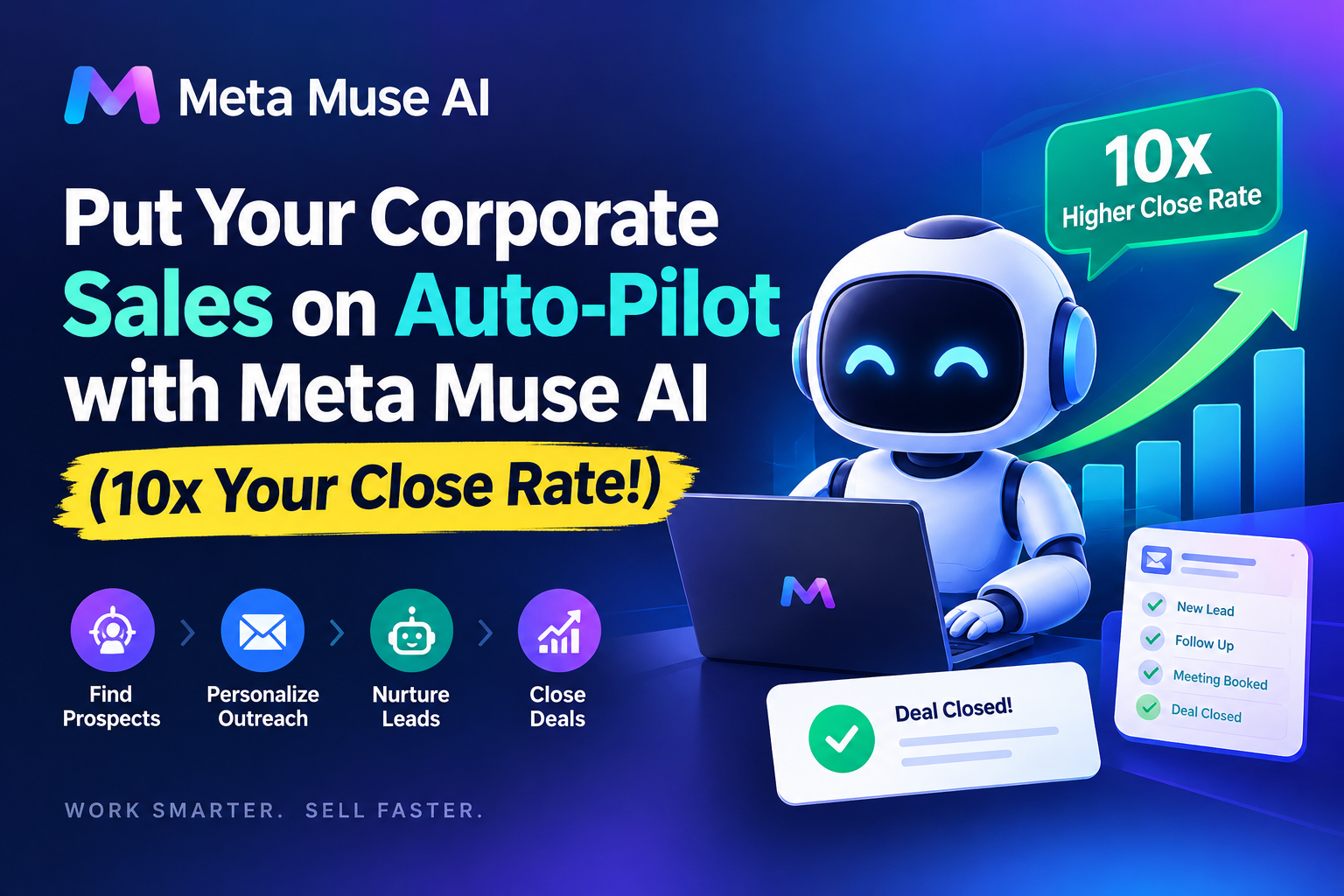
In corporate sales, time is revenue. Yet, according to industry benchmarks, the average B2B sales representative spends only one-third of their day actually selling. The rest of their time is swallowed by administrative quicksand: logging data into CRMs, chasing cold prospects over email, drafting pitch decks, and conducting manual competitor research.
To solve this, modern enterprises are shifting towards autonomous automation. If you want to streamline your pipeline, learning how to use Meta Muse AI corporate sales frameworks is the absolute best way to eliminate manual bottlenecks.
Launched by Meta as an agentic AI ecosystem powered by advanced Muse Spark large language models, this system is not just another chatbot that spits out generic templates. It is a fully functional AI agent that operates inside its own cloud-based virtual machine, meaning it can browse the web, navigate business applications, and execute complex, multi-step sales workflows autonomously—even after you close the app.
The Key Difference: Chatbots vs. Meta Muse AI Corporate Sales Agents
Before diving into automation workflows, it is crucial to understand why using Meta Muse AI corporate sales agents succeeds where traditional AI assistants fall short.
| Feature | Traditional AI Chatbots | Meta Muse AI Agent |
|---|---|---|
| Operational Model | Passive: You ask, it answers. It cannot take actions outside its chat box. | Active: You give it an objective, and it independently drafts plans and executes tasks across multiple steps. |
| System Infrastructure | Runs inside a shared web interface; stops processing when you log off. | Runs on a dedicated, isolated Muse Secure VM in Meta’s cloud to continuously work 24/7. |
| Software Integrations | Limited to copy-pasting text or direct API webhooks. | Natively connects to business systems like Slack, Zoom, Notion, QuickBooks, Asana, and Shopify. |
| Execution Method | Suggests text for a sales email but cannot open your inbox to send it. | Connects to your email, opens a secure browser session, drafts the message, and prepares it for transmission. |
4 Power Workflows for Meta Muse AI Corporate Sales Automation
1. Fully Autonomous Competitor Funnel Audits
Understanding a prospect’s market positioning is a prerequisite for a successful corporate pitch, but deep-diving into competitors takes days. When running a Meta Muse AI corporate sales setup, the agent handles this comprehensively in minutes.
- The Workflow: Instruct Muse to execute a competitor funnel breakdown. It will autonomously visit competitor websites, sign up for their corporate email newsletters, add test items to digital carts to trigger abandoned cart sequences, and log the entire journey.
- The Output: Muse captures screenshots of each step and aggregates the data into a clean competitor funnel presentation deck, instantly giving your sales reps custom insights for their next discovery call.
2. Auto-Pilot B2B Lead Scraping and Trend Analysis
Finding the right point of contact within an enterprise accounts for hundreds of wasted hours. By tying Meta Muse AI corporate sales strategies into your professional networks and databases, you can outsource lead enrichment completely.
- The Workflow: You can instruct Muse to parse industry-specific groups, forum dialogue, or platform data to identify persistent pain points associated with target corporate accounts.
- The Output: Muse extracts exact feedback text, maps those problems to decision-makers, and constructs an action-ready lead spreadsheet in connected apps like Notion or Asana.
3. Hyper-Personalized Cold Outreach Calendars
Generic bulk emailing yields abysmally low conversion rates. A dedicated Meta Muse AI corporate sales workflow remedies this by using deep contextual awareness of your brand voice, offerings, and past account success stories.
- The Workflow: Ask Muse to analyze your historically successful sales campaigns alongside your current pipeline goals.
- The Output: It crafts a complete multi-week outreach schedule. It writes context-aware, highly personalized email hooks tailored to the exact corporate targets you are pursuing, staging them inside your connected communication hubs.
4. Overwhelmed Triage and Automated Alerts
For enterprise sales managers, a cluttered inbox results in missed deal opportunities. A smart Meta Muse AI corporate sales environment acts as an administrative buffer to keep deals moving smoothly.
- The Workflow: Tell Muse you are entering a high-volume sales cycle. It scans your email traffic, calendars, and project pipelines to flag urgent incoming requests, like contract modification inquiries or scheduling conflicts.
- The Output: It filters out the noise, surfaces high-priority items that need immediate attention, and auto-drafts responses for your approval so you never drop a warm deal.
Enterprise-Grade Safety: Total Control Over Your Deals
A primary concern when deploying AI agents into corporate pipelines is security. Nobody wants an autonomous agent sending unauthorized pricing adjustments or purchasing random software licenses without supervision.
Meta built the Meta Muse AI corporate sales architecture with strict corporate safeguards to ensure you remain fully in control:
- The Human-in-the-Loop Protocol: By default, Meta enforces a strict policy—nothing goes live without your explicit approval. Muse will pull the data, open the browser, draft the text, or structure the pitch, but it stands down until you review the audit trail and tap “Approve”.
- Sentinel Safety Architecture: Inside the cloud infrastructure, an isolated security protocol called Sentinel watches over the Muse agent. Sentinel prevents the AI from leaking proprietary corporate data, viewing system passwords, or accessing unapproved domains.
- Isolated Ad and Data Pipelines: Your enterprise interaction history, client records, and strategic conversations with Muse remain confidential. They are entirely ring-fenced from Meta’s public advertising algorithms.
How to Get Started with Muse Automation
Deploying a Meta Muse AI corporate sales plan into your sales pipeline requires zero complex coding. You can initiate the process through a few simple configuration steps:
- Access the Interface: Open the dedicated desktop client or navigate to the official platform portal via Meta Muse AI.
- Train Your Agent: Provide the agent with clear documentation regarding your corporate offerings, pricing metrics, target customer profiles, and brand tone guidelines.
- Map the Connectors: Authorize connections to your operational stack, including communication hubs (Slack, Zoom), productivity boards (Asana, Notion), and standard sales communication channels.
- Deploy the First Objective: Start with a bounded, highly actionable task: “Analyze our past five corporate pitch decks alongside our main competitor’s current landing page. Draft an updated 4-stage cold email outreach sequence targeting enterprise CTOs.”
By letting Meta Muse AI corporate sales workflows absorb the exhausting legwork of prospecting, data sorting, and pipeline logistics, your sales team can step out of the spreadsheets and back into the boardroom—where they can focus exclusively on building human relationships and closing deals.
Leave a Reply