
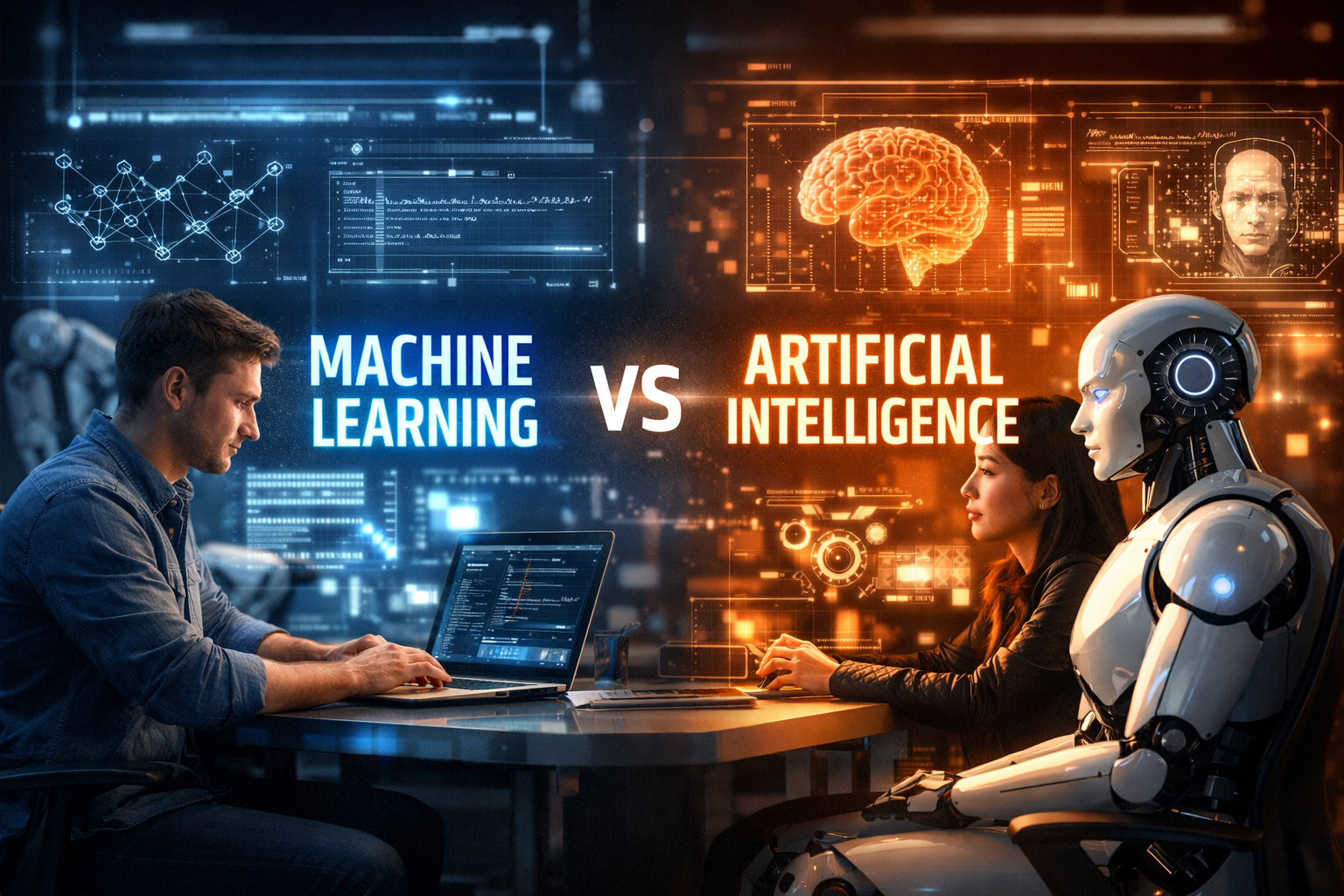
In the modern digital world, technologies are growing very fast. Two of the most discussed technologies today are machine learning v artificial intelligence. Many people use these terms together, and sometimes they think both mean the same thing. However, they are closely related but not identical.
Artificial intelligence is a broader field that focuses on creating machines that can simulate human intelligence. Machine learning is a part of artificial intelligence that allows systems to learn from data and improve their performance automatically.
Understanding machine learning v artificial intelligence helps businesses, developers, and students learn how modern technology works behind applications such as voice assistants, recommendation systems, fraud detection, and self-driving vehicles.
In this detailed guide, we will explain artificial intelligence, machine learning, their differences, applications, advantages, and real-world examples in a simple and easy way.
What is Artificial Intelligence?
Artificial Intelligence (AI) is a branch of computer science that focuses on creating intelligent machines capable of performing tasks that normally require human intelligence.
These tasks include:
- Learning
- Decision-making
- Problem-solving
- Understanding language
- Recognizing images
AI systems try to mimic human thinking and behavior using algorithms and data.
Example of Artificial Intelligence
Some common examples of AI include:
- Voice assistants like Siri or Alexa
- Self-driving cars
- Recommendation systems on Netflix or YouTube
- Smart chatbots
- Facial recognition systems
Artificial intelligence uses different technologies such as machine learning, deep learning, and natural language processing to make machines smarter.
Key Features of Artificial Intelligence
| Feature | Description |
|---|---|
| Automation | AI can perform tasks automatically without human help |
| Decision Making | AI systems analyze data and make smart decisions |
| Learning Ability | AI systems improve over time |
| Problem Solving | AI can solve complex problems |
| Pattern Recognition | AI identifies patterns in data |
Artificial intelligence focuses on building systems that behave intelligently in different situations.
Read More: Microsoft Bing: Features, History, and How It Works
What is Machine Learning?
Machine learning is a subset of artificial intelligence. It allows computers to learn from data without being explicitly programmed for every task.
Instead of writing fixed rules, developers train machine learning models using data. These models then find patterns and make predictions.
This concept is a key part when understanding machine learning v artificial intelligence, because machine learning represents a specialized area within AI.
Example of Machine Learning
Examples of machine learning include:
- Email spam filters
- Product recommendations
- Stock market prediction
- Image recognition
- Fraud detection
Machine learning algorithms analyze large amounts of data and learn patterns automatically.
Key Features of Machine Learning
| Feature | Description |
|---|---|
| Data Driven | Learning happens through data |
| Pattern Detection | Identifies patterns in large datasets |
| Continuous Improvement | Performance improves with more data |
| Automation | Reduces need for manual programming |
Machine learning focuses mainly on training models that can predict outcomes based on data.
Types of Machine Learning
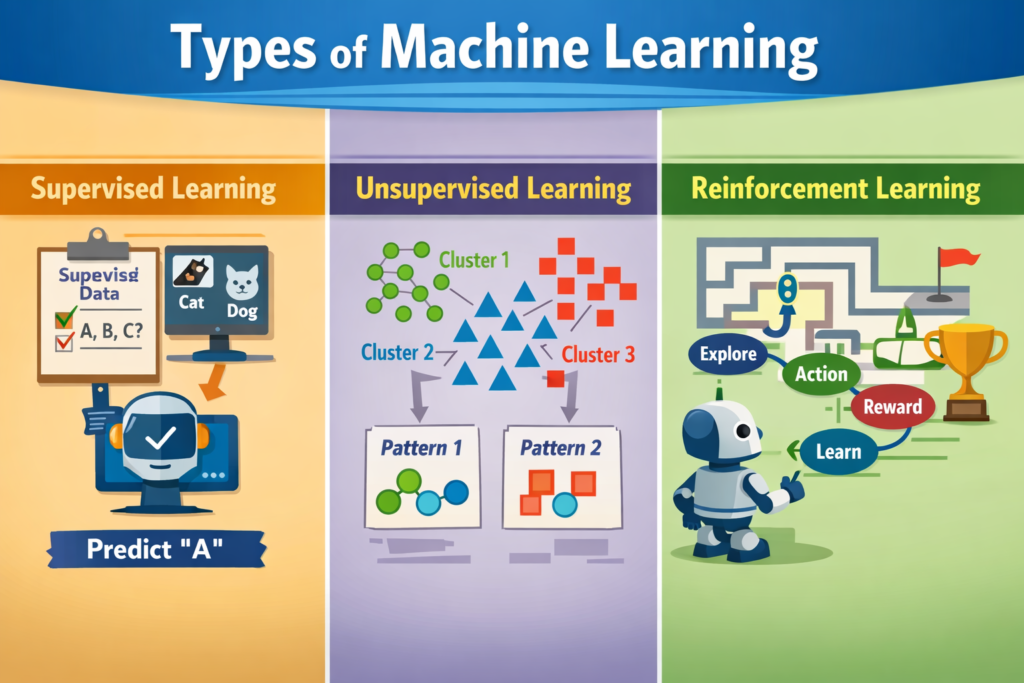
Machine learning generally has three major types.
1. Supervised Learning
In supervised learning, the model is trained using labeled data.
Example:
- Email spam classification
- Price prediction
- Image classification
Here, the algorithm learns from input data along with correct outputs.
2. Unsupervised Learning
Unsupervised learning works with unlabeled data. The system finds hidden patterns in the dataset.
Example:
- Customer segmentation
- Market analysis
- Data clustering
This method helps discover unknown relationships within data.
3. Reinforcement Learning
In reinforcement learning, systems learn through trial and error.
The model receives rewards for correct actions and penalties for wrong actions.
Example:
- Self-driving vehicles
- Game AI
- Robotics
Machine Learning v Artificial Intelligence: Key Differences
To understand the relationship clearly, we need to compare both technologies.
| Feature | Artificial Intelligence | Machine Learning |
|---|---|---|
| Definition | Broad concept of intelligent machines | Subset of artificial intelligence |
| Goal | Simulate human intelligence | Learn from data |
| Scope | Very large field | Smaller specialized area |
| Learning Method | May include rules or learning | Primarily data-driven learning |
| Applications | Robotics, virtual assistants, automation | Prediction, recommendation, analytics |
| Data Requirement | Not always required | Large datasets required |
From this comparison, it becomes clear that machine learning v artificial intelligence is not a competition. Instead, machine learning is an important part of artificial intelligence.
Relationship Between AI, Machine Learning, and Deep Learning
To understand the structure clearly, it is helpful to visualize the hierarchy.
Artificial Intelligence
→ Machine Learning
→ Deep Learning
Deep learning is a more advanced subset of machine learning that uses neural networks inspired by the human brain.
Comparison Table
| Technology | Description |
|---|---|
| Artificial Intelligence | Broad concept of intelligent machines |
| Machine Learning | AI technique that learns from data |
| Deep Learning | Advanced ML using neural networks |
This hierarchy explains how these technologies are connected.
Real-World Applications
Both artificial intelligence and machine learning are widely used in many industries.
Healthcare
Doctors use AI systems to analyze medical images and detect diseases earlier.
Machine learning helps in:
- Disease prediction
- Medical imaging analysis
- Drug discovery
Finance
Banks use machine learning models to detect fraud and analyze customer behavior.
Applications include:
- Credit scoring
- Fraud detection
- Algorithmic trading
E-commerce
Online platforms rely heavily on recommendation systems.
Examples include:
- Product recommendations
- Personalized ads
- Customer behavior prediction
Transportation
AI technology is transforming transportation systems.
Examples:
- Self-driving cars
- Traffic prediction
- Route optimization
Cybersecurity
Machine learning helps detect unusual activities in networks.
Applications include:
- Threat detection
- Malware identification
- Security monitoring
Advantages of Artificial Intelligence
Artificial intelligence offers several benefits for businesses and individuals.
1. Automation
AI can automate repetitive tasks, saving time and resources.
2. Improved Decision Making
AI systems analyze large datasets quickly and provide insights.
3. Higher Efficiency
Businesses can operate faster with intelligent automation.
4. Better Customer Experience
AI chatbots and assistants improve customer support.
Advantages of Machine Learning
Machine learning provides additional benefits when working with data.
1. Data Analysis
ML algorithms analyze massive datasets efficiently.
2. Predictive Insights
Businesses can forecast trends using predictive models.
3. Continuous Learning
Machine learning models improve as more data becomes available.
4. Personalization
ML helps create personalized experiences for users.
Challenges of AI and Machine Learning
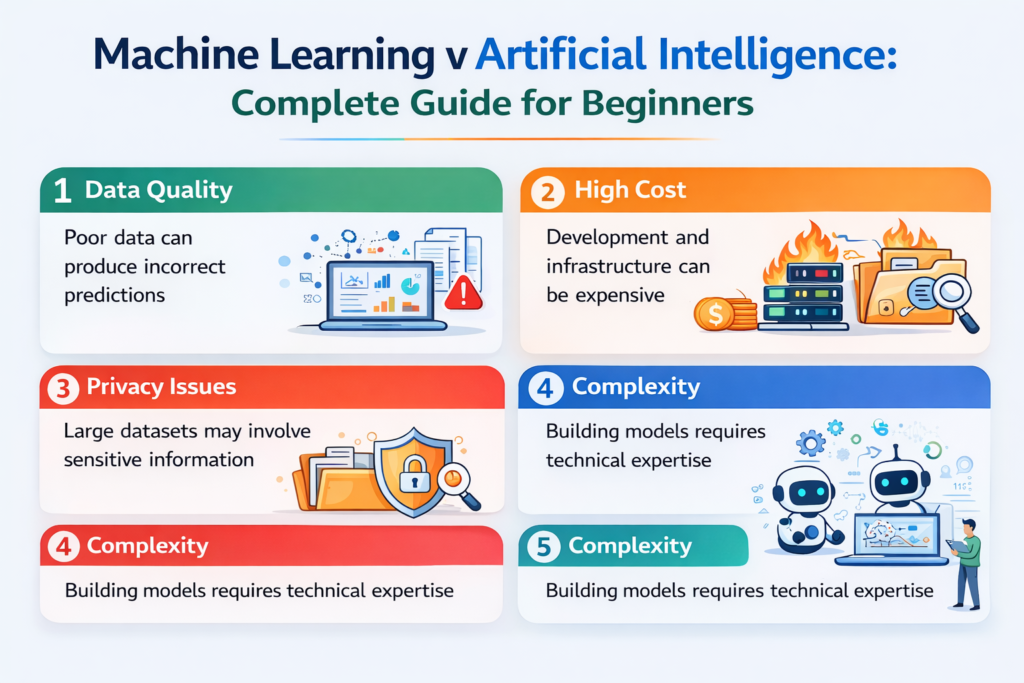
Despite many advantages, there are also challenges.
| Challenge | Description |
|---|---|
| Data Quality | Poor data can produce incorrect predictions |
| High Cost | Development and infrastructure can be expensive |
| Privacy Issues | Large datasets may involve sensitive information |
| Complexity | Building models requires technical expertise |
Organizations must address these challenges carefully when implementing AI systems.
Read More: What is Nano Technology / How to Make Money with AI in 2026
Future of Artificial Intelligence and Machine Learning
The future of these technologies is very promising.
Experts believe AI will transform industries such as:
- Healthcare
- Education
- Transportation
- Finance
- Manufacturing
Machine learning models are becoming more advanced and capable of solving complex problems.
In the coming years, technologies like generative AI, autonomous systems, and smart robotics will further expand the possibilities of machine learning v artificial intelligence.
Businesses that adopt these technologies early may gain a strong competitive advantage.
Conclusion
Understanding machine learning v artificial intelligence is essential in today’s technology-driven world. Artificial intelligence is a broad field focused on creating intelligent machines, while machine learning is a specialized area that allows systems to learn from data.
Both technologies work together to power many modern applications such as recommendation systems, fraud detection, smart assistants, and autonomous vehicles.
As technology continues to evolve, artificial intelligence and machine learning will play an even bigger role in shaping the future of businesses and everyday life.
Learning these concepts today can help students, professionals, and organizations prepare for the next generation of intelligent technology.
FAQs About Machine Learning v Artificial Intelligence
1. What is artificial intelligence?
Ans: Artificial intelligence is technology that allows machines to perform tasks that normally require human intelligence.
2. What is machine learning?
Ans: Machine learning is a part of artificial intelligence that helps computers learn from data and improve automatically.
3. Is machine learning the same as artificial intelligence?
Ans: No, machine learning is a subset of artificial intelligence.
4. What are common uses of machine learning?
Ans: Machine learning is used in recommendation systems, fraud detection, voice assistants, and image recognition.
5. Which is broader: AI or machine learning?
Ans: Artificial intelligence is the broader field, and machine learning is one of its subfields.
For regular update’s about the AI, AI Tools, AI Guide, Technology & More. Visit, The TechUnfoldedAi.com.
Leave a Reply