
In today’s digital world, organizations generate massive amounts of data every day. Companies want to use this data to gain insights, make better decisions, and improve their services. One of the most important technologies that makes this possible is machine learning.
This technology allows computer systems to learn from data and improve their performance without being explicitly programmed for every task. Instead of writing detailed instructions for each situation, developers create algorithms that enable computers to recognize patterns and make predictions.
Today, this technology is widely used in industries such as healthcare, banking, e-commerce, marketing, robotics, and transportation. In this guide, we will explain the it’s meaning, definition, types, algorithms, linear regression, decision tree, projects, and interview questions in simple and easy language.
Machine Learning Meaning
To understand the concept clearly, it is helpful to first understand the it’s meaning.
It refers to a method in which computer systems learn from data and experience to improve their performance over time. Instead of following fixed rules, the system analyzes large datasets and identifies patterns.
Once a model is trained with data, it can apply that knowledge to make predictions or decisions when new data is provided.
Simple Examples
| Application | How it Works |
| Movie recommendations | Suggests movies based on user preferences |
| Email spam filtering | Detects unwanted emails automatically |
| Online shopping | Recommends products to customers |
| Fraud detection | Identifies suspicious banking transactions |
These systems continuously improve as they process more data.
Machine Learning Definition
It’s definition can be explained in several ways by researchers and experts.
One widely accepted explanation is:
It is a branch of artificial intelligence that enables systems to learn from data and improve performance without explicit programming.
Computer scientist Tom Mitchell described it in a more technical way:
A computer program is said to learn from experience (E) with respect to a task (T) and a performance measure (P) if its performance improves with experience.
In simple terms, the more data the system analyzes, the better it becomes at solving problems.
Read More: How to Make Money with AI in 2026 / Microsoft Bing
Machine Learning AI Relationship
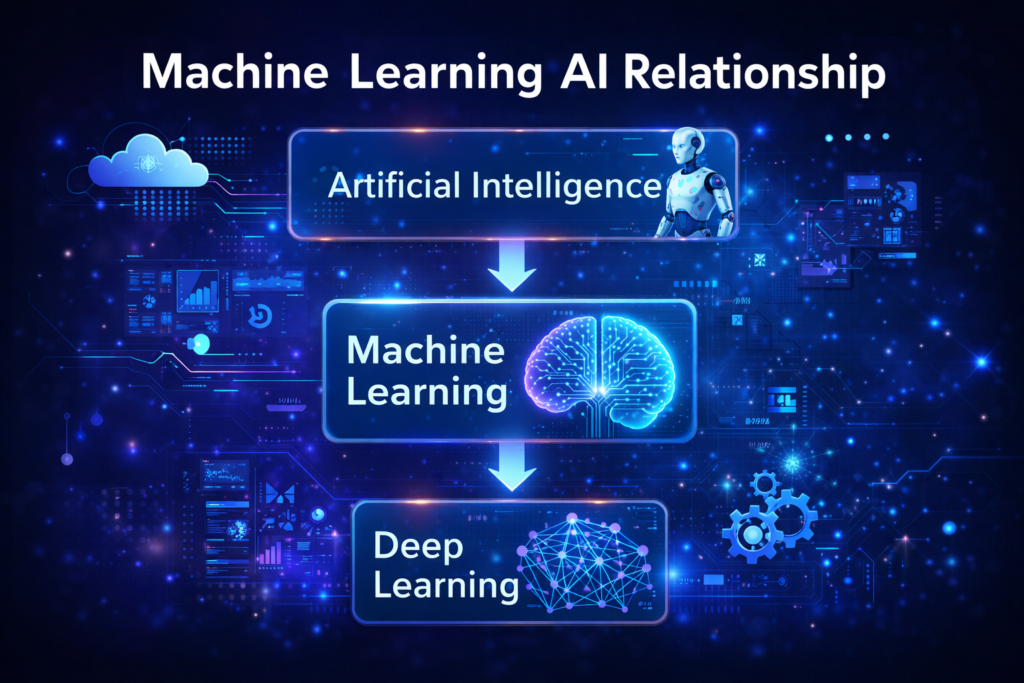
Many people wonder about the connection between the AI technologies.
The relationship can be understood as a hierarchy.
| Technology | Description |
| Artificial Intelligence | Broad field focused on building intelligent machines |
| Machine Learning | Subset of AI that learns from data |
| Deep Learning | Advanced type of machine learning using neural networks |
Artificial intelligence focuses on creating machines that simulate human intelligence. It provides the techniques that allow these systems to learn automatically from data.
For example, voice assistants, recommendation systems, and image recognition software rely heavily on the models.
How Machine Learning Works
Understanding the working process helps explain how intelligent systems are developed.
Most of the systems follow a series of steps.
| Step | Description |
| Data Collection | Gathering raw data from different sources |
| Data Preparation | Cleaning and organizing the data |
| Model Training | Algorithms learn patterns from data |
| Model Evaluation | Testing model accuracy |
| Prediction | Making decisions using new data |
During training, datasets are often divided into three parts:
- Training dataset
- Validation dataset
- Testing dataset
This helps evaluate the model’s performance and prevent errors such as overfitting.
Machine Learning Types
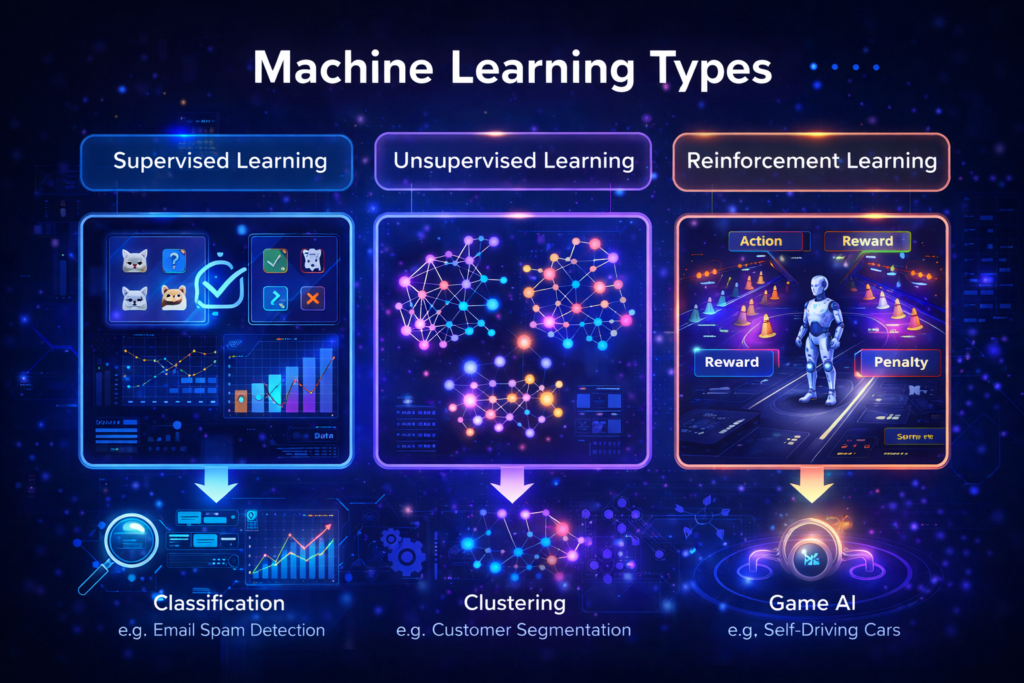
To understand the field better, we must learn about the main types. These methods are categorized based on how the model learns from data.
The three major types are listed below.
| Type | Description | Example |
| Supervised Learning | Learning from labeled data | Email spam detection |
| Unsupervised Learning | Discovering hidden patterns | Customer segmentation |
| Reinforcement Learning | Learning through rewards and penalties | Game AI |
Each approach is suitable for different types of problems.
Supervised Learning
Supervised learning is the most commonly used approach. In this method, the algorithm is trained using labeled data where both the input and the correct output are known.
Examples include:
- Email classification
- Image recognition
- Price prediction
Supervised learning tasks usually fall into two categories:
- Classification
- Regression
Unsupervised Learning
Unsupervised learning works with data that has no labels. The system tries to discover patterns and relationships in the data without guidance.
Common uses include:
- Customer segmentation
- Market analysis
- Pattern recognitio
This method is useful for exploring unknown data structures.
Reinforcement Learning
Reinforcement learning is inspired by behavioral psychology. In this approach, an agent interacts with an environment and learns by receiving rewards or penalties for its actions.
Applications include:
- Self-driving cars
- Robotics
- Game-playing AI systems
The goal is to maximize the total reward over time.
Machine Learning Algorithms
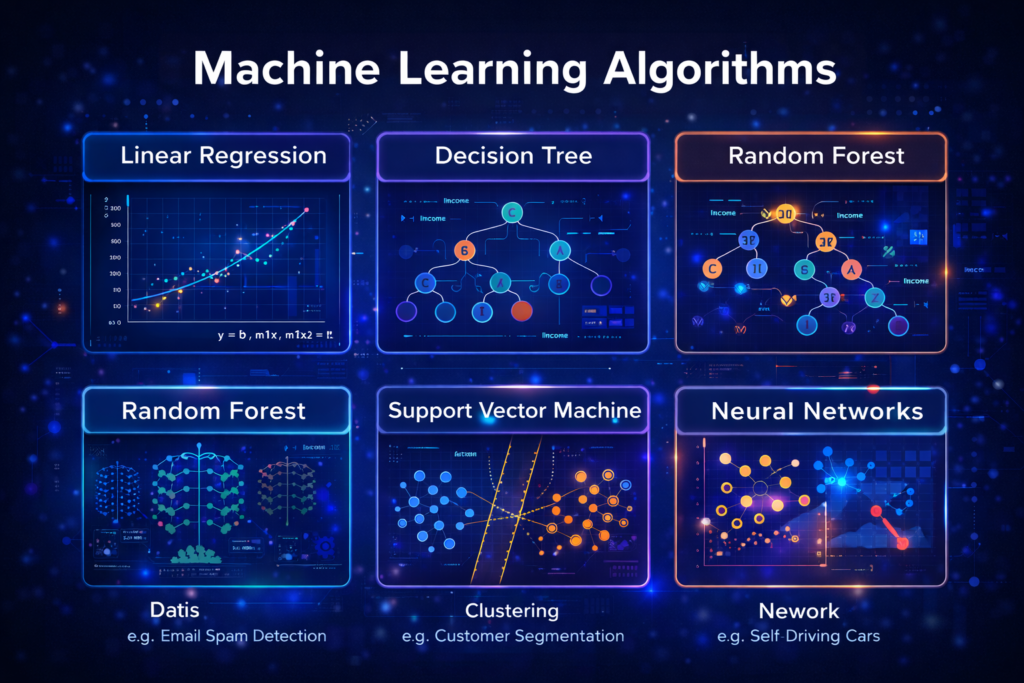
Algorithms are the core of intelligent systems. Different algorithms are used depending on the problem and dataset.
Some of the most common algorithms include:
| Algorithm | Main Use |
| Linear Regression | Predict numerical values |
| Decision Tree | Classification and prediction |
| Random Forest | Advanced classification |
| Support Vector Machine | Pattern recognition |
| Neural Networks | Complex learning tasks |
Selecting the correct algorithm is important for building accurate models.
Machine Learning Linear Regression
One of the simplest and most widely used algorithms is the linear regression.
It is mainly used for predicting numerical values by analyzing the relationship between variables.
For example, suppose we want to predict house prices.
| House Size (sq ft) | Price |
| 1000 | $200,000 |
| 1500 | $300,000 |
| 2000 | $400,000 |
The algorithm identifies the relationship between size and price and creates a mathematical equation that predicts the price of a new house.
Advantages
- Easy to understand
- Fast to implement
- Works well with simple datasets
Machine Learning Decision Tree
Another popular algorithm is the decision tree.
This model uses a tree-like structure where decisions are made by asking a series of questions about the data.
Example structure:
Age > 30?
Yes → High income group
No → Low income group
Decision trees divide data into smaller groups until a final decision is reached.
Common Applications
- Loan approval systems
- Medical diagnosis
- Customer churn prediction
The visual structure of decision trees makes them easy to understand.
Terminology
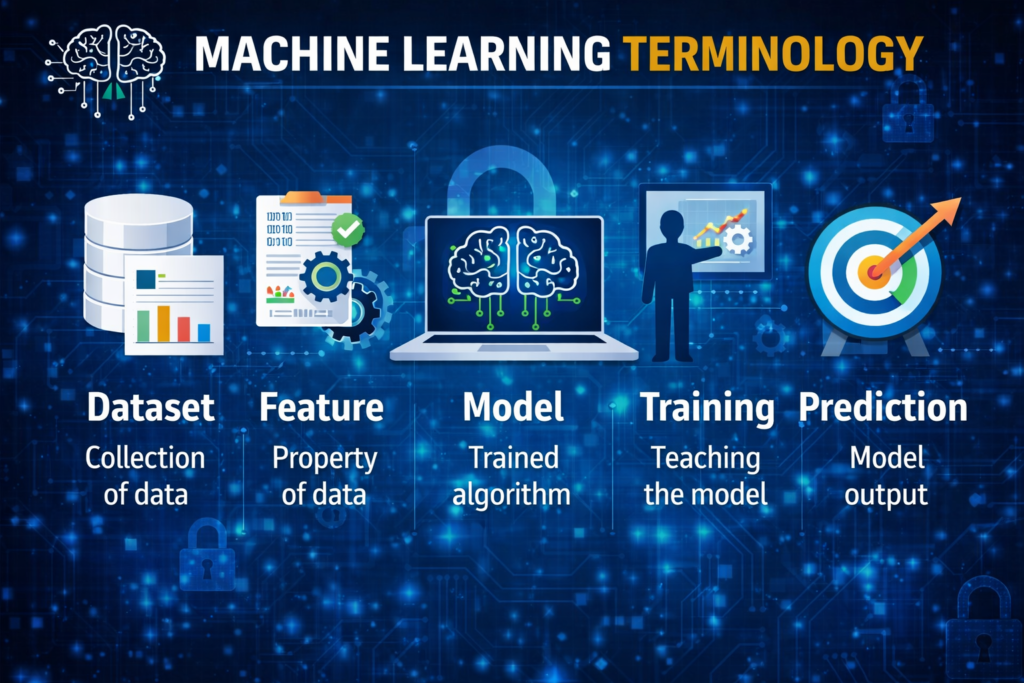
To work effectively with data models, it is important to understand some key terms.
| Term | Meaning |
| Dataset | Collection of data used for training |
| Feature | Individual measurable property of data |
| Model | Trained algorithm used for predictions |
| Training | Process of teaching the model |
| Prediction | Output generated by the model |
In most datasets, rows represent observations while columns represent features.
Projects
Practical learning is essential for understanding this technology. Working on the projects helps beginners develop real skills.
Here are some beginner-friendly project ideas.
| Project | Description |
| Movie Recommendation System | Suggests movies based on user history |
| House Price Prediction | Predicts property prices |
| Spam Email Detection | Classifies emails as spam or not |
| Stock Price Prediction | Forecasts financial trends |
| Image Recognition | Identifies objects in images |
These projects help learners understand algorithms, data preprocessing, and model evaluation.
Machine Learning Interview Questions
If you want to work in AI or data science, preparing for the interview questions is essential.
Here are some commonly asked questions.
What is machine learning?
It is a method that enables computers to learn patterns from data and make predictions.
What is the difference between supervised and unsupervised learning?
Supervised learning uses labeled data, while unsupervised learning works with unlabeled data.
What is overfitting?
Overfitting occurs when a model performs well on training data but fails to generalize to new data.
What does linear regression do?
It predicts numerical values based on relationships between variables.
What is a decision tree?
A decision tree is an algorithm that uses a tree structure to make classification or prediction decisions.
Real-World Applications
Today intelligent systems are used in many industries.
| Industry | Application |
| Healthcare | Disease prediction |
| Banking | Fraud detection |
| E-commerce | Product recommendations |
| Transportation | Autonomous vehicles |
| Marketing | Customer behavior analysis |
These applications help organizations make faster and more accurate decisions.
Benefits
There are many advantages of the technologies.
- Ability to analyze large datasets
- More accurate predictions
- Automation of repetitive tasks
- Improved decision-making
- Personalized user experiences
Businesses use these systems to increase efficiency and innovation.
Challenges
Despite its benefits, this technology also has challenges.
| Challenge | Explanation |
| Poor data quality | Inaccurate data leads to incorrect predictions |
| High computational cost | Large datasets require powerful hardware |
| Data bias | Biased data affects model fairness |
| Complexity | Advanced models are difficult to interpret |
Proper data preparation and evaluation are essential to overcome these challenges.
Read More: What is Nano Technology? Meaning, Uses, Examples, Benefits and Future
Future
The future of intelligent systems looks very promising. As computing power increases and more data becomes available, these technologies will continue to evolve.
Important future trends include:
- Smart healthcare systems
- Autonomous vehicles
- Intelligent education platforms
- Advanced robotics
- Predictive analytics in business
Many experts believe that this will become a core technology across almost every industry.
Conclusion
In simple terms, It is a powerful technology that allows computers to learn from data and improve automatically. It is a key component of artificial intelligence and is widely used in modern applications.
In this article, we discussed the it definition, meaning, types, algorithms, linear regression, decision tree, projects, and interview questions in a simple and structured way. As data continues to grow in importance, learning these concepts will become increasingly valuable for students, developers, and businesses.
FAQs About Machine Learning
1. What is machine learning?
Ans: It is a technology that allows computers to learn from data and make predictions or decisions without being explicitly programmed.
2. Why is it important?
Ans: It helps businesses analyze large amounts of data, find patterns, and make better decisions automatically.
3. What are the main types of machine learning?
Ans: The three main types are supervised learning, unsupervised learning, and reinforcement learning.
4. What is the algorithm?
Ans: A algorithm is a mathematical method that helps computers learn patterns from data and make predictions.
5. Where is it used?
Ans: It is used in many areas such as healthcare, banking, e-commerce, recommendation systems, and fraud detection.
For regular update’s about the AI, AI Tools, AI Guide, Technology & More. Visit, The TechUnfoldedAi.com.
Leave a Reply