
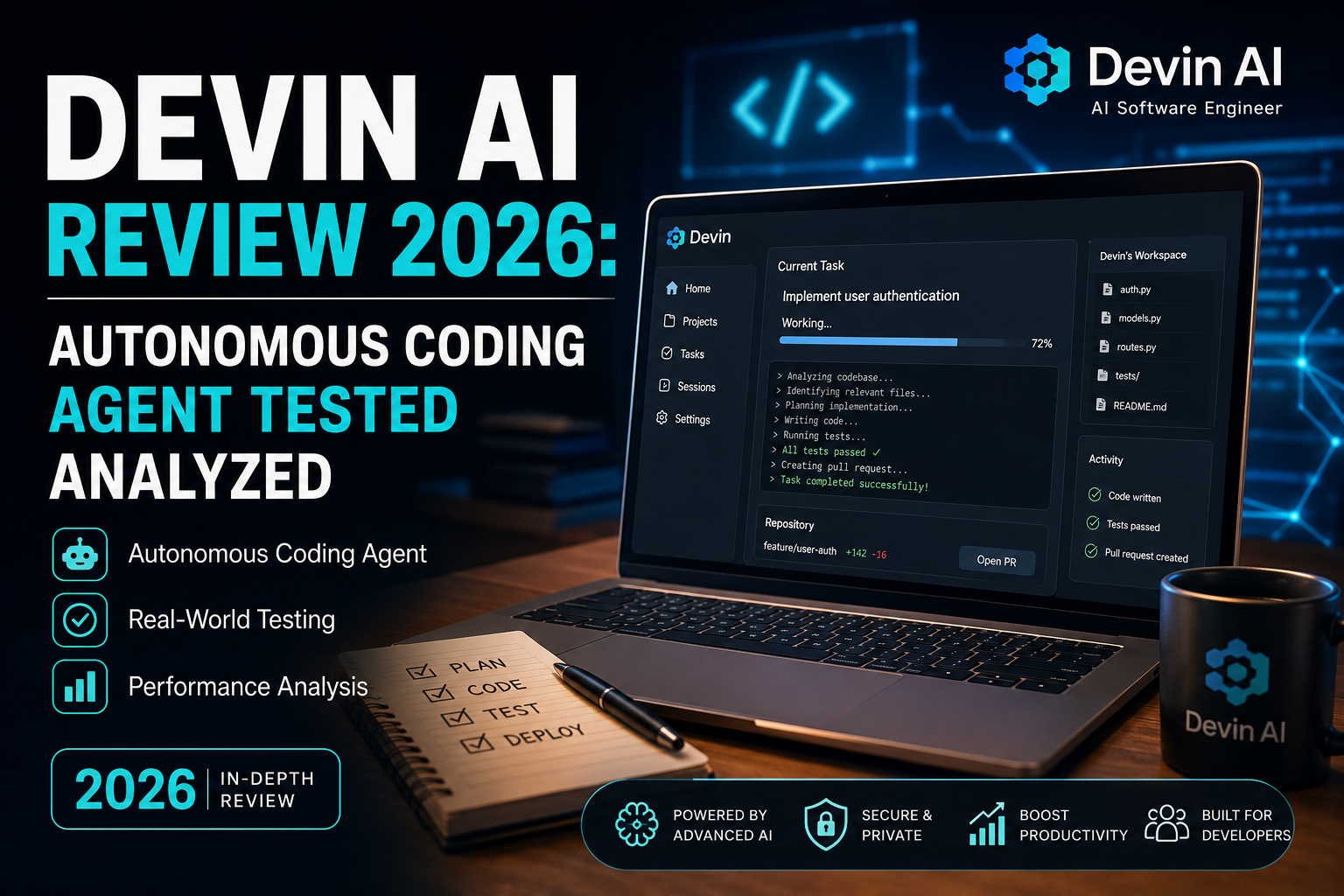
AI coding tools have evolved at breakneck speed over the past three years. GitHub Copilot, Cursor, Claude Code—each has carved out a niche in how developers write code. But Devin AI, launched by Cognition Labs in March 2024, took a fundamentally different approach: it positioned itself as the first autonomous AI software engineer capable of handling entire engineering tasks end-to-end.
The launch was met with both excitement and skepticism. The demo looked polished, but independent researchers quickly pointed out that the tasks shown appeared curated, and the actual performance didn’t always match the marketing.
Two years later, Devin has matured significantly. Cognition has raised over $1 billion in a Series D round** at a **$26 billion post-money valuation, up from $10.2 billion following a $400 million raise in September 2025. Annualized recurring revenue has grown from $37 million in May 2025 to **$492 million** in May 2026—a 13-fold increase in a single year. Enterprise customers now include Goldman Sachs, Mercedes-Benz, Citi, Dell, Santander, NASA, the U.S. Army, and the U.S. Navy.
The question isn’t whether Devin is real—it’s whether it’s actually useful for you.
This review draws on publicly available data, user reports, academic research, and official documentation to cut through the hype and give you a clear picture of what Devin AI can and cannot do in 2026.
What Is Devin AI in 2026?
Devin AI is an autonomous software engineering agent developed by Cognition Labs that can independently plan, write, test, debug, and submit code changes with minimal human supervision.
Devin operates in its own sandboxed environment—a shell, a code editor, a browser, and repository access. You give it a task via Slack, the web UI, the Devin Desktop IDE, or the CLI, and it works asynchronously: planning changes, writing code, running commands, testing, and opening a pull request when it thinks it’s done.
The key distinction from tools like Cursor or Copilot is autonomy. Those tools sit in your editor and accelerate the code you are writing. Devin is designed to take a unit of work off your plate entirely and report back.
Cognition CEO and co-founder Scott Wu—a former International Olympiad in Informatics (IOI) world champion who started coding at age nine—describes the vision as one where “software engineers operate more like architects, creatively structuring problems for armies of Devins to reliably execute on”.
Devin now supports end-to-end engineering tasks including planning, coding, testing, and security vulnerability remediation. The company has also introduced Devin Security Swarm, an AI-powered solution designed to help security teams find, validate, and remediate exploitable vulnerabilities.
The Numbers: Funding, Valuation, and Growth
Cognition’s financial trajectory is extraordinary by any measure:
| Metric | May 2025 | May 2026 |
|---|---|---|
| Annualized Recurring Revenue (ARR) | $37 million | $492 million |
| Valuation | $10.2 billion | $26 billion |
| Total Funding | ~$1.5 billion | >$2.5 billion |
The company raised over $1 billion in a Series D round** co-led by Lux Capital, General Catalyst, and 8VC, with participation from Founders Fund, Ribbit Capital, Atreides Management, and others. The **$26 billion post-money valuation more than doubled the company’s worth from September 2025.
Perhaps the most telling metric: Devin now writes approximately 89–90% of Cognition’s own internal code. The company says 89% of code committed by its own engineers is now written by Devin, with most of the remainder handled by Windsurf, an AI coding startup Cognition acquired in 2025. If accurate, this makes Cognition one of the most aggressive practitioners of its own product in enterprise software history.
Enterprise usage of Devin has grown more than 10x in 2026. The client roster now spans finance, defense, and automotive: Citi, Goldman Sachs, Mercedes-Benz, Dell, Santander, the U.S. Army, and the U.S. Navy all use Devin in production.
At Latin America’s largest bank, Itaú, Devin now resolves 70% of security vulnerabilities automatically.
SWE-1.7 and Performance Benchmarks
Benchmarks are where marketing often diverges from reality. Here’s what the numbers actually show.
The Original 2024 Claim
Devin’s headline launch claim was 13.86% on SWE-bench—the standard test that hands an AI real GitHub issues from real open-source projects and asks it to produce working fixes. The previous best was around 2%. Independent researchers later found that the actual resolution rate was substantially lower than Cognition’s claimed figure, and the tasks shown in the demo appeared curated.
SWE-1.7: The 2026 Update
On July 8, 2026, Cognition launched SWE-1.7, described as the most capable model the company has trained yet. Built on Moonshot’s Kimi K2.7 Code and powered by Cerebras inference chips, it delivers 1,000 tokens per second.
Cognition’s own benchmark table claims:
| Benchmark | SWE-1.7 Score |
|---|---|
| FrontierCode 1.1 Main | 42.3% |
| Terminal-Bench 2.1 | 81.5% |
| SWE-Bench Multilingual | 77.8% |
What the Benchmarks Don’t Tell You
Here’s the reality check. An empirical study presented at MSR 2026 (the Mining Software Repositories conference) analyzed 7,156 pull requests from five major AI coding agents—OpenAI Codex, GitHub Copilot, Devin, Cursor, and Claude Code.
The finding: 46.41% of the fixes proposed by these agents are rejected.
That’s nearly half of all AI-proposed fixes being rejected—a significant amount of wasted resources requiring human review, verification, and testing.
The study identified 14 reasons for rejection grouped into four categories:
- Incorrect implementation — incomplete fixes, wrong approach
- CI pipeline failures — fixes that don’t pass tests
- Agent inability — no code generated, sessions lost
- Low priority — fixes that aren’t worth reviewing
Devin did show the only consistent positive trend in acceptance rate (+0.77% per week over 32 weeks), while other agents remained largely stable. But the overall rejection rate remains a sobering counterpoint to the benchmark hype.
Engineering teams should also note that rejection outcomes may overstate agent error: only 35.7% of rejected PRs reflected clear agentic failures, while 31.2% were driven by workflow constraints and 33.1% lacked observable decision rationale.
Where Devin Actually Excels
After analyzing user reports, case studies, and official documentation, here’s where Devin genuinely delivers value:
1. Tedious but Mechanically Clear Tasks
Devin is at its best on work that’s boring but well-defined:
- Bumping a dependency across a monorepo and fixing resulting breakages
- Adding test coverage to an under-tested module
- Migrating files from one API to another
- Wiring up CRUD endpoints that mirror existing ones
In these cases, the task is legible, success criteria are checkable (build passes, tests are green), and the agent can iterate against fast feedback without needing your judgment.
2. Legacy System Modernization
This is where Devin has produced its most headline-grabbing results. In an initial four-week pilot with Mercedes-Benz, Devin analyzed over 200,000 lines of COBOL code and cut modernization time from an estimated eight months to eight days.
According to Cognition’s official announcement: “Devin analyzed over 200,000 lines of COBOL code and cut modernization time down from an estimated eight months to eight days”.
3. Security Vulnerability Remediation
Cognition’s Devin Security Swarm is designed to help security teams identify exploitable vulnerabilities, validate threats at runtime, and accelerate remediation. At Itaú, Latin America’s largest bank, Devin now resolves 70% of security vulnerabilities automatically.
4. Parallel Execution
The Agent Command Center and Spaces exist because Cognition expects you to work with dozens of agents in parallel—across cloud and local environments, on different parts of the same project.
Where Devin Falls Short
1. Ambiguous, Open-Ended Work
On work like “redesign how we handle auth” or “figure out why this is slow and fix it,” Devin tends to produce confident, plausible code that misses the actual point—or churns through expensive iterations chasing a problem it doesn’t understand.
2. The “Silent Failure” Risk
The honest mental model: Devin is a fast, tireless junior engineer who never asks clarifying questions and never tells you when it’s out of its depth. That’s enormously useful for the right tasks and genuinely dangerous for the wrong ones.
3. QA Testing Limitations
For QA testing specifically, Devin has notable gaps:
- Single sandbox only—no cross-browser runs
- No dashboards
- No native CI/CD integration
- Prompt-sensitive and prone to hallucinations
4. The PR Rejection Problem
The 46.41% rejection rate across AI coding agents isn’t unique to Devin, but it’s a reminder that human review remains essential. Devin’s output needs to be treated as an untrusted contribution—because that’s exactly what it is.
5. What It Doesn’t Do
According to Cognition’s documentation, the Devin Local agent does not support memories between sessions, workflows (which must be migrated to skills), or codemaps. These limitations matter for teams trying to build consistent, long-term workflows.
Devin AI Pros and Cons
| Pros | Cons |
|---|---|
| Handles repetitive coding tasks autonomously | Expensive for casual users |
| Excellent for large-scale migrations | Needs human review for every PR |
| Strong enterprise adoption and case studies | Struggles with complex architecture decisions |
| Parallel execution with multiple agents | Can make incorrect assumptions silently |
| Security vulnerability remediation | No cross-browser QA testing |
| 89% internal adoption at Cognition | Learning curve for teams |
Devin AI Pricing Breakdown
Based on Cognition’s official documentation:
| Plan | Price | Best For |
|---|---|---|
| Free | $0 | Individuals trying Devin |
| Pro | $20/month | Individual users who use Devin regularly |
| Max | $200/month | Power users who need more quota |
| Teams | $80/seat/month | Teams working with Devin together |
| Enterprise | Custom | Large organizations with compliance needs |
Teams Plan Details
- Unlimited members—invite as many teammates as you want
- $80/month minimum—every Teams account pays at least this
- Full seats: $40/month per seat, includes daily/weekly usage quota equivalent to Pro
- Flex seats: Free, draw from shared on-demand credits, no Devin Desktop access
Additional credits are purchased at $120 for 1,000 pooled credits.
Important Note on Pricing Changes
In March 2026, Devin replaced its credit-based system with a quota-based usage system. Instead of buying and spending credits, your plan now includes a daily and weekly usage allowance that refreshes automatically.
⚠️ Pricing Warning: AI product pricing changes frequently. Always check devin.ai/pricing for the most current plans before subscribing.
Devin vs. Competitors: Comparison Table
| Feature | Devin | Cursor | GitHub Copilot |
|---|---|---|---|
| Type | Fully autonomous agent | AI-assisted IDE | AI pair programmer |
| Interface | Slack, web, IDE, CLI | Desktop IDE | IDE plugin |
| Autonomy | Full: plans, codes, debugs, deploys | Assisted: you drive, AI helps | Assisted: autocomplete + chat |
| Sandbox | Cloud sandbox with shell, browser, editor | Local machine | Local |
| Background execution | Always | Background agents (early preview) | Limited |
| Entry price | $20/month | $0 (Hobby) | $10/month (individual) |
| Multi-model | Proprietary + OpenAI, Anthropic, Google | GPT, Claude, Gemini, Grok | OpenAI |
The Real Difference
The tool comparison conversations from 2024 are mostly obsolete. Capability differences between Cursor, Copilot, Devin Desktop, Claude Code, and Codex on day-to-day work are now small.
What actually matters is workflow fit:
- Devin = delegate and review. You hand off work and check back.
- Cursor = collaborate in real-time. You stay in the editor.
- Copilot = accelerate what you’re already writing.
Devin and Cursor are complementary, not competing. Use Devin for large-scale migrations, standardized refactoring, and overnight work. Use Cursor for debugging, exploration, and interactive coding.
Security and Privacy Considerations
Compliance Status
Cognition has achieved SOC 2 Type II certification. Devin and Devin Review are slated for FedRAMP High authorization in 2026. Zero Data Retention (ZDR) is enabled for all Devin Desktop and Devin CLI features in federal deployments.
Federal deployments run on AWS GovCloud as a dedicated, security-hardened version designed for customers working in air-gapped environments or requiring FedRAMP, ITAR, and IL4/5/6 certifications.
AI Guardrails
Enterprise administrators can define security boundaries for how users interact with Devin across the organization. AI Guardrails automatically screen incoming user messages—including initial messages, follow-ups, and PR comments—to detect prompt injection, data exfiltration attempts, and policy violations.
The Risk Surface
An agent that can run shell commands and open PRs unattended will occasionally do something you didn’t intend—delete a file, rewrite a config, or commit a credential it found. Cognition has a documented history of security issues that should factor into any risk assessment.
Best Practices
- Run it against a sandbox or fork first
- Require human PR review before anything merges
- Never give it write access to production systems
- Treat its output as an untrusted contribution—because that’s exactly what it is
Who Should Use Devin AI (and Who Shouldn’t)
Use Devin If:
- Your backlog is full of well-scoped, repetitive tasks with clear success criteria
- You’re doing large-scale migrations or dependency updates
- You need to parallelize work across multiple agents
- You’re comfortable with async delegation and reviewing PRs rather than writing code
- You have automated tests that can catch regressions
- Your organization has strong code review processes
Avoid Devin If:
- Your work involves ambiguous, architectural decisions
- You’re building novel systems with no existing patterns to follow
- You need deep understanding of every line of code
- Your team lacks strong code review processes
- You can’t afford wasted compute on failed attempts
- You’re expecting a senior engineer replacement
Future Outlook
Cognition is doubling down on several fronts:
SWE-1.7 and beyond: The company is investing heavily in reinforcement-learning-driven automation for software engineering. The model is available in Devin across Web, Desktop, and CLI at 1,000 tokens per second.
Acquisition of Poke: On July 23, 2026, Cognition acquired Poke, an AI assistant that users interact with via iMessage, SMS, Telegram, or WhatsApp. The deal, valuing Poke in the low nine figures, aims to bring Poke’s conversational style and personality to Devin—making it feel less like a tool and more like a colleague.
Enterprise expansion: Cognition has partnered with LTIMindtree to integrate Devin into cybersecurity assessment platforms.
Revenue target: Cognition aims to cross $1 billion in annualized revenue later in 2026.
The unanswered question is not whether AI agents will reshape software development—Cognition’s own numbers make that case already. The question is whether enterprises will let them operate unsupervised at scale, and how quickly legal, security, and compliance functions catch up to what engineering teams are already running in production.
FAQs
1. What is Devin AI?
A: Devin AI is an autonomous software engineering agent developed by Cognition Labs. It can understand codebases, plan changes, write code, conduct reviews, and handle testing and security remediation—all with minimal human intervention. Unlike code completion tools, Devin takes ownership of entire tasks and executes them end-to-end.
2. Is Devin AI free?
A: Yes, Devin offers a Free plan with limited usage for individuals trying the platform. Paid plans start at $20/month for Pro, $200/month for Max, and $80/seat/month for Teams.
3. How does Devin AI compare to GitHub Copilot?
4. Who founded Devin AI?
5. What are Devin AI’s main limitations?
6. How much does Devin AI cost?
A: Devin pricing starts at $20/month for Pro individual plans. Teams plans start at $80/seat/month, with full seats at $40/month each. A Free plan is also available with limited usage. Always check devin.ai/pricing for current pricing.
Final Verdict
Devin AI in 2026 has moved beyond the initial hype and become a useful engineering assistant for specific workflows. It performs best on structured tasks like testing, migrations, and repetitive coding work. The Mercedes-Benz eight-days-versus-eight-months story is well-documented, and the 89% internal adoption at Cognition signals genuine utility.
However, it is not a replacement for experienced software engineers. Complex architecture decisions, security-sensitive changes, and creative problem-solving still require human expertise. The 46.41% rejection rate for AI-proposed fixes is a reminder that human review remains essential.
Key Takeaways
- Devin excels at repetitive, well-defined tasks like migrations and test coverage
- It struggles with ambiguous, architectural work that requires human judgment
- Nearly half of AI-proposed fixes get rejected—human review remains essential
- Pricing starts at $20/month with a free tier available
- The rebrand to Devin Desktop positions it as an agent manager, not just an editor
For regular updates about the AI, AI tools, AI guides, technology & more. Visit, The TechUnfoldedAi.com.
Read next: Latest AI Tools | How to Use AI in Daily Life | 10 Free AI Tools for 2026 | Perplexity AI | DeepSeek AI
Leave a Reply