

Artificial intelligence is rapidly transforming the modern digital world. From voice assistants to medical diagnosis systems, intelligent technologies are becoming part of everyday life. One of the most important technologies behind these advancements is deep learning.
Deep learning enables computers to analyze large amounts of data and learn complex patterns automatically. Because of this capability, many industries are using deep learning to improve decision-making and automate tasks.
Today, deep learning is used in healthcare, finance, transportation, cybersecurity, e-commerce, and many other sectors. Understanding how deep learning works helps us understand the future of artificial intelligence.
This article explains deep learning in very simple language, including how it works, its types, frameworks, examples, applications, benefits, and challenges.
What is Deep Learning?
Deep learning is a branch of machine learning that uses artificial neural networks with multiple layers to process and analyze data.
These neural networks are inspired by the structure of the human brain. They learn patterns from large datasets and gradually improve their predictions.
In simple words, deep learning allows computers to learn complex tasks without needing detailed instructions for every step.
For example, a deep learning system can:
- Recognize faces in images
- Understand spoken language
- Translate languages automatically
- Detect diseases from medical scans
Because of its powerful learning ability, deep learning has become one of the most advanced technologies in artificial intelligence.
Relationship Between AI, Machine Learning, and Deep Learning
Many people use these terms interchangeably, but they represent different concepts.
| Technology | Description | Example |
|---|---|---|
| Artificial Intelligence | Technology that allows machines to simulate human intelligence | Chatbots |
| Machine Learning | Systems that learn patterns from data | Email spam filters |
| Deep Learning | Advanced machine learning using neural networks | Image recognition |
Deep learning is therefore a specialized part of machine learning designed to handle complex data problems.
Read More: Machine Learning v Artificial Intelligence / Microsoft Bing
How Deep Learning Works
Deep learning systems work using neural networks composed of multiple layers. Each layer processes information and passes the result to the next layer.
A neural network typically contains three main layers.
| Layer | Purpose |
|---|---|
| Input Layer | Receives the initial data |
| Hidden Layers | Process and analyze patterns |
| Output Layer | Produces the final prediction |
The learning process usually includes the following stages.
Data Input
Large datasets such as text, images, or audio are given to the model.
Pattern Recognition
Hidden layers detect patterns and relationships within the data.
Model Training
The system adjusts its parameters using algorithms.
Prediction
After training, the model can make predictions on new data.
For example, in image recognition systems:
- Early layers detect edges and shapes
- Middle layers detect patterns
- Final layers recognize objects like cars or people
This layered learning approach is what makes deep learning powerful.
Key Components of Deep Learning
Deep learning systems depend on several important components.
| Component | Description |
|---|---|
| Neural Networks | Mathematical models inspired by the human brain |
| Training Data | Large datasets used for learning |
| Algorithms | Methods used to adjust model parameters |
| GPUs | Hardware used to accelerate training |
| Activation Functions | Functions that allow networks to learn complex patterns |
Together, these components help deep learning systems process huge volumes of data.
Types of Deep Learning Models
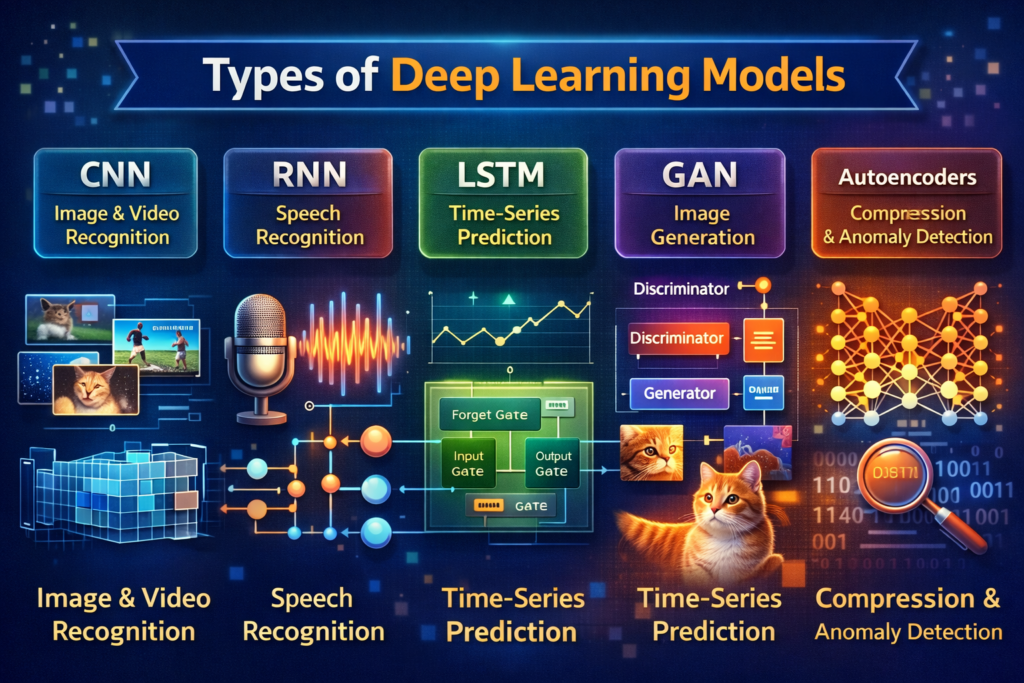
Different deep learning models are designed to handle specific tasks.
| Model | Use Case |
|---|---|
| Convolutional Neural Networks (CNN) | Image and video recognition |
| Recurrent Neural Networks (RNN) | Speech recognition |
| Long Short Term Memory (LSTM) | Time-series prediction |
| Generative Adversarial Networks (GAN) | Image generation |
| Autoencoders | Data compression and anomaly detection |
Each model type is optimized for specific data structures and problems.
Examples of Deep Learning
Deep learning is already being used in many real-world technologies. Below are some common examples.
| Example | How Deep Learning is Used |
|---|---|
| Face Recognition | Identifies people in images or videos |
| Voice Assistants | Understands and responds to voice commands |
| Language Translation | Converts text from one language to another |
| Medical Imaging | Detects diseases in X-rays or MRI scans |
| Self-Driving Cars | Recognizes traffic signs and pedestrians |
For instance, streaming platforms such as Netflix use deep learning algorithms to recommend movies based on user preferences.
Similarly, technology companies like Google and Amazon use deep learning for speech recognition and recommendation systems.
These examples show how deep learning is becoming part of everyday technology.
Deep Learning Frameworks
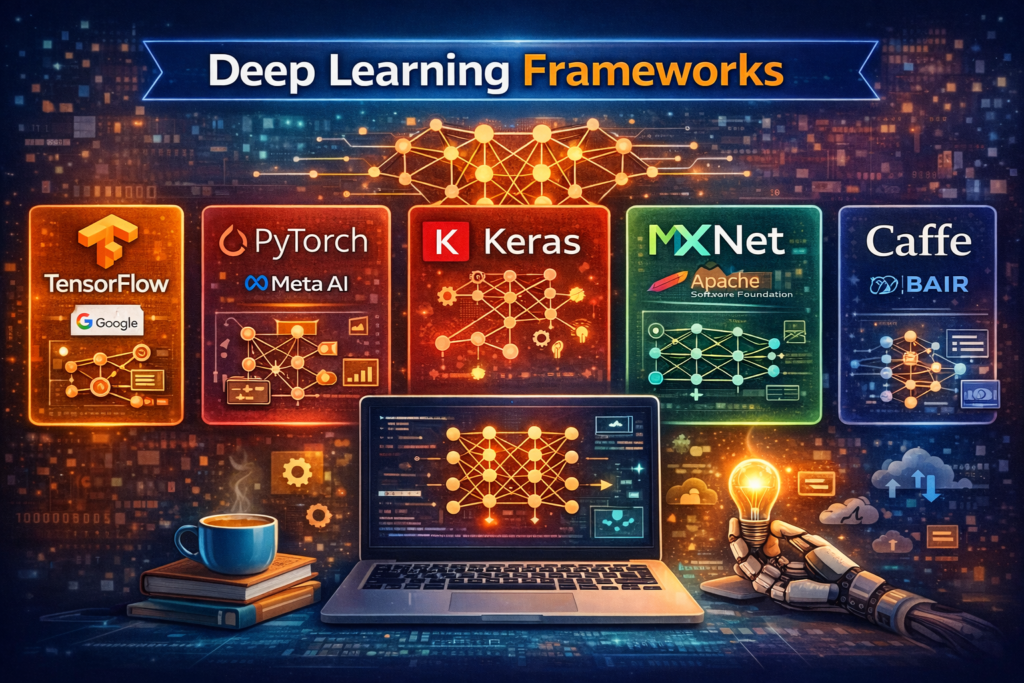
Developers use special software tools called deep learning frameworks to build and train deep learning models. These frameworks simplify the development process and provide libraries for neural network training.
Some of the most popular frameworks include:
| Framework | Developed By | Key Features |
|---|---|---|
| TensorFlow | Highly scalable and widely used | |
| PyTorch | Meta AI | Flexible and popular for research |
| Keras | Keras Team | Beginner-friendly deep learning library |
| MXNet | Apache Software Foundation | Efficient for large-scale training |
| Caffe | Berkeley AI Research | Strong performance in image processing |
These frameworks allow developers to build complex neural networks more efficiently.
Read More: How to Make Money with AI in 2026 / What is Nano Technology
Applications of Deep Learning
Deep learning is transforming multiple industries.
Healthcare
Deep learning helps doctors detect diseases using medical images and diagnostic data.
Autonomous Vehicles
Self-driving cars use deep learning to understand roads, traffic signs, and obstacles.
Financial Services
Banks use deep learning systems to detect fraudulent transactions.
E-commerce
Online shopping platforms use deep learning to recommend products to customers.
Natural Language Processing
Deep learning helps computers understand and generate human language.
These applications demonstrate the wide impact of deep learning technology.
Advantages of Deep Learning
Deep learning provides several benefits compared to traditional machine learning methods.
| Advantage | Explanation |
|---|---|
| Automatic Feature Extraction | Reduces the need for manual data processing |
| High Accuracy | Works well with complex datasets |
| Scalability | Performance improves with larger datasets |
| Versatility | Can be applied to many industries |
| Continuous Learning | Models can improve over time |
These advantages explain why deep learning is widely used today.
Challenges of Deep Learning
Despite its benefits, deep learning also has some limitations.
| Challenge | Explanation |
|---|---|
| Large Data Requirement | Needs huge datasets for training |
| High Computational Cost | Requires powerful hardware |
| Long Training Time | Training complex models can take days |
| Limited Interpretability | Models can be difficult to understand |
Researchers continue to work on improving these challenges.
Future of Deep Learning
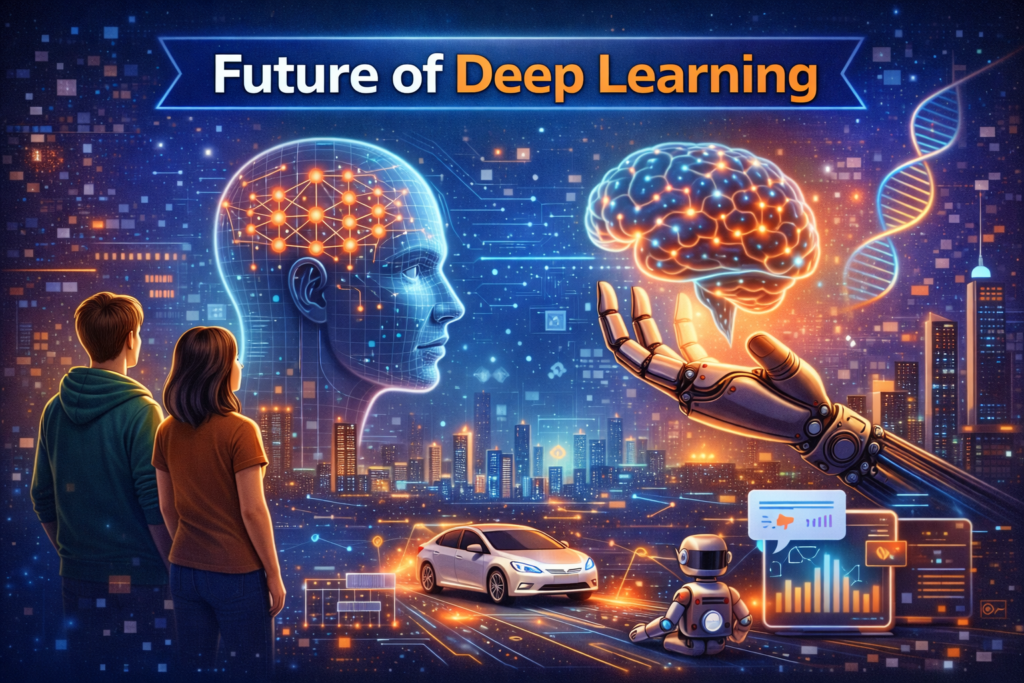
The future of deep learning is extremely promising. As computing power increases and more data becomes available, deep learning models will become more powerful.
Future advancements may include:
- More accurate disease detection systems
- Fully autonomous vehicles
- Smarter virtual assistants
- Advanced language translation systems
- Intelligent robotics
Many technology companies are investing heavily in deep learning research to drive innovation.
Conclusion
Deep learning is one of the most advanced technologies in artificial intelligence. By using neural networks with multiple layers, it enables computers to analyze complex data and make intelligent decisions.
This technology is already transforming industries such as healthcare, finance, transportation, and entertainment. Although it requires large datasets and significant computing power, its advantages continue to drive rapid adoption.
As technology continues to evolve, deep learning will play an even bigger role in building smarter and more intelligent systems.
FAQs About Deep Learning
1. What is deep learning?
Ans: Deep learning is a type of artificial intelligence that uses neural networks to learn patterns from large datasets.
2. Is deep learning part of machine learning?
Ans: Yes, deep learning is a specialized branch of machine learning.
3. What are deep learning frameworks?
Ans: Deep learning frameworks are software tools used to build and train neural networks.
4. Where is deep learning used?
Ans: It is used in healthcare, finance, autonomous vehicles, and voice assistants.
5. Why is deep learning important?
Ans: It helps computers analyze complex data such as images, speech, and text.
For regular update’s about the AI, AI Tools, AI Guide, Technology & More. Visit, The TechUnfoldedAi.com.
Leave a Reply