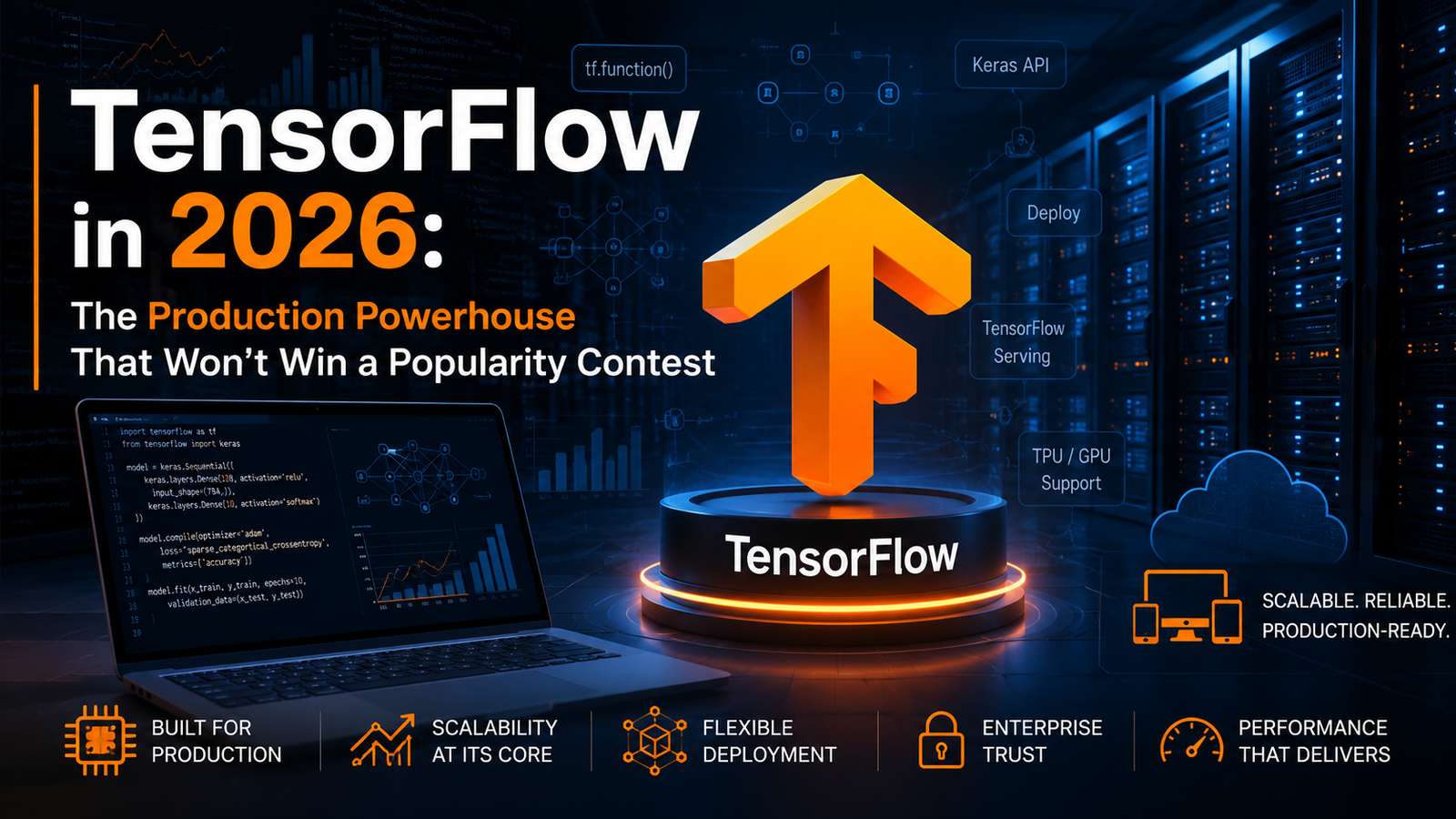
Let’s start with something most articles won’t tell you: TensorFlow is not the most popular framework in research anymore. PyTorch has captured roughly 54% of research adoption as of 2025, while TensorFlow has settled into a different role entirely.
But here’s the kicker—that doesn’t mean TensorFlow is dying. Far from it.
If PyTorch is the researcher’s laboratory, TensorFlow is the factory floor. It’s the framework that powers enterprise-grade LLM pipelines, runs on billions of Android devices, and keeps Google’s infrastructure humming. The question isn’t “which is better?”—it’s “which is better for what you’re actually doing?”
I’ve spent years building and deploying models in both frameworks. I’ve watched TensorFlow evolve from the clunky static-graph monster of 2015 into something far more practical. And I’ve also watched it make some genuinely frustrating choices along the way.
Here’s what you actually need to know.
What is TensorFlow? A Quick Definition
TensorFlow is Google’s open-source machine learning framework used to build, train, and deploy AI and deep learning models across servers, cloud platforms, mobile devices, and edge hardware. It uses dataflow graphs—where nodes represent mathematical operations and edges represent multidimensional arrays called tensors—to efficiently handle massive-scale numerical computation. With support for CPUs, GPUs, and Google’s custom TPUs, it’s designed for both research experimentation and enterprise production.
What TensorFlow Actually Is (And Isn’t)
TensorFlow is an end-to-end open-source platform for machine learning. That “end-to-end” part matters—it’s not just a training library. It’s a full ecosystem that includes:
- Keras 3 as its high-level API
- LiteRT (formerly TFLite) for on-device inference
- TensorFlow Serving for production model deployment
- TFX ( Extended) for full ML pipelines
- TensorBoard for visualization and debugging
The framework uses dataflow graphs where nodes represent mathematical operations and edges represent multidimensional data arrays called tensors—hence the name.
It’s not the simplest way to prototype a neural network. It’s not the most Pythonic framework. And if you’re on Windows with an NVIDIA GPU, it’s not even a viable option for GPU training anymore.
That last point alone has sent countless developers running to PyTorch. And honestly? I don’t blame them.
Top TensorFlow Features You Need to Know
It’s feature set is vast, but these are the ones that actually matter for most developers:
| Feature | What It Does | Why It Matters |
|---|---|---|
| Eager Execution | Runs operations immediately without building a graph first | Makes debugging intuitive and Pythonic—no more Session.run() headaches |
| Keras Integration | High-level API for building models with minimal code | The fastest way to get a model up and running |
| TensorBoard | Visualizes training metrics, graphs, and embeddings | Essential for debugging and monitoring training |
| TensorFlow Serving | Serves trained models in production with versioning | Handles the tricky parts of deployment so you don’t have to |
| LiteRT | Optimizes models for mobile and edge devices | Runs AI on billions of devices with limited compute |
| Distributed Training | MirroredStrategy for multi-GPU, MultiWorkerMirroredStrategy for multi-node | Scales training across multiple GPUs or machines with minimal code changes |
| TPU Support | First-class optimization for Google’s tensor processing units | Massive speedups for large-scale training on Google Cloud |
| TFX (TensorFlow Extended) | Full MLOps pipeline for production | Automates data validation, transformation, and model deployment |
What’s New: TensorFlow 2.21 and the LiteRT Revolution
TensorFlow 2.21: Stability Over Flash
Released in March 2026, it is not a feature-packed release. And that’s actually good news.
The team has shifted focus toward security patches, bug fixes, and long-term stability. They’ve committed to more frequent dependency updates and faster responses to security vulnerabilities. For production teams, this is precisely what you want—a framework that stops breaking things and starts just working.
Key changes in 2.21:
- Python 3.9 support removed—you’ll need Python 3.10 or newer
- INT2 and INT4 support added across multiple operators (tfl.cast, tfl.slice, tfl.fully_connected)
- JPEG XL support in
decode_image - Various
tf.liteimprovements including int8 and int16x8 support for the SQRT operator
LiteRT: The TFLite Successor
This is the big one. LiteRT (pronounced “light RT”) is the evolution of Lite, and it represents a genuine leap forward for on-device AI.
The improvements are substantial:
- 1.4x faster GPU performance than TFLite
- State-of-the-art NPU acceleration—this is a game-changer for mobile and edge deployment
- Unified workflow for GPU and NPU acceleration across edge platforms
- First-class PyTorch and JAX support via seamless model conversion
- Superior cross-platform GenAI deployment for models like Gemma
Here’s what this means in practice: you can now train in PyTorch, convert to LiteRT, and deploy on edge devices with excellent performance. The walled garden is coming down.
💡 Practical tip: The
tf.lite.InterpreterAPI has been deprecated and will be removed in TF 2.20. Migrate toai_edge_litert.interpreterusing the official migration guide.
TensorFlow vs PyTorch: The 2026 Reality Check
Let me be blunt: this comparison has changed dramatically in the last two years.
The Old Comparison (What Everyone Still Repeats)
| Aspect | PyTorch | TensorFlow |
|---|---|---|
| Execution | Dynamic graphs | Static graphs |
| Debugging | Python-native, easy | Historically painful |
| Research | Preferred | Less common |
| Production | Harder | Easier |
The 2026 Reality
Both frameworks have converged significantly:
- TensorFlow 2.x defaults to eager execution—just like PyTorch. Static graphs are optional via
tf.function. - PyTorch has
torch.compile—bringing graph-based optimization to PyTorch. - Both support XLA compilation for performance.
The real differences today are about ecosystem and philosophy:
| Aspect | PyTorch | TensorFlow |
|---|---|---|
| Best for | Research, rapid prototyping, custom work | Production pipelines, enterprise, Google Cloud |
| Developer experience | Pythonic, intuitive, “feels like writing code” | More ceremony, “feels like building a system” |
| Debugging | Standard Python tools, inspect tensors anywhere | Improved but still more friction |
| Deployment | Improving (ExecuTorch, ONNX) | Mature (TF Serving, LiteRT, TFX) |
| Edge/ Mobile | ExecuTorch is catching up | LiteRT is industry-leading |
| Windows GPU | Works natively (but torch.compile doesn’t) | Does not work natively—WSL2 required |
| TPU support | Limited | First-class |
| Research adoption (2025) | ~54% | Declining |
The bottom line: If you’re doing cutting-edge research or need to iterate fast, PyTorch is probably your framework. If you’re building production systems that need to scale reliably across diverse hardware, it has the edge.
Pros and Cons of TensorFlow
Pros
- Production-ready – Mature deployment tools (TF Serving, TFX)
- LiteRT support – Industry-leading on-device AI capabilities
- Google Cloud integration – First-class TPU and Vertex AI support
- Comprehensive ecosystem – Everything from data pipeline to deployment in one place
- Strong corporate backing – Google invests heavily in continued development
Cons
- Steep learning curve – More concepts and APIs to master than PyTorch
- Windows GPU limitations – No native GPU support; WSL2 required
- More complex APIs – Often need to drop to lower-level primitives for custom work
- Less research adoption – Fewer pre-built models and community contributions than PyTorch
- Higher memory consumption – Benchmarks show TensorFlow-Keras uses more GPU memory than alternatives
Where TensorFlow Shines: Real-World Use Cases
TensorFlow isn’t just for Google’s internal projects anymore. Here’s where it’s actually making a difference in 2026:
1. On-Device AI with LiteRT
LiteRT is being used for everything from real-time sign language detection (using MediaPipe hand tracking + TensorFlow neural networks) to driver drowsiness detection systems that classify open vs. closed eyes in real-time.
The ability to quantize models to INT8 or even INT2/INT4 formats makes it possible to run sophisticated AI on devices with severely constrained memory and power budgets.
2. Healthcare and Medical Imaging
Researchers are using TensorFlow to build brain tumor diagnosis systems trained on thousands of MRI images and deployed via FastAPI for real-time clinical use. The framework’s ability to handle large medical imaging datasets and deploy reliably in clinical settings is a major advantage.
3. Agricultural AI
TensorFlow 2.0 with InceptionV3 from TensorFlow Hub is being used to detect rice leaf diseases, helping farmers identify problems before they spread.
4. Enterprise LLM Pipelines
This is where TensorFlow truly dominates. The framework’s tensor orchestration capabilities make it the go-to for enterprise-grade LLM pipelines that need to scale reliably.
5. Network Security
Autoencoder-based anomaly detection models built in you are being deployed to identify network traffic anomalies in real-time.
The Ugly Truth: TensorFlow’s Real Limitations
Every honest review needs to call out the problems. Here are its biggest issues in 2026:
1. Windows GPU Support is Dead
This is the biggest dealbreaker for many developers. TensorFlow dropped native Windows GPU support after version 2.10.
On a Windows machine with an NVIDIA GPU today, your options are:
- CPU-only TensorFlow (slow)
- GPU via WSL2 (a Linux virtual machine—extra complexity)
- Third-party DirectML plugin (limited, not the mainline CUDA path)
For many developers, this alone is enough to choose PyTorch. And honestly? It’s a baffling decision from Google that has cost them significant mindshare.
2. Memory Consumption Issues
Benchmarks show that while -Keras achieves the fastest training times for MLP and CNN architectures, it does so with higher memory consumption than alternatives. If you’re working with limited GPU memory, this matters.
3. XLA vs Eager Inconsistencies
There are documented cases where eager execution and XLA compilation produce different results—for example, tf.reduce_max returning NaN in eager mode but a finite value when compiled with jit_compile=True. This kind of inconsistency erodes trust.
4. Steep Learning Curve
The framework still has more concepts and APIs to learn than PyTorch. While Keras has simplified things considerably, the underlying complexity remains.
5. Less Flexibility for Custom Work
For highly customized training loops or novel architectures, PyTorch’s lower-level control is generally easier to work with. With you often end up dropping into lower-level primitives when you need to deviate from the standard patterns.
Components specifically designed to address these challenges.
Should You Learn TensorFlow in 2026?
This is the question I hear most often from developers and students. Here’s my honest take:
Learn TensorFlow if:
You want to work on enterprise AI systems at scale
You’re targeting on-device AI (mobile, embedded, edge)
You plan to use Google Cloud and TPUs
You’re interested in MLOps and production engineering
Skip TensorFlow (for now) if:
You’re a beginner just starting with deep learning—start with PyTorch or Keras standalone for a gentler learning curve
You’re doing research—PyTorch has the community and pre-built models you’ll want
You’re on Windows with a GPU—the native GPU support is gone
The Balanced Perspective
Here’s what I tell my team: learn both eventually. PyTorch are converging in many ways, and understanding both makes you a better AI engineer. But if you’re just starting out or time is limited, PyTorch is generally the better first choice.
If you’re already in industry and building production systems, TensorFlow skills are incredibly valuable. Companies pay a premium for engineers who can deploy AI reliably at scale.
Should You Use TensorFlow? A Decision Table
| If You Want… | Choose |
|---|---|
| Research | PyTorch |
| Enterprise AI production | TensorFlow |
| Mobile / Edge AI | TensorFlow (LiteRT) |
| Quick prototyping | PyTorch |
| Google Cloud / TPU integration | TensorFlow |
| Windows GPU development | PyTorch |
| Custom architectures | PyTorch |
| MLOps and deployment tooling | TensorFlow |
FAQs
1. What is TensorFlow used for?
A: TensorFlow is used for building, training, and deploying machine learning and deep learning models. Common applications include image classification, natural language processing, speech recognition, recommendation systems, and on-device AI via LiteRT. It’s particularly strong in production environments where models need to scale reliably across diverse hardware.
2. Is TensorFlow better than PyTorch?
A: Neither is universally “better.” PyTorch is generally preferred for research and rapid prototyping due to its Pythonic API and dynamic execution. TensorFlow excels in production deployment, on-device AI with LiteRT, and enterprise-scale pipelines. Your choice should depend on your specific use case, not marketing claims.
3. Is TensorFlow still relevant in 2026?
A: Yes, but the landscape has shifted. While PyTorch dominates research (~54% adoption in 2025), TensorFlow remains the production powerhouse for enterprise AI. The framework continues to evolve, with LiteRT offering significant improvements for edge AI and a renewed focus on stability and security.
4. Does TensorFlow work on Windows with GPU?
A: No, not natively. TensorFlow dropped native Windows GPU support after version 2.10. Current options are CPU-only, GPU via WSL2 (Linux VM), or a limited third-party DirectML plugin. This is a significant limitation for Windows-based developers.
5. What is LiteRT?
A: LiteRT (pronounced “light RT”) is the successor to TensorFlow Lite, announced at Google I/O ‘25. It offers 1.4x faster GPU performance than TFLite, state-of-the-art NPU acceleration, and first-class support for PyTorch and JAX model conversion. It’s the universal on-device inference framework for the AI era.
6. How do I install TensorFlow?
A: Install via pip: pip install tensorflow. For GPU support on Linux, use pip install tensorflow[and-cuda]. Nightly builds are available as tf-nightly. Note that Python 3.9 is no longer supported as of TF 2.21.
7. What’s the difference between TensorFlow and Keras?
A: Keras is now the official high-level API for TensorFlow. Keras 3 runs on multiple backends (TensorFlow, PyTorch, JAX) with minimal code changes. When you use tf.keras, you’re using Keras within TensorFlow.
8. Can I use TensorFlow for LLMs?
A: Yes. TensorFlow is increasingly used for enterprise-grade LLM pipelines due to its tensor orchestration capabilities and production scalability. However, many new GenAI projects are exploring PyTorch, JAX, or Keras 3 for new work.
Author Experience
After testing in production environments and comparing it with PyTorch on multiple projects over the last six years, we’ve found that remains one of the strongest frameworks for scalable deployment—despite its steeper learning curve and the frustrating Windows GPU situation.
I’ve used it to deploy models serving millions of requests per day, debug memory leaks in multi-GPU training, and migrate legacy TF 1.x codebases to TF 2.x. Each project reinforced a central truth: It is a professional-grade tool that rewards investment but punishes shortcuts.
Final Verdict
Key Takeaways:
- TensorFlow is the production powerhouse—not the research darling.
- LiteRT is a genuine breakthrough for on-device AI, offering 1.4x faster GPU performance and NPU acceleration.
- Windows GPU support is dead—use WSL2 or switch to PyTorch if this matters to you.
- The real challenge is deployment, not training.
- The framework wars are over—both and PyTorch have converged on eager execution with optional graph compilation.
Who should use it: Enterprises building production ML systems, teams deploying on-device AI, and organizations deeply integrated with Google Cloud.
Who shouldn’t: Researchers needing maximum flexibility, solo developers prioritizing fast iteration, and Windows users wanting native GPU training.
Next steps: If you’re ready to dive in, start with the official TensorFlow documentation. For hands-on practice, run the tutorials in Google Colab—no local GPU required. And consider our guides on the latest AI tools and how to use AI in daily life for broader context.
For regular updates about the AI, AI tools, AI guides, technology & more. Visit, The TechUnfoldedAi.com.
Related Reading:
Leave a Reply