
Artificial Intelligence is one of the most exciting technologies shaping the modern world today. From voice assistants on our smartphones to recommendation systems on streaming platforms, AI has become a part of everyday life. Many of the tools people use daily are powered by artificial intelligence, often without them even realizing it.
If you are wondering what is artificial intelligence, the simplest explanation is that it is a branch of computer science that focuses on building machines capable of performing tasks that normally require human intelligence. These tasks include learning from information, identifying patterns, understanding language, solving problems, and making decisions.
Artificial intelligence is now used across many industries such as healthcare, finance, education, transportation, and entertainment. Companies rely on AI to automate work, analyze data quickly, and improve customer experiences.
In this guide, we will explore what is artificial intelligence, how it works, its history, different types, real-world uses, advantages, challenges, and the future of this powerful technology.
Artificial Intelligence?
Artificial Intelligence, commonly known as AI, refers to the ability of machines or computer systems to perform tasks that normally require human intelligence.
These tasks can include things like learning from experience, understanding human language, recognizing images, solving complex problems, and making decisions based on data.
In simple terms, artificial intelligence allows machines to learn and think in ways that are somewhat similar to humans.
Unlike traditional computer programs that follow fixed instructions, AI systems can analyze data, detect patterns, and improve their performance over time. This ability to learn from data is what makes artificial intelligence so powerful.
For example, when you ask your smartphone assistant a question, it understands your voice and provides an answer. Streaming platforms recommend movies based on what you have watched before, and online shopping websites suggest products that match your interests. All of these technologies rely on artificial intelligence.
History of Artificial Intelligence
To better understand what is artificial intelligence, it is helpful to look at how this field developed over time.
The idea of intelligent machines has fascinated scientists and thinkers for many decades. However, artificial intelligence became a formal area of research in the mid-20th century.
Early Development
One of the key figures in the early development of AI was Alan Turing, a British mathematician and computer scientist. In 1950, he introduced the idea of the Turing Test, which was designed to determine whether a machine could demonstrate intelligent behavior similar to a human.
A few years later, in 1956, researchers gathered at the Dartmouth Conference in the United States. This event is widely considered the starting point of artificial intelligence as an academic field.
Growth of AI Research
During the following decades, researchers began developing early AI programs that could solve mathematical problems and play games such as chess.
However, progress was limited at the time because computers were not powerful enough to handle complex calculations.
The Modern AI Era
In recent years, the development of faster computers, large datasets, and advanced algorithms has allowed artificial intelligence to grow rapidly.
Today, AI powers many technologies people use every day, including search engines, digital assistants, image recognition tools, and self-driving vehicle technology.
Because of these advancements, understanding what is artificial intelligence has become increasingly important.
How Artificial Intelligence Works
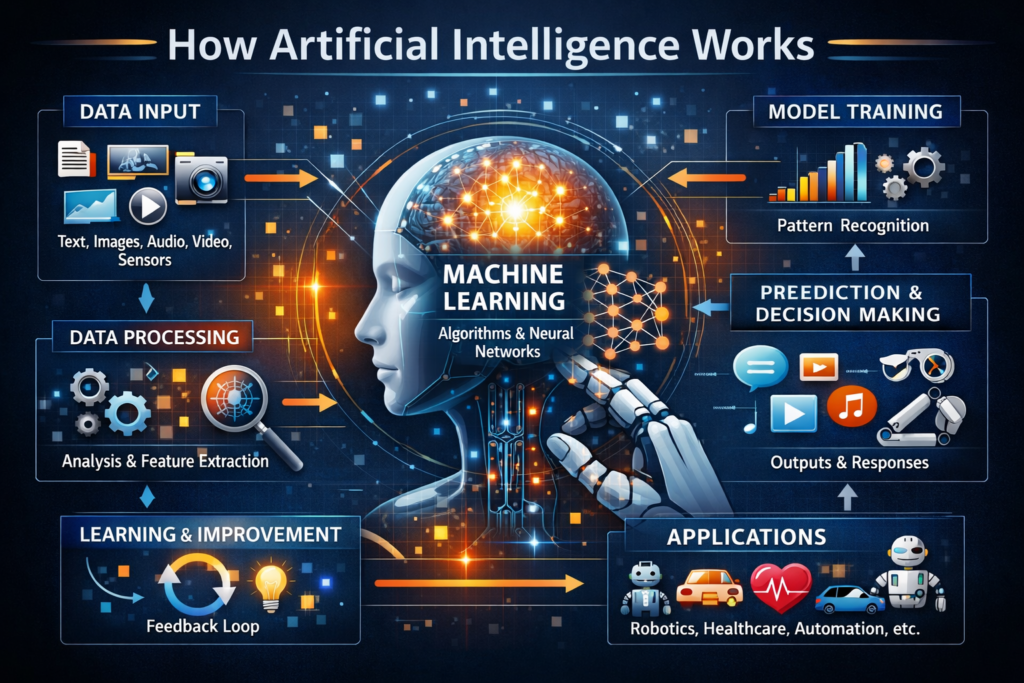
Artificial intelligence works by combining large amounts of data with powerful algorithms. These algorithms allow computers to process information, identify patterns, and make predictions.
In general, an AI system goes through several steps:
- Collecting data
- Processing and organizing the data
- Training algorithms using the data
- Learning patterns and relationships
- Making predictions or decisions based on the learned information
The more data an AI system receives, the better it becomes at performing its tasks.
Technologies Behind Artificial Intelligence
Artificial intelligence uses several important technologies that allow machines to simulate human intelligence.
| Technology | Explanation |
| Machine Learning | Allows computers to learn from data without being explicitly programmed |
| Deep Learning | Uses neural networks to process large and complex datasets |
| Natural Language Processing | Helps machines understand and interpret human language |
| Computer Vision | Enables computers to recognize and analyze images and videos |
| Robotics | Combines AI with machines that can perform physical tasks |
These technologies work together to create intelligent systems capable of solving complex problems.
Types of Artificial Intelligence
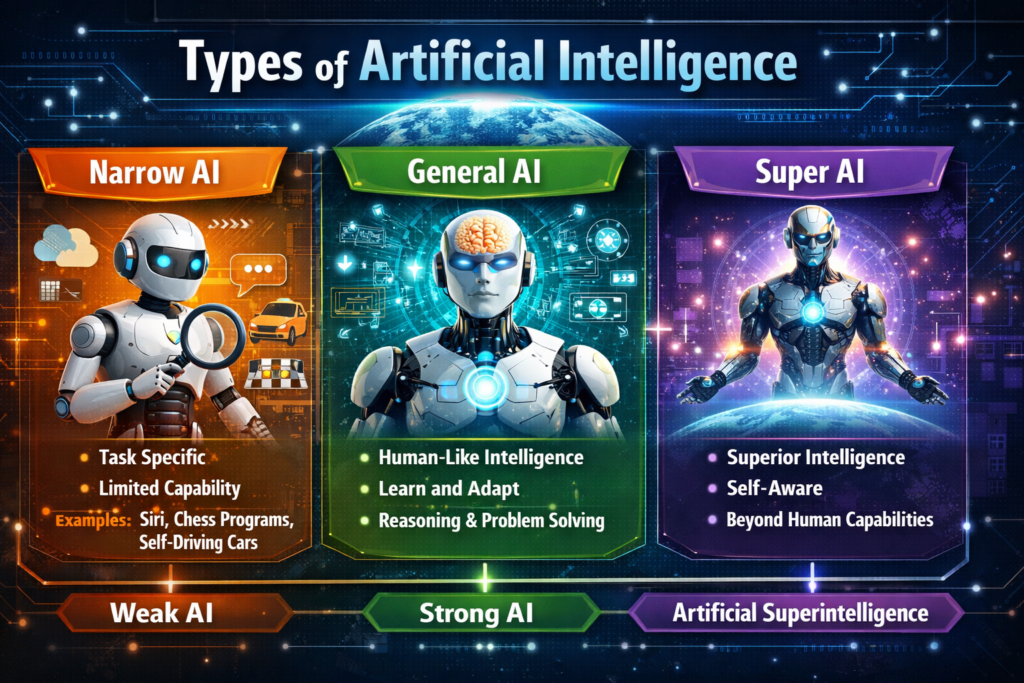
When discussing what is artificial intelligence, experts often divide AI into different categories based on its capabilities.
Narrow AI
Narrow AI, also known as weak AI, is designed to perform a specific task. Most of the AI systems used today belong to this category.
Examples include voice assistants, recommendation systems, and spam filters.
General AI
General AI refers to a theoretical type of artificial intelligence that could perform any intellectual task that a human can do.
Such systems would be able to learn and adapt across many different areas of knowledge.
At present, General AI has not yet been achieved, but it remains a major goal for researchers.
Super AI
Super AI is a hypothetical concept where machines become more intelligent than humans in every field.
While this idea is often discussed in scientific research and science fiction, it does not currently exist.
Real-World Applications of Artificial Intelligence
Artificial intelligence is now used in many industries and everyday technologies.
| Industry | AI Applications |
| Healthcare | Disease detection and medical imaging analysis |
| Finance | Fraud detection and financial risk assessment |
| Education | Personalized learning platforms |
| Transportation | Self-driving and driver assistance systems |
| Retail | Product recommendations and customer insights |
| Entertainment | Music and movie recommendation systems |
These examples show how artificial intelligence is transforming industries and improving efficiency.
Advantages of Artificial Intelligence
Artificial intelligence offers many benefits for both businesses and individuals.
Improved Efficiency
AI systems can process huge amounts of data much faster than humans. This allows organizations to make decisions more quickly.
Automation of Repetitive Tasks
Many routine and repetitive tasks can be automated with artificial intelligence, saving time and reducing workload.
Higher Accuracy
AI systems can reduce human errors, especially in areas like medical diagnosis, data analysis, and financial predictions.
Better Customer Experience
Chatbots and virtual assistants powered by AI can provide instant responses and support to customers.
Challenges and Risks of Artificial Intelligence
Despite its advantages, artificial intelligence also raises several concerns.
Job Displacement
Automation may replace certain jobs that involve repetitive tasks, which could affect employment in some industries.
Privacy Issues
AI systems rely heavily on data, which raises concerns about how personal information is collected and used.
Ethical Concerns
There are ongoing discussions about how artificial intelligence should be developed and used responsibly.
Algorithm Bias
If the data used to train AI systems contains bias, the system may produce unfair or inaccurate results.
Understanding these challenges is important when learning what is artificial intelligence and how it affects society.
Future of Artificial Intelligence
The future of artificial intelligence looks extremely promising. Experts believe AI will continue to transform industries and create new opportunities.
Some expected developments include:
- Advanced medical diagnosis tools
- Smarter personal digital assistants
- Autonomous vehicles and transportation systems
- Improved climate prediction models
- Intelligent robots used in manufacturing and logistics
Researchers are also working toward developing Artificial General Intelligence, which could potentially match human intelligence across many tasks.
However, responsible development and proper regulations will be necessary to ensure that artificial intelligence benefits society as a whole.
Quick Facts About Artificial Intelligence
| Feature | Details |
| Field | Computer Science |
| Main Objective | Develop machines capable of intelligent behavior |
| Core Technologies | Machine Learning, Deep Learning |
| Key Event | Dartmouth Conference (1956) |
| Popular Uses | Voice assistants, recommendations, automation |
| Future Potential | Autonomous systems and intelligent robotics |
Conclusion
Artificial intelligence is one of the most powerful and transformative technologies of our time. Understanding what is artificial intelligence helps us see how machines can analyze information, learn from data, and perform tasks that once required human intelligence.
From voice assistants and recommendation systems to medical research and autonomous vehicles, artificial intelligence is already playing an important role in modern life.
As technology continues to advance, AI will become even more integrated into daily activities, businesses, and industries. At the same time, it will be essential to address challenges such as ethical concerns, data privacy, and job displacement.
In simple words, artificial intelligence represents the effort to create machines that can learn, reason, and solve problems—bringing us closer to a future where technology works intelligently alongside humans.
FAQs What Is Artificial Intelligence
What is artificial intelligence in simple terms?
Artificial intelligence is a technology that allows computers and machines to perform tasks that normally require human intelligence, such as learning, reasoning, and decision making.
Where is artificial intelligence used?
Artificial intelligence is used in healthcare, finance, transportation, education, retail, entertainment, and many other industries.
Who started artificial intelligence?
Artificial intelligence research formally began in 1956 at the Dartmouth Conference, although earlier ideas were explored by scientists like Alan Turing.
What are the main types of AI?
The main types include Narrow AI, General AI, and Super AI.
Why is artificial intelligence important?
Artificial intelligence helps automate tasks, improve efficiency, analyze large datasets, and support better decision making.
For regular update’s about the AI, AI Tools, AI Guide, Technology & More. Visit, The TechUnfoldedAi.com.
Leave a Reply