
Artificial intelligence is changing how people work, learn, and create content. From writing articles to solving complex problems, modern AI models are becoming smarter and more efficient. One such advanced system is Qwen3-Next-80B-A3B-Instruct, which represents a new step in the evolution of language models.
This model is designed to deliver strong performance while using resources in a smarter way. It can understand long text, follow instructions clearly, and provide accurate results across different tasks. In this detailed guide, you will learn everything about its structure, features, benefits, and real-world uses in very simple language.
What is Qwen3-Next-80B-A3B-Instruct?
Qwen3-Next-80B-A3B-Instruct is a large-scale language model created to understand and generate human-like text. It belongs to a new generation of AI systems that focus on efficiency along with performance.
The model contains a total of 80 billion parameters, but it does not use all of them at once. Instead, it activates only a small portion when needed. This makes it faster and more efficient compared to traditional models.
It is specially designed to follow instructions. This means when a user gives a clear task, the model can understand it properly and deliver the expected output.
Quick Overview of the Model
| Feature | Details |
| Model Name | Qwen3-Next-80B-A3B-Instruct |
| Total Parameters | 80 Billion |
| Active Parameters | Around 3 Billion |
| Architecture | Mixture of Experts |
| Strength | High efficiency and accuracy |
| Context Handling | Very long text support |
| Main Purpose | Instruction-based responses |
Why This Model Stands Out
In the past, large AI models were powerful but expensive to run. They required a lot of computing power and often struggled with long inputs.
Qwen3-Next-80B-A3B-Instruct improves these areas by:
- Reducing resource usage
- Increasing response speed
- Handling long content better
- Improving instruction understanding
This combination makes it useful for both developers and general users.
Core Features in Detail
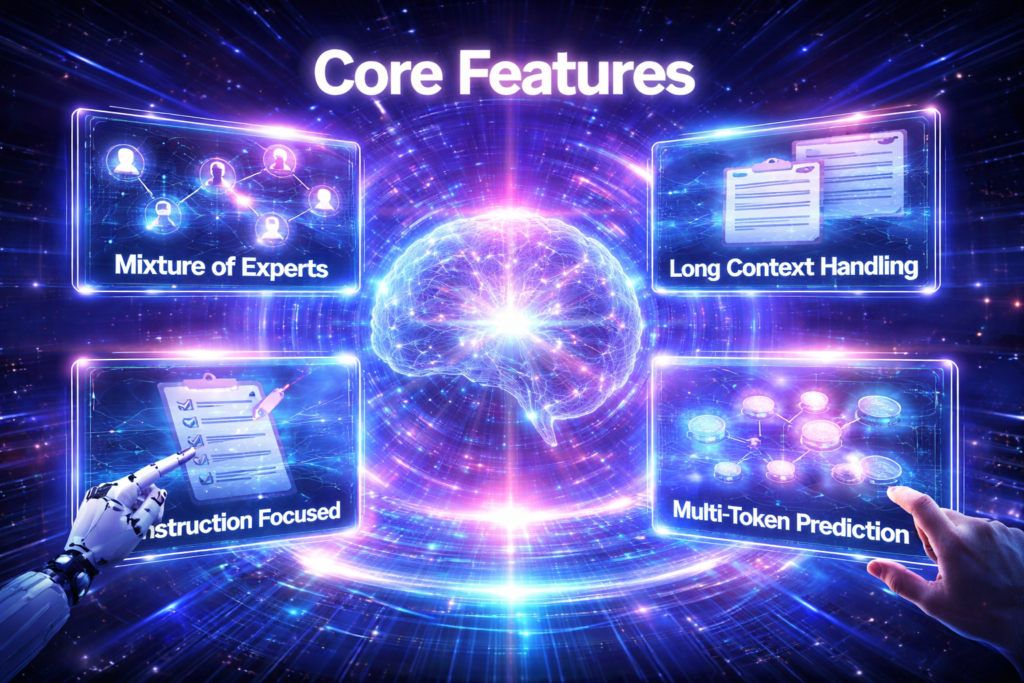
1. Mixture of Experts Architecture
The most important feature of this model is its Mixture of Experts system.
Instead of using all parameters at once, the model selects only a few experts for each task.
Simple Explanation:
Think of a group of specialists:
- One expert in writing
- One expert in coding
- One expert in reasoning
When a task comes in, the model chooses the right experts instead of using everyone.
Benefits:
- Faster responses
- Lower computing cost
- Better task-specific performance
2. Long Context Capability
Many AI models forget earlier parts of long text. This model is designed to handle very long inputs without losing important information.
What This Means:
- It can read long documents
- It can remember earlier conversation points
- It gives more consistent answers
Example:
If you give a long article and ask for a summary, the model can understand the full content instead of missing details.
3. Instruction-Based Learning
This model is trained to follow instructions carefully.
Key Advantages:
- Better understanding of user requests
- More accurate output
- Less confusion in responses
Example:
If you ask:
“Explain this topic in simple language”
The model will adjust its tone and provide an easy explanation.
4. Multi-Token Prediction
Traditional models generate one word at a time. This model improves speed by predicting multiple words together.
Benefits:
- Faster text generation
- Smooth sentence flow
- Improved efficiency
5. Efficient Performance
Even though it is a large model, it is designed to use fewer resources.
Why This Matters:
- Lower cost of operation
- Better scalability
- Suitable for real-world applications
How the Model Works
Here is a simple step-by-step explanation:
- User provides input
- Model reads and understands the text
- It selects the most relevant experts
- Attention mechanism focuses on key details
- Output is generated quickly
This entire process happens within seconds.
Technical Structure Overview
| Component | Role |
| Transformer | Core system for processing language |
| Experts Layer | Handles specialized tasks |
| Attention Mechanism | Focuses on important information |
| Token Generator | Produces output text |
Major Benefits
1. Speed and Efficiency
The model works faster because it uses fewer active parameters.
2. High Accuracy
It delivers reliable results across different tasks.
3. Long Text Handling
It can process long documents and conversations easily.
4. Flexible Usage
It can be used for writing, coding, learning, and more.
5. Cost Optimization
Efficient design reduces computing expenses.
Real-World Applications
1. Content Creation
2. Coding Support
- Writing code
- Fixing errors
- Explaining programming concepts
3. Customer Support
- Automated chat systems
- Answering common questions
- Improving response speed
4. Education
- Explaining difficult topics
- Helping with assignments
- Providing learning support
5. Business Use
- Data analysis
- Report generation
- Process automation
Comparison with Older Models
| Feature | Older Models | Qwen3-Next-80B-A3B-Instruct |
| Resource Usage | High | Optimized |
| Speed | Moderate | Fast |
| Context Length | Limited | Extended |
| Flexibility | Average | High |
| Output Quality | Good | Improved |
Limitations
Even though the model is powerful, there are some challenges:
1. Requires Strong Systems
Running large models may need advanced hardware.
2. Technical Knowledge Needed
Setup and customization can be complex.
3. Not Perfect
Like all AI systems, it can sometimes produce incorrect results.
Future Possibilities

This model shows how AI is becoming more practical and efficient.
In the future, we can expect:
- Better reasoning ability
- Even longer context support
- More natural conversations
- Lower resource requirements
It is a step toward smarter and more accessible AI systems.
Best Practices for Better Results
To use this model effectively:
1. Be Clear in Instructions
Clear input gives better output.
2. Use Simple Language
Avoid confusing or complex sentences.
3. Break Tasks into Steps
Structured input improves accuracy.
4. Test Different Prompts
Experiment to get the best results.
Conclusion
Qwen3-Next-80B-A3B-Instruct is a modern AI language model that combines power, efficiency, and flexibility. Its smart architecture allows it to perform complex tasks while using fewer resources.
With features like Mixture of Experts, long context understanding, and instruction-based design, it stands out as a strong solution for real-world applications. Whether used for writing, coding, or analysis, it offers reliable and fast performance.
As AI technology continues to grow, models like this will play an important role in shaping the future of digital tools and automation.
FAQs About Qwen3-Next-80B-A3B-Instruct
1. What is Qwen3-Next-80B-A3B-Instruct used for?
Answer: It is used for tasks like writing, coding, answering questions, and analyzing large amounts of text. It is especially useful for instruction-based tasks.
2. How is this model different from traditional AI models?
Answer: It uses a Mixture of Experts system, which activates only a small part of the model at a time. This makes it faster and more efficient.
3. Can it handle long documents?
Answer: Yes, it is designed to process long text inputs, making it suitable for summarization and detailed analysis.
4. Is it suitable for beginners?
Answer: Yes, it can be used by beginners, especially for tasks like learning and content creation, but advanced usage may require technical knowledge.
5. Does it require high computing power?
Answer: It is more efficient than older models, but still may require strong systems depending on how it is used.
For regular update’s about the AI, AI Tools, AI Guide, Technology & More. Visit, The TechUnfoldedAi.com.
Leave a Reply