
Written by: TechUnfoldedAI Editorial Team
Reviewed by: Senior Consumer Technology Editor
Last updated: September 2026
Methodology: This is a specification and pricing analysis based on Apple’s official announcement, Apple India’s product page, Samsung’s official specifications, and published third-party reporting. No physical review unit was used. Every testable claim is attributed to its source inline.
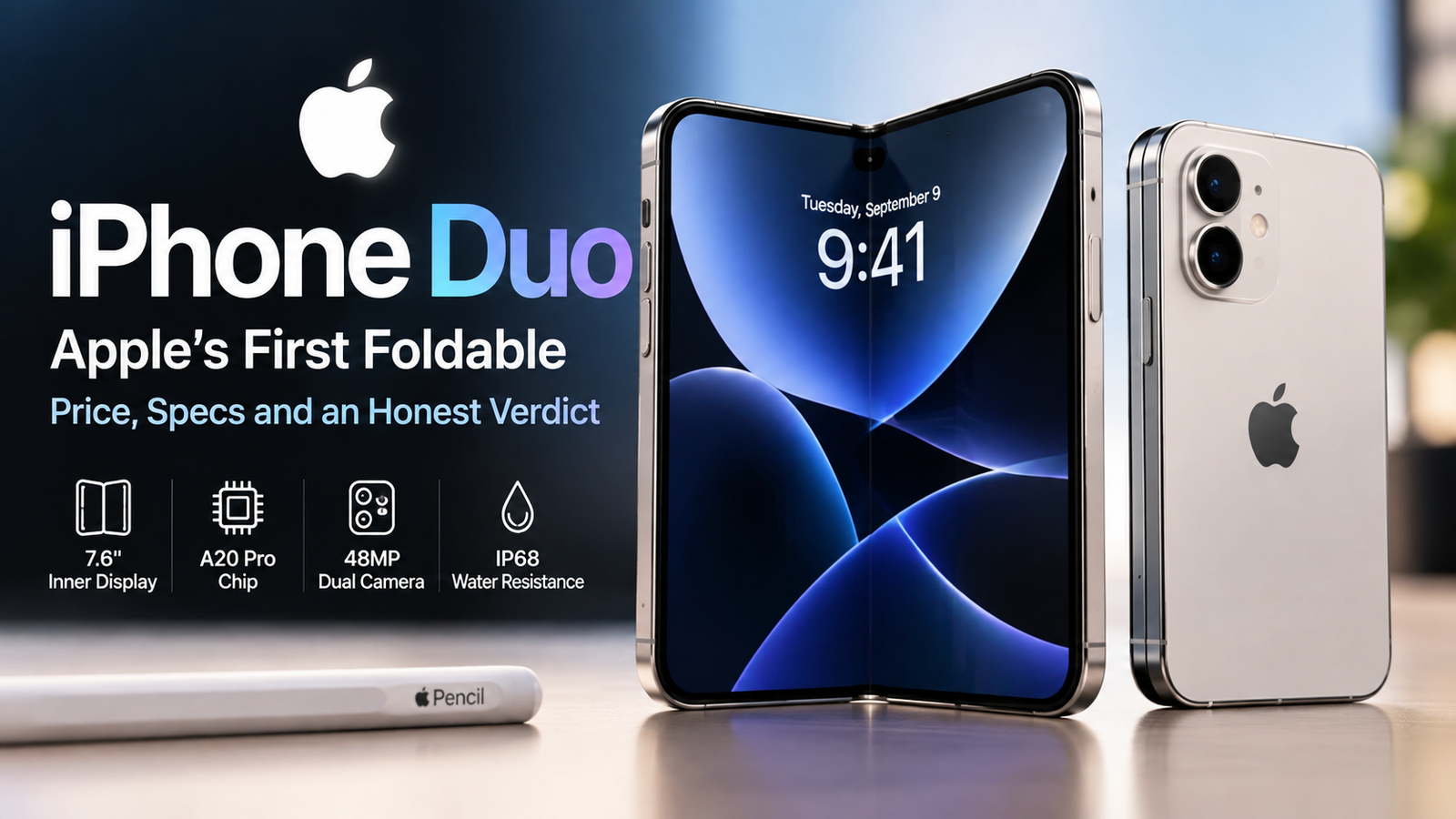
Apple’s first foldable arrives with the polish you’d expect — and the price tag to match. The iPhone Duo, announced at Apple Park on September 9, 2026, is a book-style foldable with a 7.6-inch inner display, a Grade 5 titanium frame, and the A20 Pro chip (Apple Newsroom).
But two questions matter more than the spec sheet: Is the software actually ready for a foldable? And does ₹2,99,900 buy you the best foldable available, or just the most Apple-branded one?
This article answers both — using only what Apple and Samsung have officially published, plus clearly labelled editorial assessment where the data runs out. For context on how this device fits into the broader industry shift away from slab smartphones, see our analysis of how tech giants envision a future beyond smartphones.
What Is the iPhone Duo?
Direct answer: The iPhone Duo is Apple’s first foldable iPhone — a book-style device with a 5.4-inch outer display that opens to a 7.6-inch inner display, powered by the A20 Pro chip.
According to Apple’s official specifications page, the device ships in two colours (Star White, Night Sky), uses Touch ID in the side button rather than Face ID, and is eSIM-only worldwide. Pre-orders open October 16, 2026, with availability from October 23 (Apple Newsroom; Apple specs).
Confirmed specifications (Source: Apple Newsroom, September 2026):
- Chip: A20 Pro, 2nm process
- Inner display: 7.6-inch Super Retina XDR, 2670 × 1878, 430 ppi, 120Hz ProMotion
- Outer display: 5.4-inch Super Retina XDR, 2034 × 1398, 460 ppi, 120Hz ProMotion
- Build: Grade 5 titanium frame, Ceramic Shield 2, IP68
- Cameras: 48MP main + 48MP ultrawide
- Weight: 254g
- Storage: 256GB / 512GB / 1TB / 2TB
- India price: From ₹2,99,900 (Apple India)
Note on sourcing: These figures come from Apple’s published specification page and India pricing page. Where independent verification isn’t yet available (battery capacity, real-world thermal performance), this article flags the gap rather than filling it with assumptions.
The “Duo” Name Confusion — Cleared Up Quickly
Direct answer: “Duo” now refers to two separate things, and only one still exists.
The iPhone Duo is Apple’s foldable smartphone. Google Duo was a video calling app that Google retired, migrating users to Google Meet (Google Workspace Updates). If you’re searching for a video calling app on iPhone, you’ll use FaceTime or Google Meet. There is no “iPhone Duo app.”
That’s the full answer. The rest of this article is about the hardware.
Design and Build: What Apple Confirms
Apple’s official measurements put the Duo at 5.2mm unfolded and 254g (Apple specs). For context, Apple’s own iPhone 18 Pro Max is listed at approximately 225g, and Samsung’s official Galaxy Z Fold8 specification lists 201g (Apple iPhone 18 Pro Max; Samsung Galaxy Z Fold8).
What this means practically: The Duo is significantly heavier than both its slab flagship sibling and its direct foldable competitor. Apple has not published a weight breakdown by component, so the reason isn’t officially confirmed — but foldable hinges and dual-battery architectures are the usual contributors.
Confirmed durability credentials:
- IP68 — dust-tight, water-resistant to 1.5m for 30 minutes (Apple specs)
- IP48 on Galaxy Z Fold8 — limited dust protection, no immersion rating (Samsung specs)
- Ceramic Shield 2 on the outer display (Apple specs)
Our assessment (not a fact): IP68 is a verifiable advantage over Samsung’s IP48. For buyers in monsoon-heavy regions, this is one of the Duo’s clearest published-spec wins. Whether it justifies the price gap is a separate question — see the pricing section.
Display: Specs vs. Reality of Foldable Screens
Direct answer: On paper, the Duo’s displays match or exceed the Galaxy Z Fold8. The unresolved question is the crease.
Apple’s published specs list both displays at up to 3,000 nits peak outdoor brightness with 120Hz ProMotion (Apple specs). Samsung’s official Z Fold8 specs list comparable brightness and refresh figures (Samsung specs).
What Apple has confirmed:
- Both inner and outer displays share the same aspect ratio, so content scales proportionally (Apple Newsroom)
- The inner display uses a nano-texture finish (Apple Newsroom)
- Apple Pencil support is announced but not available at launch (Apple Newsroom)
What is not yet independently verified:
- Crease visibility under long-term use
- Nano-texture impact on text sharpness compared with standard glass
- Durability of the inner display after extended fold cycles
Warning: Apple has not published a fold-cycle rating for the Duo at the time of writing. If you’re buying for multi-year use, treat this as an open question until independent durability testing is published.
Performance: A20 Pro in a Foldable Chassis
Direct answer: The Duo uses the same A20 Pro chip as the iPhone 18 Pro series. The A20 Pro should deliver flagship-level performance, but independent benchmarks are not yet available.
Apple’s published claims for the A20 Pro (Source: Apple Newsroom, September 2026):
- 2nm process
- Six-core CPU, seven-core GPU, dual 16-core Neural Engine
- Apple states CPU performance is up to 20% faster than A19 Pro, with GPU up to 40% faster
These are Apple’s claims, not independent benchmark results. We have not seen third-party benchmark data at the time of writing, and we don’t publish numbers we can’t source.
The thermal question: Foldables have less surface area for heat dissipation than slab phones of similar volume. Apple states the Duo uses a vapour chamber cooling system (Apple Newsroom). Whether that’s sufficient for sustained gaming or video export workloads will only be answered by independent thermal testing.
Tip: If sustained performance matters more than the foldable form factor, a slab flagship remains the lower-risk choice until independent thermal data is available.
Software: iOS 27’s Split View, Assessed
Direct answer: iOS 27 introduces Split View — two apps side by side on iPhone for the first time. It’s a genuine platform change, but third-party optimisation is unproven.
What Apple has confirmed:
- Split View supports two apps, including two windows of the same app (Apple Newsroom)
- Apple Pencil support is announced for “later this year” — no specific date given (Apple Newsroom)
Our assessment: Split View is the single most important software feature for the Duo, because without it a foldable is just a big phone. Samsung has several generations of commercial foldable software experience behind it, while Apple’s foldable software is new with iOS 27. The framework looks correct. The risk is app-by-app optimisation, which historically lags platform launches by months.
Warning: Apple’s “later this year” for Apple Pencil is not a launch commitment. Do not buy the Duo expecting stylus functionality on day one.
Camera System: Where the Compromises Are
Direct answer: The Duo’s camera hardware offers less zoom versatility than the iPhone 18 Pro Max.
Apple’s confirmed camera specifications for the Duo (Source: Apple specs):
- 48MP main sensor
- 48MP ultrawide
- 2x optical-quality zoom
For comparison, Apple’s iPhone 18 Pro Max camera system includes a variable aperture main camera and additional telephoto capability, per Apple’s product page. The Duo does not have a dedicated telephoto lens — which is the specific hardware reason for the zoom limitation.
What this means: If zoom range matters to you, the Pro Max has more capable hardware. We can compare published hardware specifications only — actual image quality requires independent camera testing that isn’t yet available.
Battery and Charging
Direct answer: Apple claims up to 31 hours of video playback on the inner display and 44 hours on the outer display (Apple specs).
Apple uses a dual-battery architecture in the Duo (Apple Newsroom). Apple has not published battery capacity in mAh on its specification page, and we do not publish capacity figures from unofficial sources.
Context: Samsung officially lists the Galaxy Z Fold8 at 4,800mAh with a rated video playback figure lower than Apple’s claim (Samsung specs). Cross-vendor battery ratings are not directly comparable because test conditions differ.
Note: Treat manufacturer battery claims as best-case figures. Independent battery testing is the only reliable comparison method, and it isn’t available yet.
iPhone Duo vs Samsung Galaxy Z Fold8
All figures below are from Apple’s and Samsung’s official specification pages.
| Specification | iPhone Duo | Galaxy Z Fold8 |
|---|---|---|
| Inner display | 7.6-inch, 120Hz | 7.6-inch, 120Hz |
| Outer display | 5.4-inch, 120Hz | 5.5-inch, 120Hz |
| Chip | A20 Pro (2nm) | Snapdragon 8 Elite Gen 5 |
| Weight | 254g | 201g |
| Unfolded thickness | 5.2mm | 4.5mm |
| Water/dust rating | IP68 | IP48 |
| Stylus | Apple Pencil, announced for later 2026 | No S Pen support |
| India price (256GB) | ₹2,99,900 | ₹1,79,999 |
| India price (1TB) | ₹3,74,900 | ₹2,39,999 |
Advantages based on published specifications — Duo:
- IP68 water resistance
- Planned Apple Pencil support (announced, not available at launch)
- Apple ecosystem integration
Advantages based on published specifications — Galaxy Z Fold8:
- 53g lighter
- 0.7mm thinner unfolded
- ₹1.2 lakh cheaper at base storage
Our assessment: On verifiable hardware specs, Samsung wins on weight and price. Apple wins on water resistance and stylus support. Software maturity is the tiebreaker, and Samsung has several generations of commercial foldable software experience behind it — though Apple’s iOS 27 framework is credible on paper.
India Pricing: The Full Picture
All figures below are from Apple India’s official pricing page (September 2026).
| Storage | iPhone Duo | iPhone 18 Pro Max |
|---|---|---|
| 256GB | ₹2,99,900 | ₹1,79,900 |
| 512GB | ₹3,24,900 | ₹2,04,900 |
| 1TB | ₹3,74,900 | ₹2,44,900 |
| 2TB | ₹4,49,900 | ₹3,29,900 |
The Duo costs ₹1.2 lakh more than the iPhone 18 Pro Max at base storage, and ₹1.2 lakh more than the Galaxy Z Fold8.
Our assessment (editorial, not fact): Apple is not competing on price here. The Duo is positioned as a premium device for buyers who want the most feature-dense iPhone available and treat price as secondary. That’s a defensible strategy given India’s growing ultra-premium segment — but it is not a value proposition.
Caution on cross-market pricing: Apple’s India pricing reflects import duties and local tax structures. We have not verified current pricing across all international markets and therefore don’t make a “most expensive market” claim here. If price sensitivity matters, compare official Apple Store pricing in your region directly.
What Apple’s Announcement Didn’t Address
1. No fold-cycle rating. Apple has not published a rated number of folds for the Duo’s hinge or display.
2. No battery capacity in mAh. Apple lists playback hours but not capacity.
3. No independent benchmark data. Apple’s performance percentages are self-reported.
4. No specific date for Apple Pencil support. “Later this year” is the only commitment.
5. No confirmed repairability details. Screen and hinge repair costs are not listed on the India pricing page at the time of writing.
These aren’t necessarily red flags — they’re normal gaps at launch. But they’re the reason this article stops short of a full-throated recommendation.
Featured Snippet Answers
What is the iPhone Duo?
The iPhone Duo is Apple’s first foldable iPhone, announced September 9, 2026. It has a 5.4-inch outer display and a 7.6-inch inner display, runs on the A20 Pro chip, and starts at ₹2,99,900 in India. It uses Touch ID and is eSIM-only.
Is there an iPhone Duo?
Yes. Apple announced the iPhone Duo in September 2026 as its first foldable smartphone. Pre-orders begin October 16, with availability from October 23, 2026, starting at ₹2,99,900 in India.
What is Duo on iPhone?
“Duo” now refers to two different things. The iPhone Duo is Apple’s foldable smartphone. Google Duo was a video calling app that Google retired, migrating users to Google Meet. If you want video calling on iPhone, use FaceTime or Google Meet.
Is the iPhone Duo worth it?
The iPhone Duo is worth considering if you specifically need a foldable with IP68 water resistance, Apple ecosystem integration, and planned Apple Pencil support. It costs ₹1.2 lakh more than the Galaxy Z Fold8 and weighs 53g more. For most buyers, the Z Fold8 or iPhone 18 Pro Max offers better value.
Can an iPhone use Duo?
iPhones cannot use Google Duo because the app was retired and replaced by Google Meet. The iPhone Duo is a separate product — Apple’s foldable smartphone — not a video calling app.
FAQs
1. Is the iPhone Duo available in India?
Answer: Yes. Apple’s India pricing page lists the iPhone Duo from ₹2,99,900, with pre-orders from October 16 and availability from October 23, 2026.
2. Does the iPhone Duo have Face ID?
Answer: No. Apple’s official specifications list Touch ID in the side button instead of Face ID. Apple has not publicly stated in the cited specifications why Face ID was omitted.
3. Can the iPhone Duo run two apps at once?
Answer: Yes. iOS 27 introduces Split View, which supports two apps side by side on the inner display, including two windows of the same app, per Apple’s announcement.
4. How heavy is the iPhone Duo?
Answer: Apple lists the iPhone Duo at 254g. Samsung lists the Galaxy Z Fold8 at 201g, and Apple lists the iPhone 18 Pro Max at approximately 225g.
5. Does the iPhone Duo support a physical SIM?
Answer: No. Apple states the iPhone Duo is eSIM-only worldwide. There is no physical SIM tray.
6. What colours does the iPhone Duo come in?
Answer: Apple lists two colours: Star White and Night Sky.
7. Is the iPhone Duo waterproof?
Answer: Apple lists the iPhone Duo at IP68 — dust-tight and water-resistant to 1.5 metres for up to 30 minutes. Samsung lists the Galaxy Z Fold8 at IP48, which offers limited dust protection and no immersion rating.
8. What chip does the iPhone Duo use?
Answer: The iPhone Duo uses Apple’s A20 Pro chip, built on a 2nm process with a six-core CPU, seven-core GPU, and dual 16-core Neural Engine, per Apple’s specifications.
Final Verdict
Key takeaways:
- The iPhone Duo is a well-specified first-generation foldable, based on Apple’s published specifications.
- It is heavier (254g) and more expensive (₹2,99,900) than the Galaxy Z Fold8.
- IP68 water resistance and planned Apple Pencil support are its clearest published-spec advantages.
- Critical data — fold-cycle rating, battery capacity, independent thermal and benchmark testing — is not yet available.
- Camera hardware offers less zoom versatility than the iPhone 18 Pro Max, due to the missing telephoto lens.
Who should consider it:
- Buyers who specifically want a foldable with IP68 water resistance.
- Apple ecosystem users who value integration and plan to use Apple Pencil when it arrives.
- Buyers who prioritise feature density over price.
Who should wait or look elsewhere:
- Anyone price-sensitive — the Galaxy Z Fold8 offers similar hardware for ₹1.2 lakh less.
- Photography-focused buyers — the iPhone 18 Pro Max has more versatile camera hardware.
- Buyers who need Face ID, physical SIM support, or confirmed long-term durability data.
- Anyone who wants proven foldable software — Samsung has several generations of commercial foldable software experience behind it.
Final verdict: The iPhone Duo is a credible first foldable from Apple, with verifiable advantages in water resistance and stylus support, and verifiable disadvantages in weight and price. It is not a value purchase, and important performance and durability data is still missing. If you’re buying on day one, you’re buying on Apple’s specifications and reputation — not on independently verified results.
Next steps: Wait for independent durability, thermal, and battery testing before committing at this price. If you’re in India, compare official Apple Store pricing in other regions if you have the option to purchase abroad. If you plan to use the A20 Pro’s Neural Engine for on-device AI workloads, our guides on how to use AI in daily life and AI security considerations cover what actually matters. For AI apps that work well on iOS 27, see our roundup of the latest AI tools.
Leave a Reply